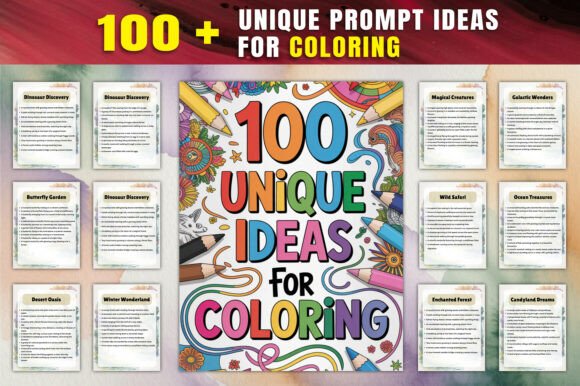
100 Unique Prompt Ideas for Coloring
Coloring isn’t just a pastime—it’s a workflow tool. For adults managing creative projects, teaching lessons, designing products, or building personal wellness routines, the right prompt can shift momentum, clarify intent, and reduce decision fatigue. 100 Unique Prompt Ideas for Coloring is designed not as a static collection, but as an active resource that integrates into real-world processes: from early-stage ideation to final output refinement, from classroom lesson planning to digital asset development.
Where This Prompt Book Fits in Your Creative Workflow
Think of 100 Unique Prompt Ideas for Coloring as a bridge between intention and execution. Before starting a coloring book project, many creators stall at theme selection—should it lean botanical, abstract, cultural, or narrative? The 14-page structure groups prompts by conceptual clusters (e.g., “Nature Reimagined,” “Architectural Whimsy,” “Emotion-Based Patterns”), allowing users to scan, filter, and align with current goals—not just mood. Teachers previewing a mindfulness unit can pull three emotion-themed prompts for student journaling; a freelance designer building a brand kit might use “Geometric Symbolism” prompts to generate texture swatches for client presentations.
During execution, the variety prevents repetition burnout. Unlike generic mandalas or florals, each prompt in this set carries subtle narrative or structural cues—“a clock face where numbers are replaced by seasons,” “a teacup filled with constellations”—that invite interpretation without prescribing style. That flexibility supports consistency across outputs while preserving individual voice, especially important for creators producing series-based work like printable planners or subscription content.
Practical Integration Across Roles and Tools
Educators and curriculum designers use the PDF version to extract single prompts for warm-up activities, embedding them directly into slide decks or LMS platforms. Because each page is cleanly formatted and high-resolution, cropping a single prompt for a worksheet takes under 30 seconds in Canva or Google Slides. The editable Canva link lets teams collaborate on custom adaptations—adding grade-level vocabulary, accessibility annotations, or multilingual labels—without needing design software.
Digital artists and app-based colorists rely on the PNG files for layer compatibility. Transparent backgrounds allow seamless import into Procreate, Adobe Fresco, or Krita. Users report pairing specific prompts with brush sets—for example, using “Fractured Mirror Landscapes” with glitch-style textures or “Nested Animal Silhouettes” with grainy ink brushes—to build repeatable stylistic systems. JPGs serve as quick reference thumbnails in digital asset libraries, tagged by theme and complexity level for fast retrieval during tight deadlines.
Small business owners and publishers treat the prompt set as modular IP. Rather than licensing full coloring books, they license individual prompts as micro-assets: one prompt becomes a social media carousel slide; another anchors a limited-edition print drop; a third fuels a workshop handout. Because all formats are included—and licensed for commercial reuse—the same prompt can appear in a PDF workbook, a Canva template bundle, and a printed zine, maintaining visual continuity across touchpoints without re-creation overhead.
Preparation, Organization, and Long-Term Usability
The 14-page layout isn’t arbitrary. It balances density with breathing room: 7 pages contain 7–8 prompts each (optimized for scanning), while the remaining 7 pages offer space for notes, sketching, or adaptation. This intentional pacing supports sustained use—no flipping through 50 dense pages looking for inspiration. Users who print the PDF often hole-punch and bind it into a physical prompt journal, adding sticky notes with project-specific tags (“#client-branding,” “#therapy-session-theme”).
Compatibility is built in—not assumed. The PDF uses standard CMYK-ready colors and embeds fonts, ensuring consistent print fidelity across home printers and professional presses. PNGs are 300 DPI with transparent backgrounds and named logically (042-botanical-circuitry.png), making batch imports into design tools predictable. JPGs follow the same naming convention and load instantly in email clients or messaging apps—critical when sharing quick ideas with collaborators across time zones.
Quality control happens upstream. Each prompt was tested across three criteria: interpretability (can it be rendered clearly at 2x and 0.5x scale?), expandability (does it suggest variations—e.g., “ocean floor map” could become coral, trench, or submarine-themed), and accessibility (no reliance on fine linework under 0.25pt or ambiguous negative space). That attention means less revision later—whether adapting for dyslexic learners, simplifying for younger audiences, or scaling for large-format prints.
Workflow Examples You Can Adapt Today
- For weekly content planning: On Monday, open the Canva link, duplicate page 9 (“Mythical Hybrid Creatures”), and replace one prompt with your brand mascot reimagined as a forest spirit. Export as PNG and schedule it for Wednesday’s Instagram post.
- For classroom prep: Print pages 3 and 11 (16 prompts total). Cut into cards, laminate, and store in a labeled box. Students draw one before journaling—no prep time needed, and themes rotate automatically every two weeks.
- For product development: Use the PDF as a spec sheet. Highlight prompts that match your target audience’s search behavior (e.g., “anxiety-relief patterns” or “ADHD-friendly symmetry”) and assign them to your next coloring book chapter outline.
- For personal practice: Set a 10-minute timer. Open the JPG folder, sort by name, and start with prompt #001. When time ends, save your progress. Next session, open #002. The numbering removes choice paralysis and builds habit through sequence—not willpower.
What Makes These Prompts Sustainable—Not Just Sparkly
Many prompt collections lose utility after the first 20 uses because they rely on novelty over structure. 100 Unique Prompt Ideas for Coloring avoids that trap by anchoring variety in repeatable frameworks: transformation prompts (“turn a kitchen utensil into a mythical artifact”), constraint prompts (“draw a city skyline using only circles and triangles”), and narrative prompts (“color the inside of a suitcase belonging to someone who’s never been home”). These patterns train creative muscle memory—so even when you move beyond the book, the thinking habits remain.
Long-term users also appreciate the lack of prescriptive style. There’s no “correct” way to interpret “a library where books grow like trees.” That openness invites iteration: try it with watercolor one week, vector lines the next, collage textures the third. It becomes less about finishing a page and more about documenting how your approach evolves—valuable data for portfolio reviews, client pitches, or self-assessment.
Finally, the formats themselves support sustainability. No login walls, no expiring links, no cloud-only access. The ZIP contains everything—no subscriptions, no updates required. You download once, organize once, and use indefinitely across devices, software versions, and life phases. That reliability matters when your workflow depends on consistency—not convenience.
Getting Started Without Over-Planning
You don’t need to use all 100 prompts—or even all 14 pages—at once. Start with one format that matches your immediate need: the PDF if you’re printing for a workshop tomorrow; the PNG if you’re prepping assets for an app update; the Canva link if you’re co-designing with a team. Bookmark the folder. Tag one prompt that resonates *today*. Then use it—fully, quickly, without editing. That first completed prompt builds confidence in the system. From there, integration deepens naturally: cross-referencing with existing templates, adding your own variants, or building checklists around recurring themes.
That’s how 100 Unique Prompt Ideas for Coloring earns its place—not as decoration, but as infrastructure.