The ADHD Brain Dump Workbook: A Practical Tool for Mental Clarity and Daily Management
For adults, teens, and students navigating life with ADHD, mental clutter isn’t just inconvenient—it’s exhausting. Racing thoughts, forgotten tasks, emotional overwhelm, and the constant pull between urgency and importance can erode focus, confidence, and consistency. The ADHD Brain Dump Workbook is a thoughtfully structured, low-barrier planner designed to meet that reality head-on—not by demanding perfection, but by offering gentle, repeatable systems to externalize, sort, and sustain progress.
What Sets the ADHD Brain Dump Workbook Apart
Unlike generic planners or digital task managers, the ADHD Brain Dump Workbook begins where many people with ADHD actually are: mid-thought, mid-stress, mid-spiral. Its core strength lies in scaffolding—breaking down abstract goals and overwhelming feelings into tangible, paper-based actions. It doesn’t assume you’ll remember to journal or track moods; instead, it embeds prompts directly into daily and weekly layouts.
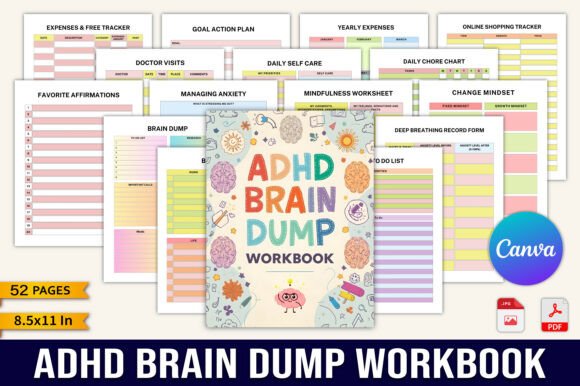
Brain dump pages act as cognitive relief valves—blank, unjudged space to offload everything swirling in your head before it loops or escalates. Paired with a Priority Matrix (often based on effort vs. impact), those raw ideas gain immediate context. This dual-step—dump *then* prioritize—is grounded in executive function research and reflects how many neurodivergent minds process information: not linearly, but associatively and urgently.
Other features reinforce this pragmatic rhythm. Daily To-Do Productivity Pages include time-blindness accommodations—like “Energy Check-In” markers and flexible time blocks—rather than rigid hourly schedules. Anxiety Stress Worksheets don’t just ask “How stressed are you?” They guide reflection through somatic cues (“Where do I feel tension?”), behavioral patterns (“What did I avoid today?”), and grounding prompts (“What’s one thing I *can* control right now?”).
How It Compares to Common Alternatives
People exploring tools for ADHD often encounter three broad categories: digital apps (e.g., Notion templates, Todoist with ADHD add-ons), traditional bullet journals, and clinical workbooks rooted in CBT or DBT. The ADHD Brain Dump Workbook occupies a distinct middle ground—more guided than a blank journal, less technical than most apps, and more behaviorally flexible than clinical manuals.
Digital tools offer searchability, reminders, and syncing—but they also introduce friction: notifications, login steps, device dependency, and the cognitive load of configuring settings. For someone already managing screen fatigue or working memory limits, opening an app may require more executive energy than the task warrants. In contrast, the ADHD Brain Dump Workbook is tactile, always accessible, and intentionally low-distraction. There’s no setup, no updates, no permissions—just open and write.
Bullet journals provide similar flexibility but demand significant upfront design time and consistent maintenance. Without built-in structure, many users abandon them within weeks—not from lack of will, but because sustaining novelty and personalization becomes its own executive burden. The ADHD Brain Dump Workbook avoids that trap by delivering tested, ready-to-use layouts. You’re not designing a system—you’re using one calibrated for common ADHD pain points: task initiation, emotional regulation, habit formation, and self-compassion.
Clinical workbooks often excel at depth (e.g., identifying cognitive distortions) but fall short on daily integration. They may assign weekly reflections but omit simple trackers for things like medication adherence, hydration, or chore completion—elements that meaningfully influence mood and focus day to day. The ADHD Brain Dump Workbook bridges that gap with practical, parallel tools: Mood Logs sit beside Self-Care Checklists; Expense Trackers appear alongside Goal Action Plans; Essay Source Trackers support academic needs without requiring separate systems.
Strengths, Tradeoffs, and Realistic Fit
The ADHD Brain Dump Workbook shines when consistency matters more than customization. Its greatest value emerges over time—through repeated use of the same Anxiety Stress Worksheet, comparing Mood Tracker entries across weeks, or reviewing past Behavior Evaluations to spot patterns. Users report reduced decision fatigue (“Do I journal? What do I write?”) because prompts are embedded and specific.
However, it’s not universally ideal. Those who prefer highly visual or color-coded planning may find its layout functional but minimal. It doesn’t include pre-printed stickers, decorative elements, or extensive habit-formation theory—its focus stays on utility, not aesthetics. Similarly, if your primary need is real-time collaboration (e.g., shared household chore tracking), a physical workbook won’t replace a shared digital board.
It also assumes willingness to engage regularly with pen-and-paper. That’s a strength for many—but a barrier for others who rely on voice notes, speech-to-text, or accessibility features like screen readers. There’s no audio version or digital fillable PDF included by default, so adaptation may be needed for certain learning or physical needs.
When It’s Likely the Right Choice
- You’ve tried apps but struggle with follow-through due to interface complexity or notification overload.
- You benefit from routine but get stuck initiating or maintaining journaling, tracking, or planning habits.
- Your overwhelm shows up as mental noise, emotional reactivity, or scattered priorities—not just missed deadlines.
- You want tools that support both practical tasks (chores, expenses, essays) and internal states (mood, self-talk, limiting beliefs).
- You’re looking for something usable *today*, without setup, subscriptions, or tech troubleshooting.
When Another Option May Serve Better
- You need real-time syncing across devices or with family members.
- You rely heavily on assistive technology (e.g., text-to-speech, high-contrast displays, keyboard navigation).
- Your main challenge is hyperfocus management—not task initiation or emotional regulation—and you need timers or interruption protocols.
- You prefer deep psychoeducation alongside exercises (e.g., detailed explanations of dopamine’s role in motivation).
- You’re actively in therapy and need worksheets aligned with a specific modality (e.g., ACT or EMDR protocols).
Using the ADHD Brain Dump Workbook Effectively
Success depends less on completing every page and more on strategic engagement. Start small: pick one section that matches your current bottleneck. If mornings feel chaotic, begin with the Daily To-Do Productivity Page and Energy Check-In. If anxiety spikes before meetings, use the Deep Breathing Emotional Check-In five minutes beforehand. Over time, layer in complementary tools—pair the Mood Log with the Self-Care Checklist to see how rest impacts emotional stability.
Many users find value in revisiting older pages—not to judge past performance, but to notice shifts. Comparing “My Greatest Accomplishments” lists from month to month reveals growth invisible in daily grind. Reviewing “The Happy List” during low-energy periods offers concrete evidence of joy beyond productivity metrics.
Importantly, the ADHD Brain Dump Workbook doesn’t promise transformation overnight. It supports micro-shifts: choosing one task instead of four, naming an emotion instead of suppressing it, tracking one expense instead of avoiding finances entirely. These aren’t minor—they’re the building blocks of sustainable self-management.
A Resource That Grows With You
The ADHD Brain Dump Workbook stands out because it meets neurodivergent cognition where it lives: in the messy, urgent, associative, and deeply human experience of trying to stay grounded. It doesn’t pathologize distraction or shame inconsistency. Instead, it offers repetition without rigidity, structure without surveillance, and compassion without cliché.
Whether you’re a college student juggling deadlines and identity exploration, a parent managing household logistics while advocating for yourself, or a professional rebuilding routines after burnout—the ADHD Brain Dump Workbook provides a quiet, steady companion. Not a fix. Not a cure. Just a reliable place to begin again, one brain dump at a time.