How the 2026 Mental Health Workbook Supports Sustainable Well-Being Across Diverse Lifestyles
Well-being isn’t a static destination—it’s a dynamic, evolving practice shaped by daily choices, environmental context, and personal rhythms. In an era where mental health awareness has deepened but time, accessibility, and personalization remain persistent barriers, tools that bridge intention with action are increasingly vital. The 2026 Mental Health Workbook responds to this need not as a prescriptive manual, but as a responsive, human-centered framework—one that adapts to how people actually live, work, learn, and heal in 2026 and beyond.
Design Philosophy: Structure Without Rigidity
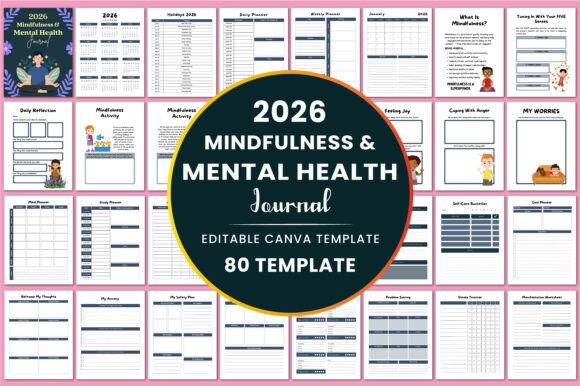
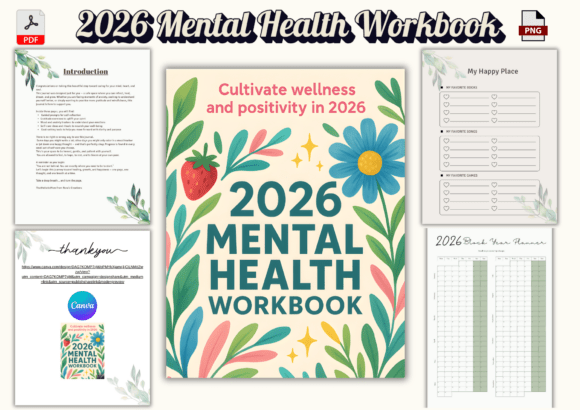
At its core, the 2026 Mental Health Workbook rejects one-size-fits-all approaches. Its 92-page architecture is built on layered intentionality: each section serves a distinct psychological function while remaining visually cohesive and cognitively light. Unlike static PDF journals or rigid habit trackers, this resource begins as an Editable Canva Template, meaning users aren’t locked into fixed layouts—they can rearrange prompts, adjust spacing for dyslexic readability, translate sections for bilingual households, or embed organization-specific goals (e.g., classroom reflection prompts for educators or clinical note placeholders for therapists).
The physical dimensions—8.5″ x 11″—are deliberately chosen not for aesthetic convention, but for functional flexibility: large enough to accommodate mind maps or sketch-based emotional processing, yet standard enough to print affordably at home, school, or clinic. This balance between scalability and accessibility makes it equally viable for a high school counselor distributing printed copies to students and a freelance wellness coach embedding custom affirmations into digital client onboarding kits.
Real-World Applications Across User Groups
What distinguishes this workbook from generic planners is how its components map directly to evidence-informed practices—and how those practices manifest differently across contexts.
Educators and School Counselors
In classrooms facing rising reports of student anxiety and executive function challenges, the 2026 Mental Health Workbook offers scaffolded entry points. The Self-Reflection Prompts avoid abstract questions like “How do you feel?” Instead, they guide metacognition: “What was one moment today when your body felt calm? What supported that?” Such phrasing aligns with trauma-informed pedagogy, reducing demand on verbal processing while building interoceptive awareness—a foundational skill for emotional regulation. Educators report using the Mood & Anxiety Trackers not for diagnosis, but as collaborative data sources during check-ins—helping students identify patterns like increased irritability after screen-heavy days or improved focus following movement breaks.
Clinical and Support Professionals
Therapists and life coaches often face ethical and logistical limits on assigning homework. The editable nature of the 2026 Mental Health Workbook allows clinicians to curate only the pages relevant to a client’s treatment phase—removing overwhelming options while preserving continuity. For example, a CBT-informed practitioner might isolate the Thought Pattern Journal and Reframe Challenge pages during cognitive restructuring work, then later layer in Gratitude Journaling Pages as positive affect strengthens. Because the template is fully customizable in Canva, professionals can add HIPAA-compliant disclaimers, integrate practice-specific models (e.g., ACT values cards), or adapt language for neurodivergent clients—without redesigning from scratch.
Digital Creators and Small Business Owners
For wellness entrepreneurs launching digital products, the workbook functions as both a finished offering and a modular design system. Its aesthetic cohesion—soft color palettes, ample white space, intuitive iconography—ensures brand alignment without sacrificing usability. Sellers have repurposed individual spreads: converting the Self-Care Ritual Ideas page into Instagram carousels, adapting the Goal Setting Framework into a lead magnet, or extracting monthly reflection prompts for email nurture sequences. Crucially, because it’s delivered as an editable Canva file—not a flattened PDF—customers retain creative control, increasing perceived value and reducing support requests about formatting issues.
Psychological Utility Beyond Aesthetics
Many journals prioritize visual appeal over cognitive load management. The 2026 Mental Health Workbook counters this by embedding behavioral science principles into its flow:
- Progressive disclosure: Early pages focus on low-barrier entries (e.g., “One thing I noticed about my breath today…”), gradually introducing deeper inquiry as user confidence builds.
- Pattern recognition scaffolding: The Emotional Trackers don’t just log moods—they invite contextual notes (“Who was I with?”, “What had I eaten?”), supporting ecological momentary assessment principles used in clinical research.
- Habit anchoring: Self-care rituals are paired with existing routines (e.g., “After brushing teeth, I’ll name one thing I’m grateful for”), leveraging established neural pathways rather than demanding entirely new behaviors.
This intentional sequencing mirrors how therapeutic change occurs—not through sudden insight, but through repeated, gentle exposure to alternative ways of relating to experience.
Adaptability in Practice: From Analog to Hybrid Workflows
One recurring theme among users is the workbook’s resistance to obsolescence. As digital fatigue grows, many return to tactile journaling—but not all environments support it. The 2026 Mental Health Workbook Editable Canva Template thrives in hybrid settings:
- A remote team uses shared Canva boards to co-create monthly “Collective Wellness Intentions,” pulling from the workbook’s goal-setting structure but adapting it for group accountability.
- A researcher studying caregiver burnout prints select tracker pages for longitudinal data collection, then digitizes responses via OCR-compatible formatting—preserving qualitative nuance while enabling thematic analysis.
- A parent uses the This Book Belongs To Page and Welcome Letter to co-author a personalized version with their teen, transforming the workbook from a tool into a relational artifact.
This versatility stems from its foundation in universal psychological needs—autonomy, competence, relatedness—rather than trend-driven features. There are no gamified badges or algorithmic suggestions; instead, there’s space for handwriting, collage, voice-to-text transcription, or even audio note embedding via linked QR codes added in Canva.
Implementation Considerations for Long-Term Use
Despite its thoughtful design, sustainability depends less on the tool itself and more on how it integrates into existing systems. Users who maintain engagement for six months or longer consistently report three practical strategies:
- Time-bounded experimentation: Starting with just two pages per week—such as the monthly calendar overview and one gratitude entry—reduces activation energy. The workbook’s modularity supports this; there’s no pressure to “catch up” on missed days.
- Environmental anchoring: Placing the printed workbook beside morning coffee or saving the digital version as the homepage on a tablet used exclusively for reflection creates consistent cues—leveraging habit formation research without requiring willpower.
- Iterative customization: After four weeks, users are encouraged to delete or hide pages that feel irrelevant and duplicate those that resonate. This isn’t failure—it’s data collection about what truly serves their nervous system.
Notably, the How to Use This Workbook section avoids prescriptive timelines (“Complete page 7 every Tuesday”). Instead, it frames usage as responsive stewardship: “Notice what feels expansive. Return to what returns you to yourself.”
Why This Approach Matters in 2026
As mental health discourse matures, so too must our tools. We’re moving past awareness campaigns toward infrastructure—systems that support ongoing maintenance, not just crisis response. The 2026 Mental Health Workbook reflects that shift. It doesn’t promise transformation; it provides calibrated touchpoints for noticing, naming, and gently redirecting attention—the micro-practices that, over months, reshape neural pathways and lived experience.
Its strength lies in refusing to position mental wellness as either purely clinical or purely lifestyle. It holds space for someone managing depression alongside someone optimizing peak performance, for a retiree rebuilding routine after loss and a startup founder navigating uncertainty. That breadth isn’t dilution—it’s fidelity to the reality that well-being is neither monolithic nor finite, but a living, breathing process best supported by flexible, respectful, and deeply human design.