Why the 2026 Self-Care Organizer Is Reshaping How Professionals Prioritize Well-Being in a Demanding World
In an era where burnout is no longer a personal failure but a systemic signal—and where “hustle culture” has given way to quiet, intentional recalibration—the 2026 Self-Care Organizer arrives not as a novelty, but as a necessary evolution in personal productivity. More than a planner, it’s a tactile response to how professionals, creators, entrepreneurs, marketers, and freelancers are redefining success: not by output alone, but by sustainable energy, emotional clarity, and daily alignment with core values.
This isn’t another calendar with pastel accents. The 2026 Self-Care Organizer reflects a deeper shift in consumer expectations—one where tools must serve both function and feeling. As hybrid work models stabilize, attention economies intensify, and mental health awareness moves from boardroom initiative to daily practice, people aren’t just seeking organization. They’re seeking integration: a way to harmonize deadlines with dopamine regulation, client calls with hydration tracking, strategy sessions with gratitude reflection. That integration is precisely what this planner delivers—thoughtfully, consistently, and without friction.
A Planner Designed for the Realities of Modern Work
Consider the typical week of a freelance designer launching a new brand identity: morning client syncs, afternoon revisions, evening content creation, all while managing invoices, sourcing stock assets, and maintaining a personal portfolio. Add in family responsibilities, fitness goals, and the low-grade hum of digital fatigue—and traditional task managers often fall short. They track what, not how well you’re holding space for yourself while doing it.
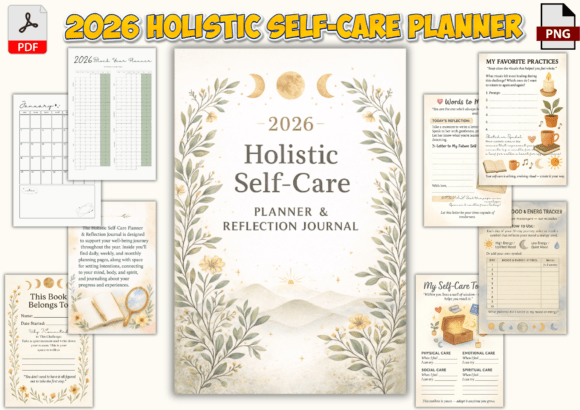
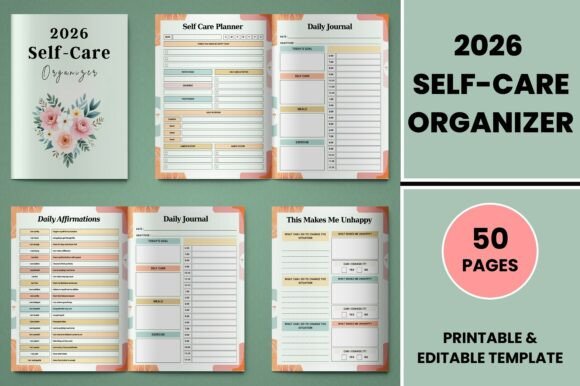
The 2026 Self-Care Organizer meets that gap head-on. Its Daily Self-Care Planner Pages (page 16) don’t ask, “Did you finish your to-dos?” Instead, they invite reflection on mood patterns, movement quality, hydration consistency, and even small moments of joy—data points that reveal energy rhythms far more actionable than a completed checklist. For a marketing strategist analyzing campaign performance, noticing a recurring dip in focus every Thursday afternoon—correlated with skipped lunch and low water intake—can prompt a simple, high-leverage adjustment: scheduling lunch as a non-negotiable “priority appointment.”
Likewise, the Weekly Meal Planner (page 19) serves dual purposes. Yes, it streamlines grocery lists—but more importantly, it reduces decision fatigue during high-cognitive-load days. When a startup founder spends hours negotiating terms or refining pitch decks, the mental bandwidth saved by knowing exactly what’s for dinner isn’t trivial. It’s resilience infrastructure.
From Habit Tracking to Habit Anchoring
Self-care tools have long leaned into gamified streaks and binary checkboxes—“Did you meditate? ✔️ / ✖️”. But research increasingly shows that sustainability comes not from rigid adherence, but from contextual flexibility and compassionate self-monitoring. The 2026 Self-Care Organizer understands this. Its Chore Habit Trackers (pages 20–21, 29) and Self-Care Checklists (pages 17–22) avoid punitive language. Instead, they use gentle prompts: “What supported me today?” “What helped me reset?” “Which habit felt most nourishing this week?”
This subtle linguistic shift mirrors broader developments in behavioral science—particularly the rise of identity-based habit formation. Rather than focusing solely on outcomes (“I want to exercise more”), users begin anchoring behaviors to who they aspire to be (“I am someone who listens to my body’s signals”). The planner reinforces that identity through repetition, visual cues (like its calming floral aesthetic), and spatial design: spacious layouts reduce cognitive load, encouraging engagement over avoidance.
Wellness as Workflow Infrastructure—Not an Afterthought
For teams and solopreneurs alike, wellness is no longer relegated to “wellness Wednesdays” or annual retreats. It’s embedded in workflow architecture. The 2026 Self-Care Organizer supports this shift by making well-being practices visible, measurable, and schedulable—just like any other critical business activity.
Take the Weekly Planner Space (page 18). Unlike generic weekly spreads, it structures time around priorities—not just tasks. This distinction matters. A social media manager may list “draft Instagram captions” as a task—but “protect 45 minutes for deep creative work before noon” becomes a priority. That framing encourages boundary-setting, reduces context-switching, and honors circadian energy peaks. Similarly, the Shopping & Travel Lists (pages 23–24) eliminate last-minute logistical stress—freeing mental space for strategic thinking rather than frantic packing.
This approach aligns with enterprise trends too. Forward-thinking companies now treat employee well-being metrics—sleep consistency, meeting-free blocks, sustained focus time—as key performance indicators alongside revenue and retention. The 2026 Self-Care Organizer functions as a personal KPI dashboard: one that doesn’t require dashboards, APIs, or HR software integrations—just pen, presence, and intention.
Design as Intentional Calm in a Noisy World
In a landscape saturated with algorithm-driven feeds, notification pings, and infinite-scroll interfaces, the physicality of the 2026 Self-Care Organizer is itself a strategic choice. Its calming floral aesthetics aren’t decorative—they’re neurologically supportive. Studies in environmental psychology show that soft natural motifs and muted palettes lower cortisol levels and improve attentional recovery. Turning a page becomes a micro-mindfulness practice.
That intentionality extends to structure. The 2026 Yearly Monthly Calendars (pages 3–15) offer clean overviews—not cluttered grids overloaded with holidays, moon phases, or irrelevant trivia. This minimalist fidelity to purpose reflects a growing preference among professionals for tools that respect their time and attention. There’s no need to filter out noise; the noise was never invited in.
Why Now? The Convergence of Need, Awareness, and Readiness
The timing of the 2026 Self-Care Organizer is no accident. It arrives amid three converging forces:
- Post-pandemic recalibration: Professionals across industries are auditing their relationship with time, autonomy, and sustainability—not just at work, but in daily life.
- Rise of the “third place” mindset: Home and office are no longer the only domains that matter. The space between them—the commute, the coffee break, the evening walk—is where self-care lives. This planner meets users there.
- Democratization of behavioral tools: Once reserved for therapists or executive coaches, evidence-based frameworks (gratitude journaling, mood mapping, habit stacking) are now accessible, adaptable, and integrated into everyday objects.
For a content creator building a newsletter audience, using the 2026 Self-Care Organizer to track energy spikes alongside publishing cadence might reveal that long-form writing thrives on Tuesday mornings—but only after a 10-minute breathwork session. That insight isn’t abstract; it’s operational intelligence.
More Than a Planner—A Practice in Progress
At its core, the 2026 Self-Care Organizer succeeds because it refuses to position self-care as indulgence or luxury. It treats it as infrastructure—as essential as Wi-Fi, as non-negotiable as contracts, as foundational as sleep. Its pages don’t promise transformation. They offer continuity: a place to return, daily, to ask, “What do I need right now?” and then honor the answer.
That’s why professionals aren’t just buying a planner. They’re investing in a rhythm—a consistent, compassionate, paper-based counterpoint to the volatility of digital workflows and unpredictable markets. In 2026, the most valuable skill won’t be speed or scale. It will be the ability to sustain attention, nurture resilience, and choose presence—even in motion. The 2026 Self-Care Organizer doesn’t teach that skill. It makes space for it to grow.