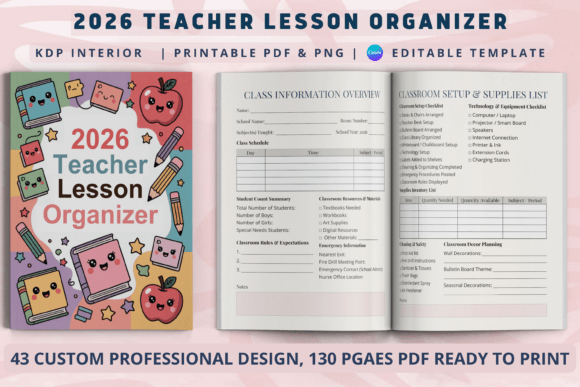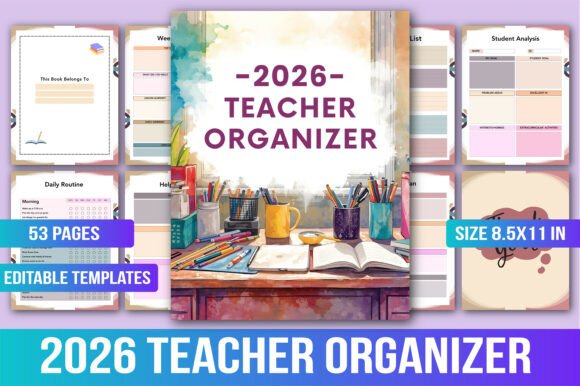
The 2026 Teacher Organizer: A Thoughtfully Structured Foundation for Educator Well-Being and Classroom Excellence
Teaching is rarely just about delivering content—it’s about sustaining attention across dozens of developmental trajectories, managing shifting administrative demands, coordinating with families and colleagues, and preserving personal energy through long academic cycles. In that context, organization isn’t a luxury; it’s the scaffolding that supports pedagogical intentionality, responsive instruction, and professional longevity. The 2026 Teacher Organizer emerges not as another generic planner, but as a purpose-built cognitive partner—one designed from the ground up to mirror how educators actually think, plan, reflect, and adapt across timeframes ranging from daily transitions to semester-long goals.
How Time Is Experienced in the Teaching Profession—and Why It Matters
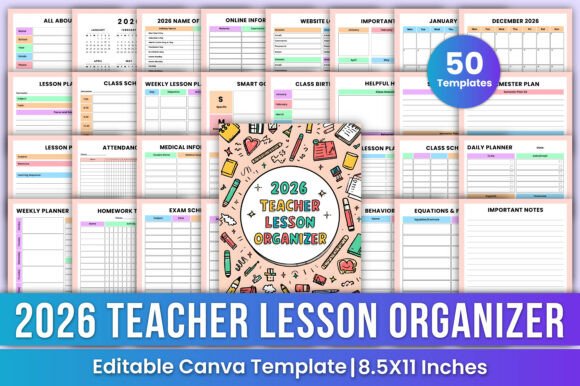
Educators navigate overlapping temporal layers: the micro-time of a 47-minute class period, the meso-time of weekly unit pacing, and the macro-time of curriculum mapping across terms and school years. Traditional calendars or digital task apps often flatten these distinctions—forcing teachers to retrofit their workflow into rigid formats that ignore pedagogical rhythm. The 2026 Teacher Organizer respects this complexity by embedding layered time awareness directly into its architecture. Its yearly monthly calendars don’t just list dates—they offer spacious, uncluttered layouts that invite strategic anchoring: marking parent-teacher conference windows in September, reserving prep blocks before standardized testing windows in March, or blocking collaborative planning days ahead of curriculum reviews in May. This isn’t passive scheduling; it’s anticipatory thinking made tangible.
From Daily Execution to Intentional Habit Formation
A single day in teaching contains dozens of micro-decisions: which student needs a follow-up note, whether a lesson requires last-minute differentiation, whether lunch was eaten, whether a personal boundary was honored. The 2026 Teacher Organizer meets this reality with its Daily Planner Pages, which go beyond simple to-do lists. Each page includes dedicated schedule blocks—not just for classes, but for planning time, collaboration slots, grading windows, and even protected “reset” intervals. Crucially, it integrates practical life supports: a meal plan section acknowledges that sustained focus requires nourishment; a shopping list prevents after-school grocery detours from eroding evening recovery time; and a notes section captures fleeting insights—like a student’s unexpected connection between literature and current events—that might later inform a future unit.
Even more revealing is the Weekly Routine Tracker. Rather than assuming habit formation follows a one-size-fits-all model, it divides routines into morning, afternoon, and evening categories—with checkboxes that encourage self-awareness over rigidity. A teacher might track whether they reviewed student exit tickets *before* leaving campus (a small act that prevents weekend grading), whether they responded to two family emails during designated communication hours (honoring both responsiveness and boundaries), or whether they stepped outside for five minutes of daylight—recognizing that circadian health directly impacts classroom presence. These aren’t performance metrics; they’re gentle prompts for alignment between professional practice and human sustainability.
Planning That Scales With Pedagogical Ambition
Lesson planning in the 2026 Teacher Organizer avoids fragmentation. Instead of isolated daily sheets, it offers interconnected tools: a Daily Lesson Planner for granular execution (objectives, materials, timing, formative checks), a Weekly Lesson Plan for coherence across subjects or skill strands, and broader Semester and Term Plans that situate daily work within curricular arcs. This nesting allows teachers to zoom in and out fluidly—adjusting a Tuesday warm-up activity while keeping sight of how it advances a six-week literacy goal, or revising a science lab sequence in light of new district resources without losing momentum toward end-of-term assessments.
For example, a middle school science educator using the 2026 Teacher Organizer might begin October by sketching a term plan around NGSS-aligned phenomena-based units. Mid-month, they’d populate weekly plans with inquiry cycles—each anchored to real-world questions like “Why do some neighborhoods flood more than others?” Then, each morning, they’d refine the day’s lesson block using the daily planner, noting where students stumbled during yesterday’s data analysis so today’s guided practice can be adjusted. The physical continuity of these pages—flipping from term to week to day—creates cognitive continuity no app notification can replicate.
Classroom Management as Relationship Infrastructure
Effective classroom management begins long before behavior interventions—it starts with knowing who students are, what supports they need, and how their growth unfolds over time. The 2026 Teacher Organizer treats student information not as static data, but as living context. Its Student Contact List includes space not only for guardians’ names and numbers but also for preferred communication modes and cultural considerations—helping teachers tailor outreach thoughtfully. Class Lists allow quick annotation of learning preferences, accommodations, or recent strengths observed. Even seemingly minor features—like dedicated Birthday Pages—support relational warmth without burdening memory or requiring digital logins.
The Reading Lists and Report Card Templates further bridge instruction and assessment. A high school English teacher might use the reading list to track independent book selections alongside whole-class texts, noting themes students gravitate toward—a subtle but powerful input for future unit design. Report card templates include narrative sections aligned with growth mindset language, prompting reflection on progress rather than deficit framing. And the Student Analysis Forms support diagnostic clarity: Was a math misconception isolated to one concept, or does it reveal a gap in foundational number sense? This kind of documentation doesn’t replace digital gradebooks—it complements them by preserving qualitative insight that algorithms often miss.
Reflection as Professional Renewal, Not Administrative Afterthought
Many planners relegate reflection to an after-the-fact appendix. The 2026 Teacher Organizer positions it at the center of its design philosophy. Its Monthly Review spreads ask not “What did I finish?” but “What did I learn about my students’ thinking this month?” “Where did my energy consistently drain—and what pattern preceded it?” “Which small change led to unexpectedly positive ripple effects?” These prompts cultivate metacognition—not just about teaching practice, but about the conditions under which it thrives.
This emphasis on reflective practice aligns with research on teacher efficacy and retention. When educators regularly name what worked, what surprised them, and what they’d protect or release next cycle, they build agency amid systemic constraints. A rural elementary teacher might note in her December review that co-teaching math rotations reduced her planning load *and* increased peer observation opportunities—prompting her to propose a formal collaboration structure for next year. That insight didn’t emerge from a mandated evaluation form; it surfaced through intentional, low-stakes documentation.
Design Choices That Serve Cognitive Load Theory
Every aesthetic decision in the 2026 Teacher Organizer serves function. The clean, uncluttered layouts reduce visual noise—critical for educators whose workdays already demand constant attention switching. The thoughtful use of color isn’t decorative; it creates intuitive visual hierarchies (e.g., blue for planning, green for reflection, gold for personal well-being). Ample white space invites annotation without overwhelm. Even paper weight and binding are selected for durability across backpacks, desk drawers, and coffee-shop study sessions—acknowledging that usability includes tactile reliability.
Importantly, it avoids over-engineering. There are no redundant sections or filler pages. Each tool exists because teachers reported needing it—not because a template demanded symmetry. That restraint makes the 2026 Teacher Organizer feel less like a system to master and more like a familiar, trusted notebook that happens to hold exactly what’s needed, when it’s needed.
Who Benefits Beyond the K–12 Classroom?
While rooted in classroom realities, the 2026 Teacher Organizer resonates across roles that balance multiple stakeholders, cyclical timelines, and relational labor. University faculty use it to map seminar syllabi alongside grant deadlines and advising appointments. Instructional coaches adapt the student tracking pages for teacher mentees—recording coaching cycles, goal progress, and resource sharing. Homeschooling parents appreciate the blend of academic planning and family logistics. Even education researchers find value in its longitudinal tracking capacity: documenting fieldwork observations across months, aligning interview schedules with participant availability windows, or journaling methodological reflections alongside data collection.
Its flexibility lies in structure—not rigidity. A museum educator designing school programs might repurpose the lesson planning tools for workshop sequences, use the weekly routine tracker to monitor volunteer coordination rhythms, and fill the personal logs with ideas sparked during gallery walks. The organizer doesn’t prescribe identity; it supports intentionality within it.
Choosing Alignment Over Automation
In an era of AI-driven lesson generators and algorithmic behavior trackers, the enduring value of the 2026 Teacher Organizer lies in its commitment to human-centered design. It doesn’t promise to replace judgment—it creates space for it. It doesn’t eliminate complexity—it helps teachers navigate it with clarity and compassion. When a first-year teacher flips to the January monthly calendar and writes “Breathe. Ask for help. Celebrate one small win daily” in the margin, she’s not filling space—she’s building resilience into her infrastructure.
That’s the quiet power of this tool: it assumes educators are already skilled, thoughtful, and deeply committed—and offers not more to do, but better ways to hold what matters.