2026 Vision Mapping Workbook Canva Kdp: A Strategic Planning Tool for Intentional Year-Ahead Design
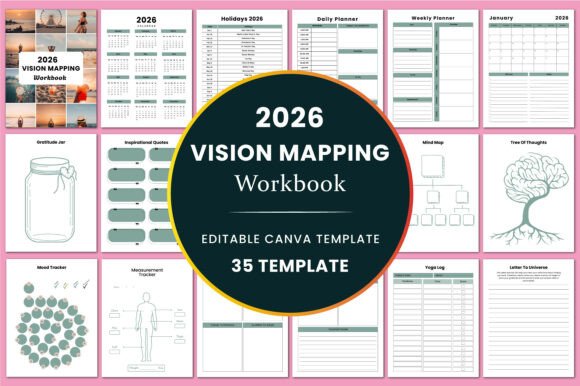
The 2026 Vision Mapping Workbook Canva Kdp is not another generic planner—it’s a deliberately structured, outcome-oriented system for translating abstract aspirations into tangible, executable plans. Designed for adults who lead with clarity—not just activity—it bridges the gap between vision and daily action through 35 purpose-built Canva templates, each calibrated for reflection, alignment, and forward motion. Unlike linear calendars or task lists, this workbook operates on a dual principle: internal coherence first, external execution second. That means your goals aren’t just written down—they’re anchored in identity, values, rhythm, and realistic capacity.
Why This Workbook Fits Strategic Decision-Making—Not Just Scheduling
For entrepreneurs, educators, freelancers, and small business owners, time is rarely the limiting factor—it’s attention allocation. The 2026 Vision Mapping Workbook Canva Kdp supports strategic decision-making by forcing early calibration: What outcomes truly matter in 2026? Which roles require your highest energy—and which can be delegated, deferred, or discontinued? Its Tree of Thoughts and Mind Map pages help surface hidden assumptions before commitments are made. Its My Average Day tracker reveals misalignments between stated priorities and actual behavior—often the first signal that a goal lacks authenticity or feasibility.
Consider a freelance graphic designer launching a signature course in Q2 2026. Without context, she might default to “launch date” as the north star. But using the 2026 Vision Mapping Workbook Canva Kdp, she maps backward from desired learner outcomes—not just sales targets—to identify prerequisite milestones: content validation (Q4 2025), beta cohort design (Q1 2026), and personal bandwidth assessment (via the Mood Tracker and Yoga Log). That shifts planning from reactive deadlines to proactive capacity stewardship.
How to Use the 2026 Vision Mapping Workbook Canva Kdp With Discipline—Not Just Enthusiasm
Most planning tools fail not because they’re poorly designed—but because they’re used episodically. The 2026 Vision Mapping Workbook Canva Kdp delivers value only when integrated into consistent, low-friction rituals. Start with these three anchors:
- Weekly Alignment Review (20 minutes): Use the Weekly Planner and Reflective Thoughts page—not to check off tasks, but to ask: Did my actions this week reflect my stated “I Am Grateful For” and “My Best Self” definitions? If not, what boundary or assumption needs adjusting?
- Monthly Calibration (45 minutes): Cross-reference the 2026 Monthly Planner with the Gratitude Jar and Measurement Tracker. Are metrics you’re tracking actually tied to outcomes—or just proxies for busyness? For example, tracking “email subscribers” matters only if it connects to a documented goal like “increase qualified leads by 25%.”
- Quarterly Identity Check (60 minutes): Revisit the Vision Board (both layouts), Letter to the Universe, and Affirmations Page. Ask: Does this still feel like me—or am I performing a version I think others expect? This prevents drift into unsustainable roles or messaging.
Crucially, avoid treating the 2026 Vision Mapping Workbook Canva Kdp as a static artifact. Its editable Canva link isn’t just for aesthetics—it enables iterative refinement. Update color palettes when your brand evolves. Swap out inspirational quotes when your definition of resilience shifts. Replace the Mood Tracker scale with one calibrated to your nervous system—not a generic emoji grid.
Where It Adds Real Operational Value—Beyond Motivation
This workbook strengthens operations not by adding more steps—but by reducing cognitive load at critical inflection points. The Checklist and Notes Page templates streamline handoffs, onboarding, or client briefs. The 8.5 × 11 inch size and CMYK color mode ensure print-ready consistency for team workshops or in-person coaching sessions. Educators use the Daily Planner alongside the Tree of Thoughts to scaffold student metacognition—not just lesson timing. Bloggers repurpose the Vision Board layouts into Pinterest-optimized graphics, linking visual planning directly to audience-facing assets.
For publishers and KDP creators, the 2026 Vision Mapping Workbook Canva Kdp serves a dual function: as a product development framework *and* a marketing asset. Its 300 DPI high-resolution files allow confident scaling for social previews or email headers. Its built-in 2026 Holidays and Calendar pages help time launches around cultural moments—not arbitrary dates. One small business owner used the Inspirational Quotes section to seed weekly LinkedIn posts, turning internal reflection into external authority—without creating new content from scratch.
Risks of Using the 2026 Vision Mapping Workbook Canva Kdp Without Context
Without grounding in clear intent, even the most elegant tool becomes noise. Common pitfalls include:
- Template substitution: Filling every page without interrogating prompts. The “I Am Grateful For” section loses power if treated as a gratitude journal rather than a litmus test for resource allocation (“What am I protecting—and what am I willing to sacrifice to keep it?”).
- Visual overfunctioning: Spending hours designing the Vision Board while neglecting the Reflection Worksheets. A beautiful board without honest answers to “What would need to be true for this to happen?” remains decorative—not directive.
- Calendar-first thinking: Starting with the 2026 Monthly Planner before completing the Yoga Log or Mood Tracker. You cannot schedule sustainable output without first mapping your biological and emotional rhythms.
The 2026 Vision Mapping Workbook Canva Kdp assumes you’ll use it to clarify—not compensate. It won’t fix inconsistent boundaries, replace skill gaps, or automate accountability. Its value emerges only when paired with honest self-assessment and willingness to prune non-essential commitments.
Long-Term Positioning: How This Workbook Builds Capacity Over Time
Year after year, users report one unexpected benefit: increased pattern recognition. The Gratitude Jar entries from January reveal what energizes them before burnout sets in. The Measurement Tracker exposes whether “more clients” actually correlates with higher revenue—or just lower margins. Over time, the 2026 Vision Mapping Workbook Canva Kdp becomes less about 2026 and more about building a personal operating system—one where goals evolve organically from lived experience, not external benchmarks.
That’s why the Editable Canva Link matters strategically: it allows versioning. Save your Q1 2026 layout as “2026_V1_Alignment,” then duplicate and rename it “2026_V2_Adaptation” after your mid-year review. Compare them—not to judge progress, but to observe how your relationship to time, energy, and contribution has matured.
Ultimately, the 2026 Vision Mapping Workbook Canva Kdp succeeds when it helps you make fewer, better decisions—not more of them. It’s for those who understand that vision without verification is fantasy, and planning without presence is performance. Use it not to chase 2026—but to design the conditions where your best work naturally emerges within it.