2026 Guided Letters to Heal My Heartbreak: A Strategic Tool for Emotional Clarity and Intentional Growth
Heartbreak isn’t just emotional noise—it’s data. Unprocessed grief, unresolved endings, and unexamined self-judgment quietly shape decision-making, creative stamina, communication patterns, and even how you position yourself professionally. That’s why 2026 Guided Letters to Heal My Heartbreak matters—not as a sentimental ritual, but as a precision instrument for recalibrating inner alignment. When used intentionally, it supports long-term outcomes far beyond emotional relief: sharper strategic thinking, more grounded leadership, clearer boundaries in client or team relationships, and sustainable creative output.
Why This Isn’t Just Another Journal—It’s a Framework for Cognitive Reordering
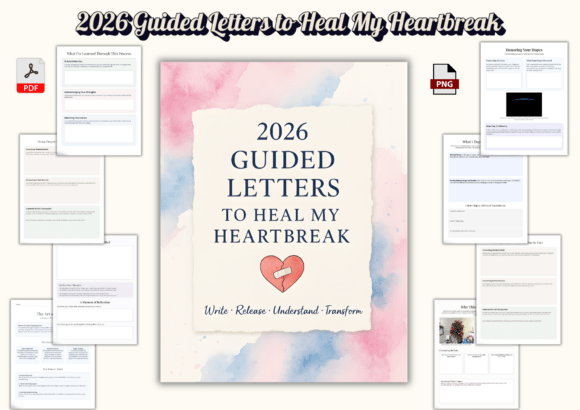
Most journaling tools ask “How do you feel?” 2026 Guided Letters to Heal My Heartbreak asks, “What story are you still holding—and what version serves your next chapter?” Its structure—84 carefully sequenced letter prompts, reflection pages with intentional whitespace, and gentle storytelling scaffolds—creates cognitive distance from reactive emotion. That distance is where strategy begins.
For professionals navigating high-stakes transitions—a founder exiting a partnership, an educator processing burnout, a freelancer redefining their niche—this workbook offers something rare: a low-risk space to test narratives before they become public positioning. Writing a letter you’ll never send to an ex, a former collaborator, or even your younger self isn’t catharsis for its own sake. It’s rehearsal for the clarity you’ll need when drafting a new website bio, renegotiating contracts, or mentoring others through similar shifts.
When to Use It—And When to Pause
2026 Guided Letters to Heal My Heartbreak delivers highest ROI when aligned with concrete goals—not as background ambiance. Use it:
- Before major decisions: When considering a pivot, hiring, or boundary shift, completing three targeted letters (e.g., “What I’m releasing,” “What I now protect,” “What I choose to lead with”) surfaces subconscious assumptions that might otherwise derail planning.
- During role transitions: New managers, consultants stepping into authority, or creators launching signature offerings often carry unspoken loyalty conflicts or imposter echoes. The workbook’s self-forgiveness prompts help distinguish inherited expectations from authentic standards.
- After feedback loops stall: If client surveys, team retrospectives, or audience engagement metrics feel confusing or contradictory, the reflection pages can reveal misaligned internal narratives—like equating visibility with vulnerability, or conflating urgency with importance.
Avoid using it reactively—right after conflict, during acute stress, or as a substitute for professional support when trauma or clinical depression is present. Without clear intention, the act of writing can reinforce rumination rather than release. Ground each session with one question: What outcome am I preparing for?
Design Choices That Serve Strategy—Not Just Aesthetics
The watercolor aesthetic and torn-paper texture aren’t decorative flourishes. They’re functional design cues: soft edges signal psychological safety; tactile imperfection lowers the barrier to honest expression. The 8.5 x 11 inch layout isn’t arbitrary—it accommodates handwriting without crowding, supporting deeper neural engagement than typing. Studies show handwritten reflection activates different pathways than digital capture, strengthening memory integration and conceptual linking—critical when synthesizing lessons from past projects or relationships.
The inclusion of both PDF and PNG files reflects operational pragmatism. Print the full workbook for deep weekly work, but extract individual prompt pages as digital templates for quick daily resets—say, before a difficult call or after sending a proposal. This flexibility supports consistency without rigidity, aligning with how high-performing professionals actually manage energy, not just time.
Practical Integration: From Insight to Action
Don’t wait for “spare time.” Build 2026 Guided Letters to Heal My Heartbreak into existing workflows:
- Link prompts to real-world outcomes: After writing “What I’ve outgrown in this relationship,” ask: “Which of these patterns show up in my pricing conversations? Where do I compromise value to avoid discomfort?” Then revise your next client onboarding script.
- Use reflection pages as calibration tools: Before quarterly planning, complete the “Clarity Check-In” prompt. Compare answers across months—not for progress tracking, but to spot recurring themes in what you’re protecting, defending, or avoiding. That pattern recognition informs resource allocation and delegation decisions.
- Leverage the gentle storytelling elements for external communication: The workbook’s narrative framing helps translate raw experience into resonant messaging—without oversharing. Notice how your tone shifts when writing to “my future self” versus “the person who disappointed me.” That tonal awareness sharpens email voice, sales copy, and speaking presence.
Risks of Misalignment—And How to Mitigate Them
The biggest risk isn’t skipping pages—it’s divorcing the process from purpose. Using 2026 Guided Letters to Heal My Heartbreak as a vague “self-care habit” risks reinforcing passive identity (“I’m someone who journals”) instead of active agency (“I’m designing how I engage with uncertainty”).
Another pitfall: treating completion as the goal. Finishing all 84 letters means little if the insights don’t inform behavior change. Counter this by scheduling a 15-minute “integration review” every 10 prompts. Ask: “What one small action reflects this insight? What metric would show it’s landing?” For a coach, that might be tracking how often they name boundaries early in discovery calls. For a creator, it could be measuring engagement on posts that reflect reclaimed confidence versus apology-tinged language.
Who Benefits Most—And Why It’s Not Just About “Healing”
This workbook serves professionals who understand that emotional coherence compounds over time. Therapists use it to model embodied processing for clients—not as homework, but as shared reference points for naming complex dynamics. Educators integrate select prompts into resilience curricula, teaching students how to articulate loss without collapsing into helplessness. Small business owners apply its closure frameworks to exit strategies, vendor transitions, or rebranding—transforming endings into deliberate design choices.
Even marketers benefit: the practice of writing unsent letters builds empathy muscles essential for audience insight. When you deeply understand your own resistance to change, scarcity triggers, or fear of invisibility, you stop guessing at customer psychology—you recognize shared architecture.
Long-Term Positioning: Beyond the First Draft
Think of 2026 Guided Letters to Heal My Heartbreak as infrastructure—not a one-time fix. Revisit key letters at inflection points: six months after a launch, before renewing a major contract, or when onboarding a new team member. The prompts evolve with you because your relationship to past pain changes. What felt like betrayal in March may read as necessary pruning by October—information that reshapes how you mentor others or design systems.
Over time, the real asset isn’t the filled workbook—it’s the muscle memory of returning to curiosity instead of judgment, of separating facts from interpretations, and of trusting your capacity to hold complexity without rushing to resolution. That’s the foundation for decisions that endure, brands that resonate authentically, and work that sustains rather than depletes.
Final Consideration: Your Attention Is the First Boundary
You don’t need to “heal” to begin. You need only decide what attention you’re willing to protect—and what outcomes you’re willing to design toward. 2026 Guided Letters to Heal My Heartbreak works because it meets you where strategy and humanity intersect: in the quiet space between what happened and what you choose to build next.