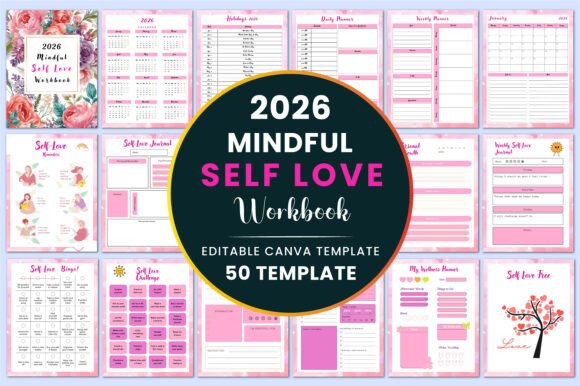
2026 Mindful Self Love Workbook Interior: A Thoughtfully Structured Foundation for Intentional Living
At the heart of sustainable personal growth lies a simple yet profound truth: transformation begins not with external achievement, but with internal alignment. The 2026 Mindful Self Love Workbook Interior is engineered to support that alignment—not as a prescriptive manual, but as a responsive, compassionate framework rooted in evidence-informed practices from positive psychology, mindfulness-based stress reduction, and narrative therapy. Its design reflects a deep understanding that self-love is neither indulgence nor abstraction; it’s a daily practice of attention, choice, and gentle accountability.
How Structure Supports Self-Relationship Development
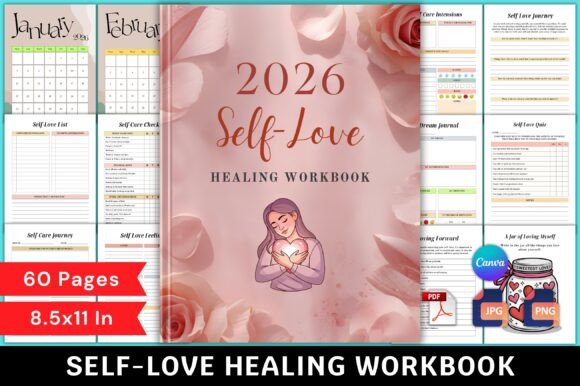
Unlike generic planners that prioritize output over inner process, the 2026 Mindful Self Love Workbook Interior organizes time around relational intentionality. The 2026 calendar isn’t just a backdrop—it’s a scaffold for noticing patterns. Each month opens with a Self-Love Journey reflection page prompting users to observe emotional rhythms across seasons: Where did energy naturally rise or recede? When did boundaries hold—or erode? What small acts of care were consistent, and which required recalibration?
This cyclical awareness builds what researchers call “affective forecasting accuracy”—the ability to predict how future choices will impact emotional well-being. For example, a teacher using the 2026 Mindful Self Love Workbook For Canva KDP Interior might notice recurring depletion every Thursday afternoon. Instead of labeling it “burnout,” the weekly planner invites them to trace upstream causes: Was Wednesday’s parent meeting followed by unstructured grading time? Did morning hydration or movement habits shift that week? The structure doesn’t diagnose—it reveals data points for compassionate interpretation.
Practical Integration Across Lived Realities
The workbook’s utility emerges most clearly in its adaptability across roles. A small business owner may use the Self-Care Bucket List not for leisure alone, but as a strategic resilience tool—mapping non-negotiable replenishment moments alongside quarterly financial reviews. A researcher might repurpose the Self Love Questions section to examine implicit assumptions in their methodology: “What am I protecting by avoiding this line of inquiry?” or “Where have I conflated rigor with self-punishment?”
Hobbyists benefit from the Self Love Bingo grid, which replaces performance-driven goals (“Complete 3 watercolor studies”) with presence-centered markers (“Paused mid-brushstroke to notice light on paper”). This subtle reframing shifts focus from product to process—a principle validated in flow-state research where intrinsic motivation correlates more strongly with sustained engagement than outcome targets.
For educators, the Daily Self Love Note serves dual function: a private grounding ritual before class and a source of authentic modeling for students. When a high school counselor writes, “Today, I honored my need for silence after three back-to-back sessions,” they’re not just journaling—they’re reinforcing neural pathways that associate boundary-setting with competence, not guilt.
From Static Pages to Dynamic Practice
The editable Canva link included with the 2026 Mindful Self Love Workbook For Canva KDP Interior transforms static content into living documentation. Users aren’t limited to pre-set layouts. A nonprofit director might duplicate the Self-Care Assessment page to evaluate team-wide wellness indicators alongside individual ones. A writer could merge the Gratitude Journal with the My Notes section to track how appreciation language evolves across manuscript drafts.
This flexibility addresses a key limitation in traditional self-help tools: rigidity. Studies show that adherence to structured programs drops significantly when users can’t modify pacing or emphasis. By enabling customization—changing affirmation fonts for dyslexic readability, adding bilingual prompts for multilingual households, or inserting custom habit trackers—the 2026 Mindful Self Love Workbook Interior supports neurodiverse needs and cultural specificity without requiring technical expertise.
Why Affirmations Work Differently Here
The Self Love Affirmation pages avoid vague declarations like “I am enough.” Instead, they guide users through layered construction: first identifying a current self-talk pattern (“I’m behind on everything”), then naming the underlying need (“I need clarity about priorities”), then drafting an affirmation anchored in agency (“I pause to identify one priority before responding to requests”). This mirrors cognitive-behavioral techniques proven to rewire automatic negative thoughts more effectively than positive-only statements.
A software engineer reported using this method to transform “I’ll never understand this legacy code” into “I allocate 25 minutes daily to document one function—progress compounds.” The shift isn’t semantic; it moves affirmation from wishful thinking to observable behavior.
Tracking Beyond Metrics: The Self-Care Tracker as Compass
The Self-care Tracker deliberately avoids quantification traps. Rather than counting minutes of meditation, it asks: “Did I notice my breath three times today?” or “When did I choose rest over ‘just one more email’?” This aligns with self-determination theory, which identifies autonomy, competence, and relatedness—not productivity—as core drivers of lasting motivation.
Consider the 30 Day Self-Care Challenges. Unlike competitive social media versions, these are opt-in, non-linear, and permission-based. Day 7 might read: “If you’ve said ‘yes’ to three obligations this week, say ‘not now’ to one request—even if it’s your own.” The emphasis stays on attunement, not accumulation.
Intersections With Broader Well-Being Systems
The 2026 Mindful Self Love Workbook Interior recognizes that self-love cannot be isolated from structural realities. The Self Care Intention pages include prompts like “What systems currently make consistent care difficult?” and “Which supports do I already have access to, even if underutilized?” A nurse using this might list hospital-provided EAP services alongside community childcare co-ops—making invisible resources visible.
Similarly, the Self-Love Tree visual exercise maps roots (core values), trunk (current practices), branches (aspirations), and fruit (tangible outcomes). When a caregiver draws their tree, they often realize their “fruit” includes their child’s stability—not just personal milestones. This honors interdependence as integral to self-love, countering individualistic narratives that equate wellness with solitary achievement.
Implementation Nuances Worth Noting
Effectiveness hinges less on completion than on interaction quality. Research on journaling interventions shows benefits correlate with depth of engagement, not page count. Users report greatest impact when they:
- Use the Daily Self Love Journal within 90 minutes of waking—not to plan, but to name one sensation present in their body;
- Revisit monthly Self Love Planner reflections quarterly, looking for thematic echoes rather than linear progress;
- Apply the Self Love Checklist not as a pass/fail test, but as a “compass calibration”—identifying which items feel resonant versus performative.
One educator noted that crossing off “practiced gratitude” felt hollow until she paired it with the My Wellness Planner’s “energy audit” column, noting whether gratitude arose from genuine resonance or obligation. That distinction became her most valuable metric.
Design Choices With Purpose
Every specification serves functional intent. The inclusion of 2026 Holidays isn’t decorative—it creates natural inflection points for reviewing relational patterns: How did family dynamics shift during winter break? What boundaries held or dissolved around New Year’s gatherings? The Weekly Planner integrates Self-Love Reminders as contextual anchors (“After Tuesday’s budget meeting: sip tea without screens”), embedding practice into existing routines rather than adding cognitive load.
Even the Self Love Activity List avoids prescriptive language. Entries read “Notice where your shoulders hold tension” instead of “Do shoulder rolls.” This honors somatic intelligence—the body’s capacity to signal needs before the mind names them.
Ultimately, the 2026 Mindful Self Love Workbook Interior functions as both mirror and map: reflecting habitual responses while illuminating alternative pathways. It doesn’t promise transformation—it creates conditions where the user’s own wisdom can emerge, steadily and without fanfare, one intentional page at a time.