Why the 2026 Teacher Lesson Organizer Canva Kdp Is Reshaping Educator Productivity in the Digital-Age Classroom
In an era where educators juggle curriculum mandates, student well-being, data-driven instruction, and personal sustainability—often with shrinking administrative support—the demand for intelligent, adaptable, and human-centered planning tools has never been higher. Enter the 2026 Teacher Lesson Organizer Canva Kdp: not just another printable planner, but a thoughtfully architected productivity ecosystem built for the realities of modern teaching. Designed from the ground up for flexibility, scalability, and creative ownership, this resource reflects a broader shift across education technology: away from rigid, one-size-fits-all software and toward customizable, teacher-led systems that honor pedagogical autonomy while delivering operational clarity.
A Tool Forged at the Intersection of Pedagogy and Practicality
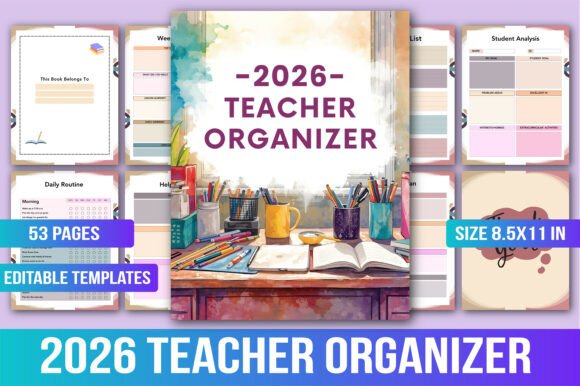
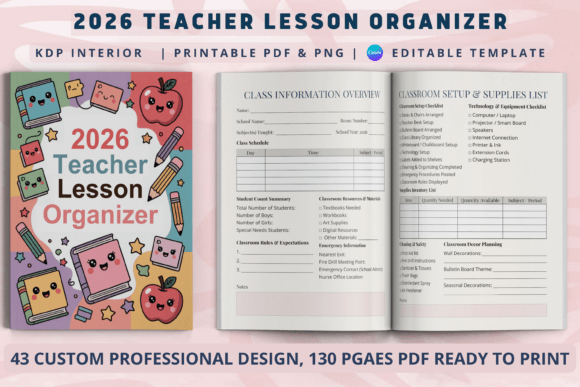
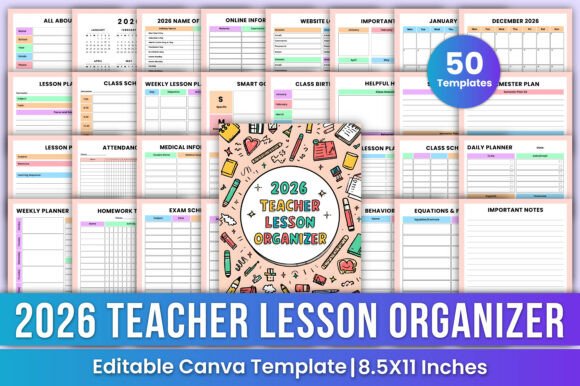
The 2026 Teacher Lesson Organizer Canva Kdp Templates 🌈✨ represent a meaningful evolution in educator resource design. Unlike static PDF planners or clunky LMS-integrated scheduling modules, this organizer merges the structure teachers need with the creative control they deserve. Every page—from the 2026 Year-at-a-Glance Calendar to the SMART Goals section for teacher growth—is fully editable in Canva. That means no more wrestling with locked fields or incompatible fonts. Teachers can adjust color palettes to match school branding, resize sections to accommodate dual-grade assignments, swap out icons for inclusive visuals, or translate headers into bilingual formats—all without technical training or third-party plugins.
This level of customization isn’t merely aesthetic. It signals a deeper understanding of how educators actually work: iteratively, contextually, and collaboratively. A middle school science teacher might duplicate the Weekly lesson plan template for each of her three preps, then embed lab safety checklists directly into the daily layout. An inclusion specialist could adapt the Behavior log and Communication log to align with IEP documentation requirements—and share the updated version with co-teachers via Canva’s real-time collaboration features. These aren’t edge cases—they’re everyday workflows made smoother, safer, and more sustainable.
Meeting the Moment: Trends Driving Adoption
Three converging trends make the 2026 Teacher Lesson Organizer Canva Kdp especially timely:
- The Rise of Hybrid Resource Ecosystems: Educators no longer rely on a single platform for planning, grading, communication, or professional development. Instead, they curate lightweight, interoperable tools—like Canva-editable PDFs—that slot seamlessly into existing tech stacks (Google Workspace, Microsoft Teams, Seesaw). The organizer’s print-ready 8.5x11 PDF format ensures accessibility offline, while its Canva-native structure supports digital annotation, screen sharing, and cloud-based revision history.
- Teacher Retention Through Agency: Research consistently links teacher burnout to a lack of control over workload and instructional design. The 2026 Teacher Lesson Organizer Canva Kdp Templates restore agency—not by adding tasks, but by removing friction. When teachers spend less time reformatting spreadsheets or rebuilding lesson logs each August, they reclaim cognitive bandwidth for what matters most: responsive instruction, relationship-building, and reflective practice.
- Consumer-Grade Design Expectations: Today’s educators are also creators, entrepreneurs, and lifelong learners. They expect tools with intuitive interfaces, visual coherence, and brand-aligned aesthetics—standards long met in marketing and design spaces, but historically underdelivered in edtech. The rainbow-hued, emoji-enhanced, professionally spaced layouts of these templates don’t sacrifice function for flair; they use design as a cognitive scaffold—guiding attention, reducing visual load, and reinforcing positive emotional associations with planning.
More Than Planning: A Framework for Intentional Teaching
What distinguishes the 2026 Teacher Lesson Organizer Canva Kdp from generic planners is its embedded pedagogical architecture. Consider the Semester-wise lesson planning section: rather than blank grids, it scaffolds backward design—prompting teachers to anchor units in standards, define success criteria, sequence formative assessments, and allocate time for differentiation. Or the Classroom volunteers list, which goes beyond names and contact info to include skill tags (“STEM mentor,” “bilingual reader,” “arts & crafts support”)—transforming volunteer coordination into a strategic talent-mapping exercise.
Even logistical tools carry instructional intent. The Attendance log monthly includes space for noting patterns—not just absences, but late arrivals, early dismissals, or wellness-related notes—supporting early intervention. The Reading list integrates genre tags, Lexile ranges, and read-aloud prompts, turning independent reading tracking into a literacy development dashboard. These aren’t isolated features; they’re interconnected nodes in a system designed to surface insights, reduce redundancy, and elevate consistency—without standardizing creativity.
Business, Creativity, and Community Convergence
For creators and entrepreneurs in the education space, the 2026 Teacher Lesson Organizer Canva Kdp exemplifies a high-value niche opportunity: solving real problems with elegant, scalable solutions. Its Canva-first delivery model lowers production barriers (no coding, no app store approvals) while maximizing reach (Canva’s 135M+ users include millions of educators). More importantly, it invites co-creation: savvy sellers bundle complementary resources—like editable behavior incentive charts or editable parent newsletter templates—into cohesive, branded suites. This isn’t just product stacking; it’s community building through shared language, visual identity, and workflow alignment.
Marketers and freelancers working with edupreneurs recognize another layer of resonance: authenticity. Teachers increasingly distrust overly polished, “teacher-flavored” stock imagery and generic slogans. The 2026 Teacher Lesson Organizer Canva Kdp Templates succeed because they feel *made by teachers, for teachers*—evident in subtle details like margin space for handwritten reflections, grayscale-friendly versions for budget-conscious printing, or inclusive iconography across seating charts and medical logs. That authenticity translates directly into trust, conversion, and organic advocacy.
Designing for What’s Next—Without Losing Sight of What’s Essential
Looking ahead, the trajectory isn’t about adding more features—it’s about deepening fidelity to teacher experience. As AI-assisted lesson generation gains traction, the value of human-curated, context-aware frameworks like the 2026 Teacher Lesson Organizer Canva Kdp only increases. Why? Because AI outputs require curation, adaptation, and ethical grounding—precisely the work these templates support. Imagine a teacher using an AI tool to draft a science inquiry prompt, then dropping it directly into the Standard lesson planner with built-in reflection prompts on equity, pacing, and scaffolding options.
Similarly, as schools adopt more flexible scheduling models—block periods, interdisciplinary rotations, project-based cohorts—the Class schedule and Specials schedule pages become dynamic coordination hubs, not static timetables. Their Canva-editability allows for real-time adjustments mid-semester, preserving continuity without chaos.
Final Thought: Organization as an Act of Care
At its core, the 2026 Teacher Lesson Organizer Canva Kdp reframes organization—not as a compliance task, but as an act of care. Care for students’ learning journeys. Care for colleagues’ collaborative capacity. Care for one’s own professional identity and well-being. In a profession where so much is dictated externally, having a tool that says, “Your voice, your style, your priorities matter—here’s the structure to hold them” is quietly revolutionary.
It’s why educators aren’t just buying a planner. They’re investing in clarity. In confidence. In the quiet certainty that comes from knowing their most vital work—teaching—is supported by a system that evolves with them, not against them. And in 2026, that kind of thoughtful, teacher-centered design isn’t just helpful. It’s essential.