2026 Holistic Self-Care Planner
Stepping into 2026 doesn’t have to mean rushing toward goals without pause. It can mean choosing presence over pressure — and that starts with a tool designed not just to schedule your time, but to honor your energy, emotions, and evolution. The 2026 Holistic Self-Care Planner is more than a calendar or checklist. It’s a quiet invitation: to observe yourself with kindness, align daily choices with deeper values, and build resilience through consistency—not intensity.
A Thoughtful Framework, Not Just a Format
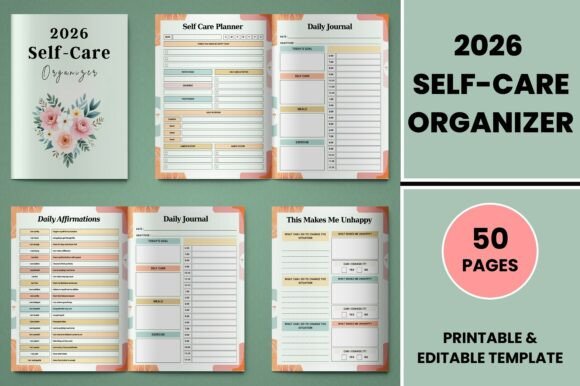
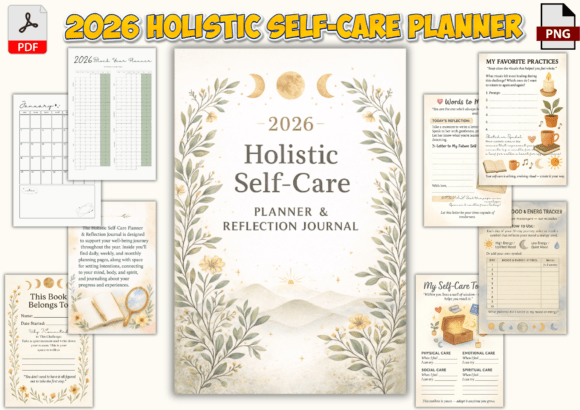
At 6x9 inches and 25 pages, this planner strikes a deliberate balance between substance and simplicity. Its PDF and PNG formats make it instantly usable — whether printed for tactile reflection or opened on a tablet for digital journaling. Unlike sprawling planners that overwhelm with options, the 2026 Holistic Self-Care Planner focuses on what moves the needle: mood + energy tracking, intentional habit scaffolding, and reflective prompts grounded in emotional literacy.
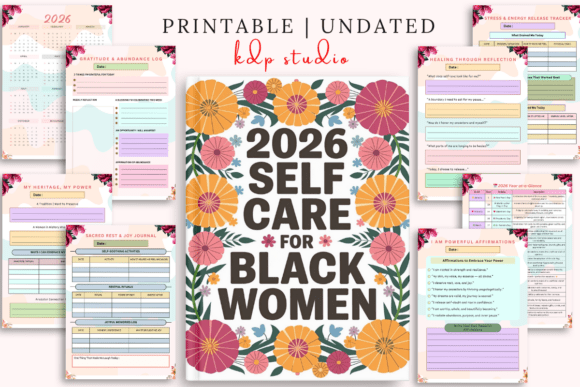
The soft watercolor aesthetic isn’t decorative filler — it’s functional design. Warm minimalism reduces visual noise, helping your attention land where it matters: on your breath, your boundaries, your “why.” Botanical accents echo growth, seasonality, and gentle change — subtle reminders that self-care isn’t about perfection, but tending.
Creative Applications Beyond Daily Journaling
This planner thrives when adapted to real-life rhythms — not forced into rigid routines. Here’s how different users bring it to life:
- Freelancers & entrepreneurs use the monthly calendars to block “energy-aligned” work windows — pairing high-focus tasks with peak energy days (tracked via the mood-energy grid), then scheduling rest *before* burnout hits.
- Educators & caregivers repurpose the “Letter to Myself” pages as weekly check-ins — not to critique performance, but to ask: What did I protect this week? What did I release? These become anchors during emotionally dense seasons.
- Content creators & designers treat the “Self-Care Toolbox” pages as a living style guide — sketching small rituals (e.g., “5-minute tea ritual before opening email”), then testing and refining them like design iterations.
- Small business owners print two copies: one for personal use, one to gift with onboarding kits — signaling early that team wellness isn’t an afterthought, but part of operational culture.
Practical Ways to Deepen Its Impact
Consistency grows from flexibility — not discipline alone. Try these grounded approaches:
- Start with one anchor practice. Pick just one section — say, the gratitude space or the Sunday reflection prompt — and commit to it for three weeks. Notice what shifts before adding more.
- Use the mood-energy tracker diagnostically, not judgmentally. After two months, scan for patterns: Do creative bursts follow restful mornings? Does low energy correlate with back-to-back Zoom calls? Let data inform boundaries — not guilt.
- Rotate reflection prompts by season. In spring, lean into intention-setting pages. In autumn, revisit “Letter to Myself” entries — what surprised you? What held true?
- Pair with analog tools intentionally. Keep a fine-tip pen and soft pencil nearby. The tactile act of writing slows cognition — creating space between stimulus and response, especially useful for those managing anxiety or ADHD.
Adapting for Different Contexts and Audiences
The 2026 Holistic Self-Care Planner scales meaningfully across platforms and purposes:
- Digital-first users: Import the PDF into apps like GoodNotes or Notability. Use layers to add voice notes to reflection pages or embed quick audio check-ins beside mood entries.
- Workshop facilitators: Print select pages (e.g., the self-care toolbox or ritual space) as handouts. Invite participants to co-create personalized versions — fostering ownership and relevance.
- Gift-givers: Pair the planner with a single meaningful item — a locally made candle, a packet of calming tea, or a handwritten note naming one quality you admire in the recipient. The planner becomes part of a larger gesture of seen-ness.
- Hobbyists & lifelong learners: Use the blank margins and ritual spaces to document micro-experiments — “Tried forest bathing Tuesdays: energy ↑, mental clutter ↓.” Track what builds capacity, not just productivity.
Why This Works — Without the Hype
There’s no magic in the 2026 Holistic Self-Care Planner. Its strength lies in its restraint. Twenty-five pages means no decision fatigue about “what to fill out today.” The 6x9 size fits easily in a tote or on a nightstand — removing friction between intention and action. And because it’s built around reflection, not output, it supports people who’ve grown weary of “hustle journals” that measure worth by checkboxes.
It also respects cognitive load. Prompts are open-ended but specific enough to spark insight (“What emotion showed up most this week — and what did it ask for?”), not vague affirmations. Gratitude space includes room for nuance — not just “what went well,” but “what was harder than expected, and how did I meet it?”
Making It Your Own — Without Losing Clarity
Personalization shouldn’t mean chaos. Keep your adaptation effective by asking three questions weekly:
- Is this still serving my current season? (A new job, caregiving shift, or health change may call for different emphasis.)
- Where am I adding complexity instead of clarity? (If color-coding moods feels like extra labor, simplify to emoji or checkmarks.)
- What’s one small way I honored myself this week — even if the planner stayed closed? (Self-care includes rest from self-care.)
The 2026 Holistic Self-Care Planner works best when treated as a collaborator — not a taskmaster. It holds space so you don’t have to. It tracks patterns so you can respond, not react. And its gentle aesthetic reminds you, again and again: You’re not building a perfect year. You’re cultivating a sustainable way to be here — fully, softly, and humanly — in 2026.