2026 Christian Life Journal Canva KDP
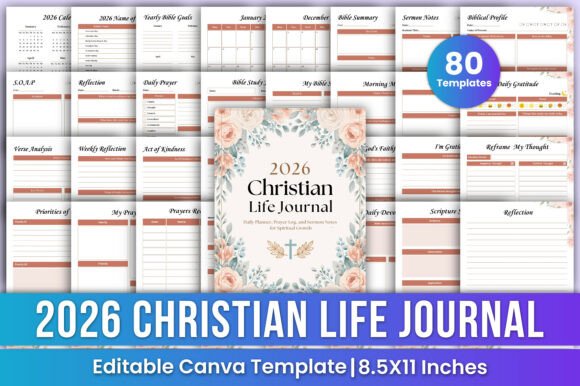
Staying spiritually grounded while managing work, family, and personal growth isn’t about adding more to your plate—it’s about integrating faith into the rhythm of daily life. The 2026 Christian Life Journal Canva KDP is designed for that integration: a practical, editable system that meets you where you are—whether you're leading a small group, launching a ministry podcast, homeschooling, running a creative business, or simply seeking consistency in quiet time.
Unlike static planners or generic notebooks, this journal combines theological depth with real-world flexibility. Every page supports a specific spiritual discipline—prayer, Bible study, reflection, gratitude—while remaining fully customizable in Canva. That means no more choosing between structure and personal expression. You get both.
Why Editability in Canva Changes How You Engage With Scripture
When your journal adapts to your season, your faith practice stays relevant. The 2026 Christian Life Journal Canva KDP includes an editable Canva link so you can adjust fonts for readability during early-morning devotionals, swap colors to match your church’s liturgical calendar, or reformat sermon notes pages to fit longer teaching series. A freelance graphic designer might add her brand palette; a youth pastor could insert small-group discussion prompts directly into weekly reflection sections; a homeschool mom might simplify SOAP worksheets for teen learners.
This isn’t just visual customization—it’s cognitive alignment. Research shows that personalizing learning tools improves retention and engagement. When you tailor layout, spacing, and emphasis, you’re not just decorating a page—you’re reinforcing intentionality in how you process truth.
A Year-Long Framework That Fits Real Life
The 2026 yearly section goes beyond a standard calendar. It includes monthly overview pages with dedicated space for setting Bible reading goals—say, working through Psalms alongside your church’s worship series—or tracking answered prayers across seasons. The holiday list accounts for both civil and Christian observances (like Advent, Lent, and Pentecost), helping educators plan devotional themes and small-group leaders align studies with liturgical time.
For entrepreneurs or content creators, the monthly goal tracker doubles as a spiritual accountability tool. If you’re launching a Bible-based course in Q2, you can pair that milestone with a corresponding Bible study focus—like exploring “faithfulness” in Ruth during planning weeks, then “courage” in Esther during launch prep.
Prayer That Moves Beyond Lists
The prayer sections avoid vague prompts. Instead, they guide meaningful intercession with categories like supplication, confession, missionary prayer, and relational petitions—for family, friends, and church community. Each type includes subtle cues: a line asking “What does Scripture say about this need?” next to supplication prompts, or space to record how God answered a specific request weeks later.
This matters most when life accelerates. A nurse juggling night shifts can use the daily prayer log to anchor herself before each shift—not with lengthy entries, but with three focused lines: one thanksgiving, one surrender, one request. A small business owner facing staffing decisions can turn to the “Prayers for Church Community” page to reflect on how leadership values from 1 Timothy 3 apply beyond Sunday services.
Bible Study Tools That Build Confidence, Not Clutter
The 2026 Christian Life Journal Daily Prayer Journal Bible Study Notebook includes SOAP worksheets—but not as filler. Each component serves a distinct purpose: Scripture encourages slow reading; Observation asks open-ended questions (“Who is speaking? What repeats?”); Application moves beyond “What should I do?” to “Where might this challenge my assumptions?”
Sermon notes pages include space for key passage notes *and* blank margins—so you can sketch connections, jot cross-references, or paste in quotes from commentaries. Bible summary sheets help visualize themes across books (e.g., covenant in Genesis–Deuteronomy), while character profiles invite deeper study of figures like Nehemiah—not just his actions, but his emotional responses in crisis.
Growth That Shows Up in Everyday Choices
Weekly reflection pages don’t ask, “Did you have quiet time?” They ask, “When did you sense God’s presence this week—and where did you resist it?” Gratitude logs include daily checkboxes *and* weekly synthesis prompts (“Which blessing surprised you most?”), encouraging pattern recognition over time. This kind of design helps professionals spot spiritual drift before burnout sets in—and helps creatives reconnect inspiration with worship.
One educator using this journal noticed how tracking “moments of peace amid chaos” revealed her reliance on control rather than trust. Another blogger realized her “favorite verses” list leaned heavily on comfort passages—prompting her to intentionally study justice-oriented texts in Amos and Micah. These aren’t abstract outcomes. They emerge from consistent, low-pressure engagement.
Who Benefits Most—and When to Consider Alternatives
This journal suits adults who value both depth and adaptability: pastors preparing sermons, counselors integrating faith into sessions, writers developing devotional content, or parents modeling spiritual habits for teens. It’s especially helpful if you’ve tried rigid planners that felt legalistic—or digital apps that fragmented your focus.
That said, it’s not ideal for everyone. If you prefer audio-based devotionals or rely entirely on mobile tools, a printable PDF—even a beautifully designed one—may feel like extra friction. And while Canva editing is intuitive, those unfamiliar with basic drag-and-drop functions may need 20–30 minutes to orient themselves before first use. (A quick Canva tutorial video is worth the investment.)
It also assumes some baseline familiarity with terms like “SOAP” or “liturgical calendar.” Beginners will still benefit, but may want to pair it with a short guide—many users find YouTube videos on SOAP study or free church calendar resources helpful companions.
Print-Ready Clarity Meets Creative Freedom
The final deliverable—high-resolution 8.5×11” PDFs—is optimized for home printing *and* professional binding. Margins accommodate spiral binding without losing text; fonts render clearly even on budget printers; grayscale versions preserve hierarchy if color ink is limited. One small business owner printed 12 copies for her discipleship cohort, then added custom cover stickers with each person’s name and a personalized verse.
Because everything is editable pre-print, you avoid the common frustration of buying a journal only to realize the prayer section doesn’t match your family’s needs—or the Bible study layout feels too dense for your current capacity. You shape the tool before it shapes you.
The 2026 Christian Life Journal Canva KDP doesn’t promise transformation. It offers something quieter but more reliable: a consistent, thoughtful container for the work God is already doing in you. Whether you’re reviewing last year’s answered prayers in January or sketching out a new Bible study in July, it meets you—not with pressure, but with presence.