2026 Coping with Divorce for Adults
Divorce reshapes lives—not just legally or financially, but emotionally, socially, and even logistically. For adults navigating this transition in 2026, the landscape has shifted: more people are seeking structured, compassionate, and *actionable* support—not just therapy referrals or generic advice, but tools that meet them where they are: at home, on a laptop, in a quiet coffee shop, or while managing work, kids, and self-care all at once. That’s where 2026 Coping with Divorce for Adults stands apart. It’s not another passive workbook. It’s a responsive, human-centered framework—designed to be lived in, written on, returned to, and reshaped over time.
A Planner Built for Real Emotional Work
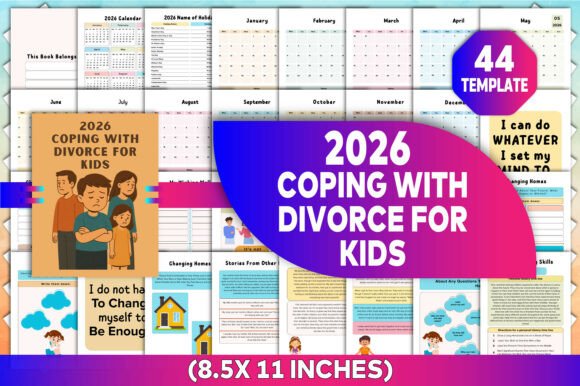
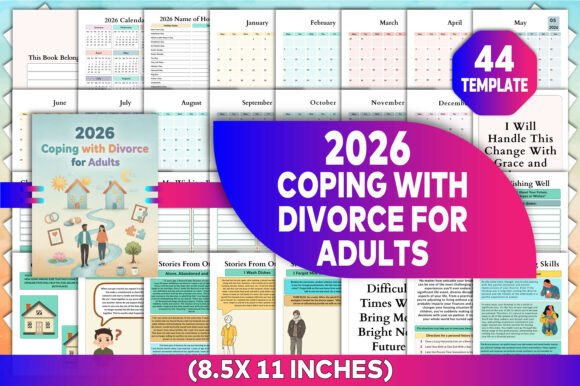
This isn’t about checking boxes. It’s about honoring complexity. The interior template includes 44 premium pages—each intentionally sequenced and thoughtfully titled—to guide reflection without pressure. “Changing With Seasons” invites gentle tracking of emotional shifts across weeks and months—not as setbacks, but as natural rhythms. “My Wishing Well” offers space to name hopes without demanding immediate answers. And “Stories From Others” provides curated, anonymized reflections—not prescriptive narratives, but grounded, relatable moments that say: *you’re not inventing this feeling.* These aren’t filler pages. They’re scaffolds for meaning-making, especially when language feels thin and energy is low.
Why Customizable Canva Templates Change the Game
Most divorce journals assume one size fits all—or worse, they’re locked PDFs you can’t adapt. 2026 Coping with Divorce for Adults flips that. Its editable Canva template gives full control: swap fonts, adjust spacing, insert personal photos, highlight key sections, or simplify layouts for accessibility. No design degree required. Just open it in Canva, click, drag, and personalize. That flexibility matters—whether you’re a therapist adding client-specific prompts, a school counselor adapting pages for teen co-parenting workshops, or a freelance writer repurposing content into a digital mini-course.
Practical Use Across Roles and Realities
For creators and KDP publishers: This is production-ready. At 8.5 x 11 inches and 300 DPI, it meets Kindle Direct Publishing specs out of the gate—no resizing, no guesswork. The layered Canva file lets you test cover pairings, update copyright years, or localize language before export. One user reported cutting their interior layout time from 14 hours to under 90 minutes—without sacrificing polish.
For educators and counselors: The “Divorce Coping Skills” section (nine distinct pages) translates clinical concepts—like boundary-setting, cognitive reframing, or somatic grounding—into accessible, nonclinical language. You can extract single pages for handouts, embed them into slide decks, or adapt them for group facilitation. One family services coordinator used “My Support Network” as a visual mapping tool during intake sessions—revealing gaps and strengths faster than verbal interviews alone.
For individuals rebuilding: The “Draw Your Feelings” and “My Notes” pages meet people who struggle to articulate loss in words. A graphic designer shared how she used the blank journal spreads to sketch floor plans of her new apartment alongside grief timelines—turning spatial change into emotional continuity. That kind of dual-purpose utility is rare.
What Makes the Design Feel Human—Not Clinical
Notice what’s missing: rigid daily trackers, forced positivity, or judgmental prompts like “What did you do wrong?” Instead, there’s “This Book Belongs To”—a simple, dignified title page that affirms ownership of the process. There’s “Changing Homes,” which acknowledges logistical upheaval without reducing it to paperwork. Even the typography choices (clean, readable, with intentional line height) reduce cognitive load—a subtle but critical detail for someone processing stress or fatigue.
Real Considerations Before You Begin
Customization is powerful—but only if used intentionally. Don’t default to changing everything. Start by using the template as-is for two weeks. Notice which pages land—and which feel irrelevant. Then edit: shorten prompts, add your own questions, or hide sections that don’t serve your current needs. Also, remember that high-resolution files (PDF/JPG/PNG) mean larger downloads—ideal for print or professional use, but consider compressing PNGs if embedding digitally for email newsletters or client portals.
More Than a Tool—A Quiet Companion
In 2026, adults facing divorce aren’t just looking for information. They’re looking for resonance. For permission. For structure that doesn’t erase nuance. 2026 Coping with Divorce for Adults delivers that—not through volume, but through curation. Not through rigidity, but through intelligent flexibility. Whether you’re publishing your first KDP journal, supporting clients through transition, or quietly turning pages on your kitchen table at midnight, this template meets you with clarity, care, and zero condescension.
Getting Started Is Simpler Than You Think
You don’t need to overhaul your workflow. Open the Canva template. Duplicate a page you connect with—say, “My Notes.” Tweak the header font. Add your name. Print one copy. Sit with it for three days. See how it holds space for what’s true—not what’s expected. That’s where real coping begins: not in perfection, but in presence. And with 2026 Coping with Divorce for Adults, presence has a shape, a texture, and room to grow.