2026 Coping with Divorce for Kids
Divorce is never easy on children—but how adults support them during this transition makes all the difference. The 2026 Coping with Divorce for Kids resource isn’t just another workbook or coloring page collection. It’s a thoughtfully structured, emotionally intelligent tool designed to help kids name feelings, process change, and rebuild stability—without oversimplifying complex emotions or relying on outdated assumptions about childhood resilience.
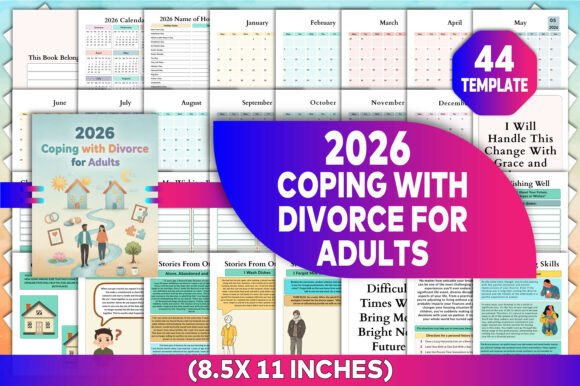
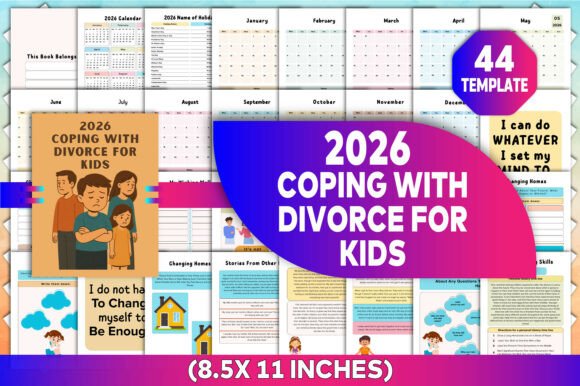
What sets this apart—and why creators, educators, counselors, and parents are turning to it in 2026—is its balance of clinical grounding and creative accessibility. Pages like My Wishing Well, Draw Your Feelings, and Stories From Other Kids aren’t gimmicks. They’re evidence-informed prompts that invite expression without pressure, reflection without judgment, and connection without expectation.
Common Missteps That Undermine Real Support
Many well-meaning adults reach for divorce-related resources with urgency—only to discover later that the material doesn’t land the way they hoped. Here’s where things often go off track:
- Assuming “kid-friendly” means oversimplified. Some planners reduce big feelings to smiley-face scales or vague affirmations (“It’s okay!”). But children aged 6–12 don’t need cheerleading—they need vocabulary, space, and permission to feel confused, angry, or relieved all at once. The 2026 Coping with Divorce for Kids avoids this by pairing gentle visuals with open-ended writing prompts and age-appropriate metaphors (like Changing With Seasons) that honor emotional complexity.
- Overlooking print and format readiness. You might find a beautifully written PDF online—only to realize it’s low-resolution, lacks bleed margins, or uses fonts that won’t render correctly on KDP. That’s a costly delay if you’re publishing. This template set delivers true KDP-ready files: 300 DPI, US Letter size (8.5 x 11 inches), CMYK-optimized, and pre-formatted for interior uploads—no last-minute resizing or color corrections needed.
- Treating customization as optional—not essential. One-size-fits-all rarely fits well when supporting kids through family change. A child with shared custody needs different prompts than one adjusting to a new stepfamily—or a nonverbal child who communicates best through art. The Canva-editable nature of this template means you can swap text, adjust layouts, add photos, or simplify language—all without hiring a designer or learning InDesign.
What Happens When These Details Are Missed?
Skipping verification steps may seem efficient—but it carries real consequences. A planner with cramped margins or faint gray text becomes unusable for younger readers or those with visual processing differences. A template missing editable layers forces you to retype every page manually, wasting hours instead of minutes. Worse, emotionally tone-deaf content can unintentionally isolate kids further—making them feel like their grief, anger, or ambivalence isn’t valid.
We’ve seen creators publish rushed versions only to get low reviews citing “too generic,” “hard to read,” or “doesn’t match what my child actually experiences.” That’s not a flaw in the child—it’s a mismatch between intention and execution.
Better Choices Start Before You Click “Publish”
If you’re evaluating or preparing to use 2026 Coping with Divorce for Kids, here’s what to verify—not assume:
- Check the structure—not just the cover. Flip through sample pages. Do sections like My Support Network and My Family Changing offer room for names, roles, and relationships—not just static labels? Does Today I Feel include more than six basic emotions? Look for nuance: words like “conflicted,” “relieved,” or “tired” signal deeper understanding.
- Test the Canva editability yourself. Don’t rely on marketing claims. Open the template in Canva and try changing a heading font, swapping an icon, or resizing a text box. If layers are locked or elements disappear, it’s not truly customizable. This set uses unlocked, grouped, and clearly labeled layers—so edits stay predictable and clean.
- Confirm file versatility. Need both digital distribution and print-on-demand? Make sure you receive PDF (for KDP), JPG (for social previews), and PNG (for transparent overlays or website use)—not just one format. All 44 templates here ship in all three, fully resolution-matched.
Real Impact Starts With Intentional Design
This isn’t about making a prettier planner. It’s about giving kids tools that meet them where they are—not where we wish they were. Consider a child who draws a storm cloud over their home in Changing Homes, then writes, “I miss sleeping in my old bed but like my new room has glow stars.” That moment of layered truth—the tension between loss and hope—is exactly what thoughtful design makes possible.
That’s why educators use these pages in small-group counseling, therapists integrate them into play-based sessions, and self-publishers build entire series around the core framework—adding themed variations like Co-Parenting Calendars or School Transition Checklists. Because the foundation is strong, adaptable, and grounded—not trendy or transactional.
Final Thought: Quality Isn’t Measured in Pages—It’s Measured in Permission
The most effective resources for kids navigating divorce don’t try to fix feelings. They create safe containers for them. When you choose 2026 Coping with Divorce for Kids, you’re not just selecting a product—you’re committing to clarity over cliché, flexibility over rigidity, and emotional honesty over forced positivity.
That shows up in the details: in the generous line spacing that reduces visual overwhelm, in the intentional blank space beside Notes where a parent might jot down a follow-up conversation, in the subtle leaf motif across Changing With Seasons that quietly reinforces growth as natural, ongoing, and non-linear.
If your goal is to support children with integrity—not just check a box—start with tools built to hold complexity, not smooth it over.