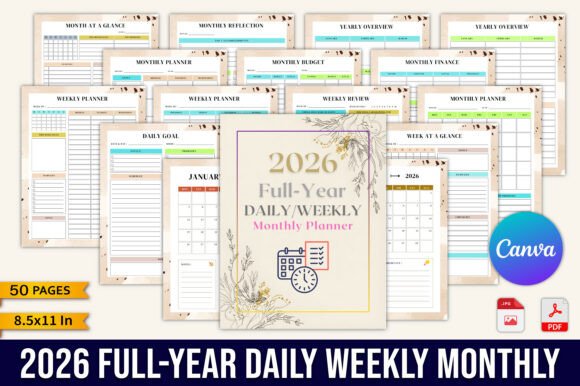
2026 Full-Year Daily Weekly Monthly Plan
The 2026 Full-Year Daily Weekly Monthly Plan is an all-in-one printable and editable planning system designed to support consistent time management, goal tracking, habit formation, and personal reflection across the entire year. It integrates structured layouts for daily scheduling (5 AM–12 AM), weekly overviews, monthly budgeting, and yearly planning—all within a single cohesive framework. Unlike standalone calendars or digital apps, this planner combines functional categories—including fitness logging, mood and weather tracking, meal and water intake monitoring, financial recording, and wellness check-ins—into physical or digital pages sized at 8.5×11 inches.
People often seek this type of planner when they notice recurring gaps between intention and execution: goals remain unmet, tasks pile up without clear prioritization, or lifestyle habits lack measurable consistency. Students may struggle with balancing coursework, part-time work, and self-care. Professionals juggling meetings, deadlines, and professional development might find fragmented tools inefficient. Entrepreneurs frequently need visibility across operations, finances, and personal sustainability. The 2026 Full-Year Daily Weekly Monthly Plan responds to these needs by centralizing inputs and outputs in one place—reducing context switching and supporting routine-building through repeated, low-friction engagement.
Key benefits include continuity and intentionality. Because it spans the full year, users can align daily actions with longer-term objectives—for example, breaking down a certification goal into weekly study blocks and monthly review points. The inclusion of both quantitative trackers (e.g., money in/out, water intake, fitness minutes) and qualitative prompts (e.g., weekly rating, monthly reflection, top five achievements) supports balanced self-assessment. The editable Canva link and 50 template variations allow customization without requiring design expertise, while the high-resolution PDF ensures print clarity and compatibility with common devices.
However, effectiveness depends on consistent use and realistic expectations. A planner cannot automate discipline—it provides structure, not motivation. Users who expect immediate behavior change without adjusting routines or reviewing reflections may become discouraged. Similarly, those preferring minimalist systems may find the density of sections overwhelming at first. The daily hourly schedule runs from 5 AM to 12 AM, which suits early risers or night workers but may feel misaligned for people whose natural rhythm begins later or ends earlier. The absence of built-in reminders or syncing capabilities also means users must manually initiate reviews and updates—making it less suitable for those reliant on push notifications or calendar integrations.
This planner is a strong fit for individuals who value tangible, tactile engagement with their planning process and prefer predictable, repeatable formats over adaptive algorithms. It works well for learners building executive function skills, remote workers managing asynchronous schedules, or caregivers coordinating multiple responsibilities across timeframes. Its emphasis on reflection—through weekly ratings and monthly summaries—supports metacognition: understanding how one’s choices accumulate over time. For someone aiming to improve consistency in health habits, financial awareness, or project follow-through, the integrated tracking reduces the cognitive load of maintaining separate logs.
Conversely, alternatives may be more appropriate in certain situations. People who rely heavily on shared calendars (e.g., teams, families) may find the static nature of printed pages limiting unless supplemented with digital coordination tools. Those needing real-time collaboration, automatic backups, or voice-to-text input will likely benefit more from platforms like Notion, Google Calendar with add-ons, or specialized habit apps. Individuals with rapidly shifting priorities—such as freelancers with irregular client cycles—may prefer modular, swipeable digital planners that allow reordering or hiding sections dynamically. Likewise, users with accessibility requirements—like screen reader compatibility or adjustable font scaling—should verify whether the PDF or Canva templates meet their specific needs before purchase.
Practical decision-making starts with assessing current pain points. Ask: Do I lose track of small daily habits because they’re not visible? Am I spending too much time toggling between apps to manage time, money, and wellness? Do I reflect on progress only during crises—or never? If yes, the 2026 Full-Year Daily Weekly Monthly Plan offers a unified format to consolidate those efforts. But if the main challenge is remembering to act—not organizing the action—the solution may lie more in environmental cues, accountability partnerships, or simplified triggers than in additional planning layers.
Another consideration is implementation effort. While the planner includes ready-to-use pages, adapting it meaningfully requires initial setup: defining key goals, selecting relevant trackers, and establishing review rituals (e.g., Sunday evenings for weekly planning, last weekend of the month for reflection). Skipping these steps risks reducing the tool to passive documentation rather than active guidance. Users who commit to even 10 minutes per week for review and 5 minutes per day for logging typically report stronger alignment between daily choices and broader intentions.
Finally, evaluate long-term fit. A planner used intensively for three months and then abandoned suggests either mismatched expectations or insufficient integration into existing routines. Consider starting with one section—such as the weekly layout or daily wellness page—to test compatibility before engaging with the full system. The availability of editable Canva files supports gradual adoption: begin with two or three templates, then expand as confidence grows.
In summary, the 2026 Full-Year Daily Weekly Monthly Plan serves as a comprehensive scaffold—not a shortcut—for intentional living. It does not replace judgment or adapt automatically, but it does make patterns easier to see, commitments easier to honor, and progress easier to acknowledge. Whether you're preparing for academic milestones, launching a business, improving health markers, or simply seeking steadier days, its value emerges not from ownership, but from sustained, thoughtful use.