Don’t Be Afraid, Little One
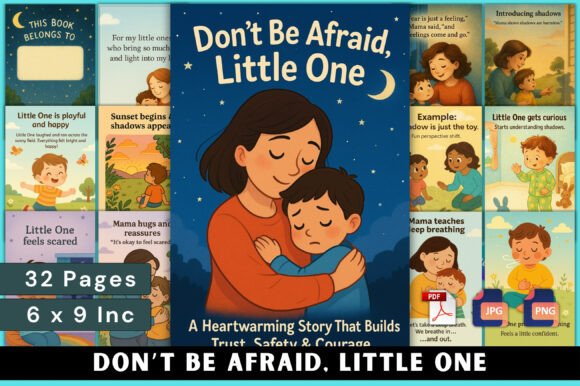
When bedtime becomes a tug-of-war—when a child freezes at the sight of a shifting shadow on the wall or clings tight at the thought of turning off the light—it’s not just about sleep. It’s about emotional literacy in action. Don’t Be Afraid, Little One meets families right there: in the quiet, vulnerable space between wakefulness and rest, where fear feels large and words feel small. This isn’t another “fix-the-nightmare” tool. It’s a 30-page invitation—to name fear, hold it gently, and walk through it with love as the compass.
A Resource That Works With, Not Against, Developmental Realities
Young children don’t lack courage—they lack context. Their nervous systems are still learning how to interpret sensory input, regulate arousal, and connect physical sensations (a racing heart, tight chest) with emotional meaning. Don’t Be Afraid, Little One speaks their language: soft watercolor illustrations that soften edges instead of sharpening threats; rhythmic, repetitive phrasing (“It’s okay to feel this way… It’s okay to breathe slow…”); and Mama’s presence—not as a problem-solver, but as a steady anchor. That distinction matters. Educators and pediatric therapists often observe that strategies fail not because they’re flawed, but because they ask children to bypass feeling before they’ve learned how to name it. This book doesn’t skip to “brave.” It pauses at “scared,” validates it, and walks alongside it.
Practical Support for Adults Who Support Children
Parents, early childhood educators, and therapists consistently report one recurring challenge: translating emotional concepts into actions a 3–7-year-old can embody. Don’t Be Afraid, Little One embeds teachable moments so naturally that adults don’t need training manuals to use them. On page 14, for example, Mama guides the child through three breaths—illustrated by expanding and contracting crescent moons—while naming each inhale and exhale. No jargon. No abstract instruction. Just visual rhythm + verbal cue + embodied practice. A preschool teacher in Portland told us she uses that spread daily during transition time—not just for anxious students, but as a group regulation tool before circle time. Similarly, the gentle, science-adjacent explanation of shadows (“Light plays hide-and-seek… and sometimes, it leaves a friend behind”) helps caregivers answer “What *is* that?” without resorting to dismissal (“It’s nothing!”) or overcomplication (“It’s the absence of photons…”).
Who Benefits Most—and Why
- Early childhood educators using social-emotional learning (SEL) frameworks: The book aligns seamlessly with CASEL’s core competencies—especially self-awareness and self-management—without requiring supplemental lesson plans.
- Therapists and counselors working with anxiety-sensitive children: Its non-pathologizing tone avoids labeling fear as “bad” or “wrong,” making it especially useful for neurodivergent kids who may experience sensory-based fears more intensely.
- Parents navigating separation anxiety or nighttime resistance: Because it models co-regulation—not correction—it reduces power struggles and builds mutual trust over time.
- Librarians and booksellers curating inclusive, trauma-informed collections: Its emphasis on relational safety (not “toughening up”) and absence of punitive messaging makes it a quietly powerful counterpoint to more directive titles.
Not a Standalone Fix—But a Consistent, Compassionate Companion
It’s important to be clear: Don’t Be Afraid, Little One won’t eliminate all nighttime fears overnight. Fear is adaptive. It keeps children alert, curious, and attuned to their environment. What the book does reliably is shift the relationship *to* fear—from something to suppress or endure, to something that can be witnessed, named, and softened with presence. That shift changes outcomes. One speech-language pathologist shared how a nonverbal 5-year-old began pointing to the “breathing moon” page during meltdowns—a nonverbal cue signaling, “I need help calming.” Another parent described how reading it nightly for six weeks coincided with her daughter independently fetching her favorite blanket before bed—not as a talisman against monsters, but as a self-soothing ritual she’d internalized from the story.
Design Choices With Intentional Impact
The physical details matter. The book’s matte, slightly textured cover invites touch—not just for children, but for adults holding it during late-night readings. Its trim size (8.5" x 8.5") fits comfortably in small hands and on laps. Page turns are paced to allow pause—no rushed resolutions. Even the typography uses rounded, open letterforms that feel approachable rather than clinical. These aren’t aesthetic flourishes; they’re accessibility features. For a child with visual processing sensitivities, high-contrast text or sharp angles can heighten arousal. Here, every design decision serves regulation first.
When to Consider Alternatives
Don’t Be Afraid, Little One excels when the goal is nurturing emotional vocabulary and relational safety. It may be less suited for families seeking behavior-focused interventions (e.g., graduated exposure for specific phobias) or those needing multilingual editions—currently available only in English. If a child’s fear is accompanied by persistent physical symptoms (chronic stomachaches, refusal to attend school), pairing this book with professional support is advisable. And while its gentle pace supports most learners, some highly active children may benefit from companion activities—like drawing their own “friendly shadow” or practicing breaths with a feather—to deepen engagement.
Why This Belongs on More Shelves Than Just Nursery Bookshelves
At its core, Don’t Be Afraid, Little One models something rare in children’s publishing: emotional humility. It doesn’t promise fearlessness. It offers companionship. That stance resonates far beyond bedtime. Freelancers managing creative blocks, entrepreneurs facing uncertainty, educators navigating systemic stress—all know what it is to stand at the edge of something unknown and wish for a calm voice saying, “This feeling has a shape. Let’s look at it together.” The book’s quiet authority lies in its restraint. No grand pronouncements. No forced positivity. Just 30 pages of witnessed humanity—softly lit, deeply kind, and profoundly useful.