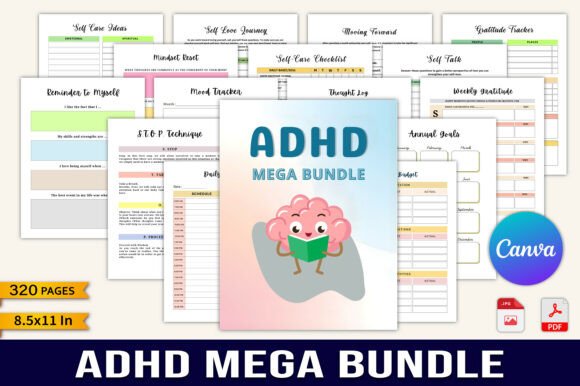
The ADHD Mega Bundle: A Real-World Life Organizer for Focus, Calm, and Consistency
Living with ADHD often means juggling brilliant ideas, big emotions, and shifting energy—while trying to keep up with deadlines, bills, meals, workouts, and self-care. It’s not about lacking motivation or discipline. It’s about needing tools that match how your brain works. That’s where the ADHD Mega Bundle stands apart—not as another generic planner, but as a thoughtfully layered, neurodivergent-informed system built for momentum, not perfection.
More Than Pages—A Coordinated Ecosystem for Daily Living
The ADHD Mega Bundle Planner isn’t just “a planner with extras.” It’s a synchronized set of resources designed to reduce cognitive load across multiple life domains at once. Think of it like having a personal operations center—one that doesn’t demand rigid adherence, but instead offers flexible scaffolding you can lean into, adapt, or skip based on your energy, focus, and priorities that day.
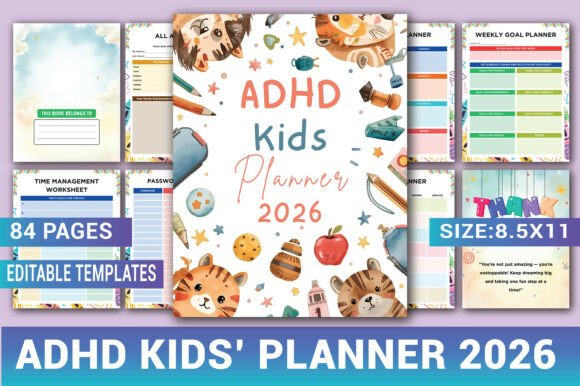
For example, if your morning feels scattered, you might open to the Daily Planner page—clean, uncluttered, with space for 3 priority tasks, one emotional check-in, and a visual time-blocked section. Later, when budget stress flares up, you flip to the Spending Log and Bill Tracker, both laid out with color-coded categories and minimal writing—so tracking feels light, not laborious. And when anxiety spikes mid-afternoon? The 5-4-3-2-1 Coping Technique and S.T.O.P. Technique are right there—no scrolling, no searching, just immediate, embodied support.
Structure That Breathes With You
Many planners fail people with ADHD because they assume linear progress, consistent energy, and flawless follow-through. The ADHD Mega Bundle rejects that myth. Its structure is intentionally modular and forgiving.
- Weekly Planner includes optional “Energy Forecast” prompts—so you can plan around your natural rhythm, not against it.
- Habit Tracker uses checkboxes and color-fill options—making consistency feel tactile and satisfying, even when streaks break.
- Assignment Tracker pairs due dates with “first small step” prompts—cutting through overwhelm before it starts.
- Annual Overview isn’t a rigid roadmap—it’s a visual anchor, with space to note milestones, seasonal shifts, and “what matters most this year” in your own words.
This flexibility makes the ADHD Mega Bundle equally useful for college students managing back-to-back classes and part-time work, remote professionals balancing deep work and household logistics, or parents rebuilding routine after burnout. It doesn’t ask you to become someone else—it supports who you already are.
Mental Health Tools Built In, Not Bolted On
Self-regulation isn’t separate from productivity—it’s the foundation. That’s why mental wellness isn’t tucked into an appendix in the ADHD Mega Bundle. It’s woven throughout.
The Anxiety Tracker, for instance, doesn’t just log symptoms—it asks, “What helped *just now*?” reinforcing agency over reaction. The Deep Breathing Record Form includes space to note heart rate, time of day, and what came next—turning breathwork into observable, learnable data. Even the Letter of Forgiveness and Reminder to Myself pages offer gentle, non-shaming reconnection points when shame or self-criticism takes over.
And because ADHD often coexists with rejection sensitive dysphoria (RSD), the Safety Plan and Managing Anxiety worksheets include concrete, sensory-based actions—like “hold something cold,” “name three things I see,” or “text my person the code word ‘blue’”—not abstract advice. These aren’t theoretical exercises. They’re field-tested responses, ready when your nervous system needs grounding—not analysis.
Practical Systems for Real-Life Complexity
Life doesn’t happen in silos—and neither does organization. The ADHD Mega Bundle bridges gaps between domains that usually live in separate apps or notebooks:
- Budget + Fitness: The Vacation Budget page includes estimated activity costs *and* a checklist for packing workout gear—because travel planning shouldn’t mean abandoning movement goals.
- Meal Planning + Mental Load: The Meal Planner has space for “leftover repurpose ideas” and “store-bought shortcuts”—validating real-world constraints, not idealized cooking routines.
- Goal Setting + Neurodivergent Reality: The Annual Goals worksheet asks, “What would make this feel sustainable—not impressive?” and “What support do I need *before* I begin?”
This cross-pollination reduces the friction of context-switching—the very thing that drains executive function reserves. Instead of opening five different tabs or flipping between three notebooks, everything lives in one place, visually cohesive and consistently formatted.
Who Benefits Most—and Why Timing Matters
You don’t need an official ADHD diagnosis to benefit from the ADHD Mega Bundle. It serves anyone whose attention shifts quickly, whose memory works better with external cues, or whose motivation depends on clarity—not willpower.
Students use it during exam season to map study blocks alongside sleep and snack windows—because cramming fails when hunger or fatigue hijacks focus. Entrepreneurs rely on the Password Tracker and Contact List to offload working memory clutter, freeing mental space for strategy. Caregivers appreciate the Subscription Tracker and Debt Snowball Worksheet—tools that quietly prevent financial drift while emotional bandwidth runs thin.
Crucially, the ADHD Mega Bundle works best when introduced *before* crisis hits. Starting during a calm week—when energy is steady and motivation is neutral—lets you explore pages without pressure. Try one tool for three days. Skip what doesn’t land. Circle back when your needs shift. There’s no “right way” to use it—only what helps you feel more grounded, capable, and kind to yourself today.
Design Choices That Support Your Brain
Every detail reflects an understanding of neurodivergent cognition:
- Visual clarity: Ample white space, consistent icons (like 📌 for trackers), and bold headers reduce scanning fatigue.
- Low-barrier entry: Worksheets use sentence starters (“One thing I’m proud of…”), checkboxes, and fill-in-the-blank prompts—not blank journal pages demanding creativity on demand.
- Progress visibility: Monthly Savings Tracker shows cumulative totals graphically; Habit Tracker includes weekly review prompts—not just “did I do it?” but “what made it easier/harder?”
- Tactile reinforcement: Printable PDF format means you can write by hand—a proven memory aid for many with ADHD—and physically flip pages to mark transitions.
It’s not flashy. It doesn’t gamify or over-promise. But it meets you where you are—with respect, realism, and quiet confidence that structure, done right, isn’t restrictive. It’s liberating.
Getting Started Without Overwhelm
If you’ve ever stared at a new planner thinking, “Where do I even begin?”—you’re not behind. You’re human. Here’s a low-pressure way in:
- Print just two pages: Your favorite Daily Planner layout + the 4-7-8 Breathing Technique sheet.
- Use them for 3 days. No tracking, no reviewing—just noticing what feels helpful.
- After Day 3, ask: “Which part reduced friction? Which felt like extra work?” Then add one more tool—maybe the Spending Log or the Mental Health Journal—that aligns with your current biggest pinch point.
The power of the ADHD Mega Bundle isn’t in using every page. It’s in knowing exactly which ones hold space for your focus, your calm, and your capacity—whenever you need them.