ChatGPT Creative Idea Generation: Your Real-World Spark for Better Thinking
Imagine staring at a blank document before a product launch—your team’s energy is low, deadlines are tight, and “fresh ideas” feel like a luxury you can’t afford. Or picture an educator needing 10 engaging lesson hooks for climate science, a freelance writer stuck on blog angles for sustainable fashion, or a small-business owner trying to rebrand without hiring an agency. That’s where ChatGPT Creative Idea Generation shifts from abstract tool to daily ally—not by doing the work for you, but by reliably jump-starting your own thinking.
What It Actually Is (and What It Isn’t)
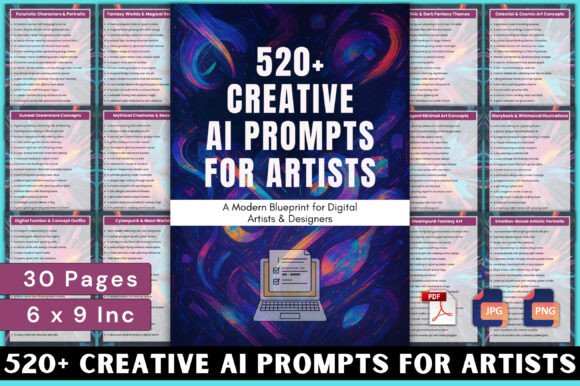
ChatGPT Creative Idea Generation isn’t software, a subscription service, or AI that writes finished content. It’s a curated, human-designed collection of 1300 thoughtfully structured prompts—questions, constraints, analogies, and reframing techniques—built specifically to activate ChatGPT (or similar LLMs) for idea work. Think of it as a high-signal “idea ignition kit”: no fluff, no vague “give me ideas about marketing,” but instead prompts like “Rewrite this SaaS onboarding flow as if it were a board game—what are the levels, power-ups, and fail states?” or “List 7 product names for a reusable coffee filter brand targeting over-40 urban gardeners—each must contain a subtle botanical reference.”
It’s editable (via Canva), print-ready (6×9 inches), and delivered in multiple formats—so whether you’re scribbling notes in a café, prepping for a workshop, or printing a prompt deck for your design sprint, it adapts to how you actually work.
Where It Fits Into Real Work—Not Just Theory
The value isn’t in the number of prompts—it’s in how they land in real situations:
- For solopreneurs and side-hustlers: You don’t have a brainstorming team. One prompt—“What’s the most unexpected place my ideal customer spends time online? Generate 5 content ideas tailored to that platform’s culture”—can uncover a niche channel (like Reddit’s r/PlantCare or TikTok’s #SmallBizTips) and give you 3 ready-to-film video scripts in under two minutes.
- For educators and trainers: Lesson planning fatigue is real. A prompt like “Turn the water cycle into a 90-second classroom skit with 4 student roles—include one humorous misconception as a plot twist” delivers structure, engagement, and pedagogical nuance in one go—no extra research needed.
- For marketers and content teams: When SEO keywords dry up, try “List 12 blog titles about ‘meal prep for shift workers’—each must include a specific time-of-day pain point (e.g., ‘3 a.m. hunger,’ ‘post-midnight cravings’) and imply a solution”. Instantly actionable, audience-specific, and algorithm-friendly.
- For product and UX designers: Stuck in feature creep? Try “Describe this app’s core function using only verbs—and then list 5 ways to remove one verb without losing usefulness”. It forces ruthless prioritization grounded in behavior, not assumptions.
Who Benefits—and How Their Needs Differ
A startup founder uses ChatGPT Creative Idea Generation to pressure-test messaging before spending on ads—prompting variations like “Explain our AI scheduling tool to a busy pediatrician who distrusts tech—use only metaphors from their clinic workflow.” The output isn’t copy; it’s insight into mental models and friction points.
A fiction writer might use the same prompt bank differently—pulling prompts like “Give me 8 opening lines for a thriller set in a city where all clocks run 7 minutes fast—each must imply a different kind of tension (moral, physical, bureaucratic, emotional)”. Here, the goal isn’t efficiency—it’s texture, voice, and controlled constraint.
Even non-creatives benefit: HR managers use prompts like “Rewrite our remote-work policy as a choose-your-own-adventure guide—what are the 3 most common decision points new hires face in Week 1?” That doesn’t just clarify policy—it surfaces hidden onboarding gaps.
Practical Considerations Before You Jump In
It works best when you understand its rhythm—not as magic, but as a collaborator with clear boundaries:
- You still steer. The prompts help you ask better questions—but you decide which outputs resonate, which need refining, and which reveal blind spots. A prompt like “List 10 taglines for a compostable phone case—then critique each for unintended connotations (eco-guilt, fragility, trend-chasing)” gives you both raw material and built-in reflection.
- Context matters more than volume. Dropping 1300 prompts into ChatGPT won’t auto-generate brilliance. Pick 2–3 aligned with your immediate challenge. Test them. Tweak the wording. Save what works. The PDF’s 67 pages aren’t meant to be read cover-to-cover—they’re a reference library you return to.
- Output quality depends on your input. Vague prompts yield vague results. The strength of this collection is how many prompts bake in specificity: audience, format, tone, constraint, or emotional subtext. That reduces the “revise-and-resubmit” loop.
- It complements—not replaces—human judgment. An AI might suggest naming a bakery “Crumble & Co.” because it’s alliterative and food-adjacent. But only you know if that name clashes with your neighborhood’s historic branding or feels too generic next to “Hearth & Rye” down the street.
Strengths That Stand Out in Practice
What makes this prompt set genuinely useful—not just another digital download?
- Industry-aware framing. Prompts aren’t generic. There are dedicated sections for educators, developers, therapists, nonprofit fundraisers, and even podcast hosts—each with language and priorities that match their workflows.
- Anti-bias guardrails built in. Several prompts explicitly ask for alternatives to common stereotypes (“Rewrite this ad concept without referencing ‘busy moms’ or ‘tech bros’—focus instead on skill-based archetypes”). Others prompt for accessibility-first adaptations or cultural nuance checks.
- Format flexibility. Need a quick warm-up for your team’s Monday meeting? Print the “Lightning Round” page. Prepping for investor storytelling? Flip to the “Narrative Arc” section. Stuck on visual identity? Use the “Brand Voice → Visual Metaphor” conversion prompts.
- No login, no paywall, no tracking. It’s a static resource—yours to annotate, share internally, or adapt. That reliability matters when tools change terms, shut down, or start throttling free tiers.
A Note on Limits—So You Use It Wisely
It won’t replace domain expertise. A prompt asking for “10 sustainable packaging innovations for frozen meals” won’t tell you which materials meet FDA freezing specs—or which suppliers exist in your region. It will, however, generate angles you hadn’t considered: edible rice-paper sleeves, phase-change gel inserts repurposed as reusable cold packs, or QR-coded compost instructions printed directly on cellulose film. That’s the sweet spot: expanding possibility space, not delivering final answers.
And while the Canva link lets you customize layouts, fonts, and colors, it doesn’t auto-generate designs—it empowers you to make the resource yours. That’s intentional. Creativity thrives when tools serve your process, not dictate it.
If your work involves generating ideas—even occasionally—ChatGPT Creative Idea Generation meets you where you are: tired, time-crunched, or simply ready to think with more precision and less friction. It’s not about thinking harder. It’s about thinking with better leverage.