520 Creative AI Prompts for Artists: Your Practical Guide to Unlocking Visual Innovation
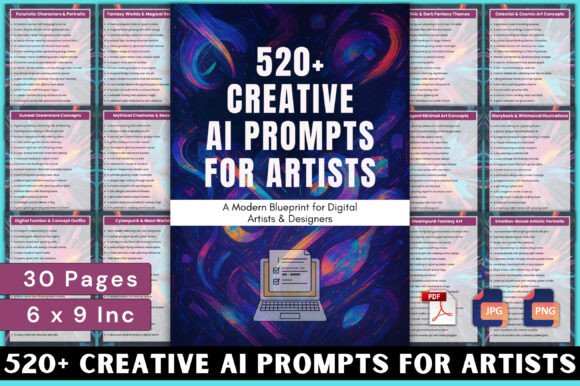
Imagine standing before a blank digital canvas—not with hesitation, but with excitement—because you already know exactly what to create. That’s the power of 520 Creative AI Prompts for Artists: a modern, thoughtfully curated collection designed not just to inspire, but to accelerate and elevate your creative process in the age of generative AI.
What Is This Prompt Collection—and Why Does It Matter?
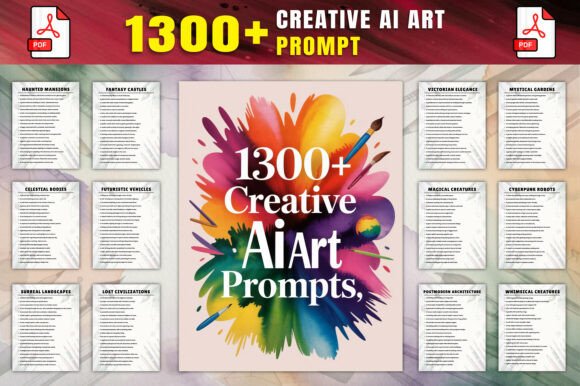
At its core, 520 Creative AI Prompts for Artists is more than a list of ideas—it’s a strategic toolkit. Each of its 520 prompts is professionally structured, semantically rich, and optimized for leading AI image generators like Midjourney, Stable Diffusion, DALL·E, Adobe Firefly, and Leonardo AI. Unlike generic or overly vague prompts (“a cool robot”), these are crafted with intention—balancing descriptive specificity, stylistic cues, lighting guidance, and compositional hints to help users generate consistent, high-fidelity visuals.
This matters because prompt engineering—the art of writing effective instructions for AI—is now a foundational skill for digital artists, illustrators, game designers, authors building visual assets, marketing teams creating social content, and even educators designing immersive learning materials. Without strong prompts, even the most advanced AI tools can produce inconsistent, off-brand, or conceptually muddy results.
How It’s Organized: Structure Meets Creativity
The collection is divided into 15 intuitive thematic categories, each serving a distinct creative need:
- Futuristic Characters: Think quantum engineers in adaptive nano-armor or glitch-aesthetic portraits with holographic overlays—ideal for sci-fi concept art or NFT character design.
- Fantasy Worlds: From floating kingdoms tethered by aurora-light bridges to enchanted forests where trees bloom with stained-glass leaves—perfect for book covers or RPG world-building.
- Surreal Dreamcore Concepts: Pastel fog rooms, liminal library staircases, and floating doors suspended mid-air—great for mood boards, ambient branding, or therapeutic visual storytelling.
- Mythical Creatures: Crystal dragons refracting light like prisms, stardust whales swimming through nebula clouds, or elemental foxes woven from wind and ember—bridging folklore with contemporary aesthetics.
- AI-Human Hybrid Concepts: Robotic-organic healers with bioluminescent veins, elders whose faces shift between memory-laced holograms and weathered skin—exploring identity, evolution, and empathy in tech-forward narratives.
- Cyberpunk Environments: Rain-slicked neon alleys pulsing with data streams, rooftop gardens growing inside server farms, street samurai with neural lace tattoos—vibrant, layered, and deeply atmospheric.
Other categories—including Digital Fashion, Underwater Realms, Cosmic Visuals, Gothic Themes, Minimal Art, and Whimsical Storybook Concepts—ensure coverage across moods, markets, and mediums. Whether you're designing a fashion line’s lookbook, prototyping a VR environment, or illustrating a children’s app, there’s a prompt structure ready to spark precision and originality.
Why “Well-Written” Prompts Make All the Difference
A common misconception is that AI tools “just understand ideas.” In reality, they interpret language statistically—and subtle wording shifts dramatically alter outputs. For example:
- Vague prompt: “A dragon in space.” → May yield a cartoonish dragon photoshopped onto a starfield.
- Optimized prompt (from the collection): “Cosmic tiger hybrid dragon, iridescent obsidian scales shifting between violet and deep indigo, orbiting a binary star system, volumetric nebula glow, cinematic lighting, ultra-detailed 8K render, art by Craig Mullins and Moebius.” → Delivers narrative depth, textural richness, lighting control, and stylistic anchoring.
This level of craftsmanship reduces trial-and-error time, supports brand consistency, and helps beginners learn *how* to think like a prompt engineer—not just copy-paste.
Who Benefits—and How?
520 Creative AI Prompts for Artists serves a wide, real-world audience:
- Digital Artists & Illustrators: Use prompts as springboards for personal projects—or adapt them into client-ready concepts faster.
- Game Designers: Generate rapid iterations of characters, environments, UI elements, or lore visuals during pre-production.
- Authors & Publishers: Create evocative cover art, chapter headers, or companion illustrations without hiring an illustrator for every idea.
- Educators & Students: Teach visual literacy, speculative design, and AI ethics through hands-on, category-based exploration.
- Content Creators & Marketers: Produce on-brand social visuals, ad banners, or newsletter graphics in minutes—not days.
- Beginners: Learn prompt structure intuitively by observing patterns—e.g., how “lighting,” “artist reference,” and “detail level” consistently appear in high-performing prompts.
Importantly, this resource doesn’t replace artistic skill—it amplifies it. The best results still come from human curation: selecting, refining, editing, and integrating AI-generated assets into larger creative workflows.
Beyond Inspiration: Building Creative Confidence
Many creatives hesitate to adopt AI tools—not from resistance, but from uncertainty. Questions like “Where do I even start?” or “Will this dilute my voice?” are valid. This collection directly addresses those concerns by:
- Demystifying prompt logic through consistent formatting and category-based learning.
- Encouraging remixing: Every prompt invites adaptation—swap “neon” for “bioluminescent,” or “cyberpunk” for “steampunk,” and observe how meaning evolves.
- Prioritizing aesthetic integrity: No low-effort stock tropes. Instead, emphasis on mood, texture, cultural resonance, and emotional tone.
It transforms AI from a black box into a collaborative partner—one that responds thoughtfully when given clear, imaginative direction.
Real-World Relevance in a Rapidly Evolving Landscape
In 2024 and beyond, visual fluency isn’t optional—it’s essential. Brands compete for attention in saturated feeds. Educators seek immersive ways to explain abstract ideas. Developers prototype interfaces with photorealistic mockups. And artists explore new forms of expression at the intersection of code, culture, and craft.
520 Creative AI Prompts for Artists meets this moment by grounding innovation in usability. It’s not about chasing trends—it’s about equipping creators with timeless frameworks for visual thinking, adapted for today’s most powerful tools. Whether you’re sketching storyboards, designing a mobile game, launching a Patreon, or teaching middle-school digital art, these prompts offer immediate utility and lasting creative scaffolding.
Getting Started Is Simple
You don’t need expensive software or technical training to begin. Pick a category that resonates—say, Atmospheric Landscapes. Try one prompt in your preferred AI tool. Observe how modifiers like “mist-laced dawn,” “isometric perspective,” or “Studio Ghibli meets Zaha Hadid” shape the output. Then tweak one element and compare results. That’s experiential learning—fast, tactile, and deeply rewarding.
Over time, you’ll internalize patterns: how color palettes influence mood, how artist references steer style, how scale and composition guide focus. You’ll also develop your own signature variations—turning borrowed prompts into authentic creative extensions.
In a world where attention is scarce and imagination is abundant, 520 Creative AI Prompts for Artists doesn’t just give you ideas—it gives you agency, clarity, and creative momentum.