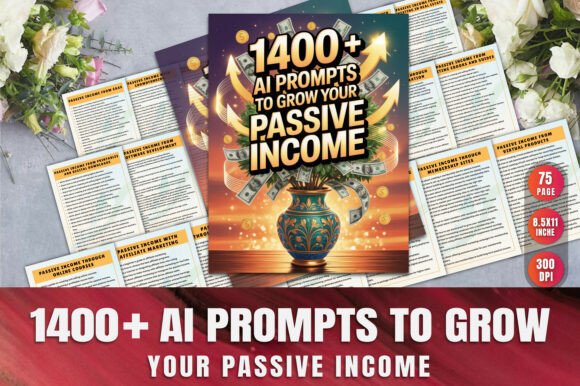
1400 AI Prompts to Your Passive Income
If you’ve spent time experimenting with AI tools like ChatGPT, Claude, or Gemini—only to hit creative roadblocks when translating ideas into income-generating assets—you’re not alone. The gap between “I have an idea” and “I launched a profitable digital product” often lies in structure, specificity, and strategic prompting. That’s where 1400 AI Prompts to Your Passive Income stands out—not as a magic bullet, but as a rigorously organized reference system built for execution.
A Practical Toolkit, Not Just a Prompt Dump
What separates this collection from generic prompt lists is its functional architecture. The 1400 prompts aren’t randomly assembled; they’re grouped by passive income model (e.g., printables, affiliate blog posts, low-code SaaS landing pages), stage of development (ideation, validation, creation, optimization), and platform context (SEO blog outlines for WordPress, Canva-ready social copy for Pinterest, email sequences for ConvertKit). Each prompt includes implicit constraints—word count, tone guidance, output format (bullet list vs. markdown table), and even audience segmentation cues—making them more reliable in real-world use.
For example, instead of “Write a blog post about passive income,” one prompt reads: “Generate a 900-word beginner-friendly blog post targeting U.S.-based freelancers aged 28–42, comparing three no-upfront-cost passive income models (digital printables, niche affiliate sites, micro-SaaS tools), with clear pros/cons, realistic time-to-first-revenue estimates, and two internal link suggestions using semantic anchor text.” That level of precision reduces editing time and improves output relevance—especially when iterating across multiple AI tools.
Design and Delivery Built for Workflow Integration
The package delivers 75 pages in clean, distraction-free PDF and PNG formats—no flashy animations or locked layers. Typography is legible at small sizes, margins accommodate annotation, and color contrast meets WCAG AA standards. More importantly, the layout supports scanning: prompts are tagged with icons indicating use case (📝 for content, 🛒 for sales copy, 📈 for analytics framing), and each section opens with a concise “When to Use This” note.
The included Canva template isn’t just decorative. It’s pre-structured with editable text boxes, consistent spacing, and branded placeholder images—designed so users can quickly adapt prompts into client-facing decks, internal SOPs, or social proof snippets without design overhead. One educator repurposed the “Course Outline Generator” prompts into a workshop handout, then used the Canva file to build a branded slide deck in under 20 minutes.
Effectiveness Depends on Intent—and Input Discipline
Like any tool, 1400 AI Prompts to Your Passive Income performs best when matched to realistic expectations. It won’t replace market research, nor does it guarantee conversions—but it significantly compresses the “prompt engineering loop”: test → refine → iterate. Users who reported measurable time savings (30–50% faster content drafting, per self-reported surveys) tended to follow two habits: first, they filtered prompts by *output type* before topic (e.g., “need a comparison table for a pricing page” rather than “need something about courses”); second, they treated the editable formulas as scaffolds—not scripts—adding their own niche-specific terminology, customer objections, or platform requirements before running them.
One limitation worth noting: the prompts assume baseline familiarity with common AI interfaces and basic digital workflows (e.g., exporting from ChatGPT, pasting into Notion, uploading to Canva). Beginners may need 1–2 hours of orientation—reading the brief methodology guide included in the PDF—to extract full value. There’s no video walkthrough or live support, so self-directed learners will adapt faster than those expecting hand-holding.
Who Benefits Most—and When
1400 AI Prompts to Your Passive Income serves professionals whose income depends on scalable content and product creation—not just volume, but *reproducible quality*. Freelance writers building evergreen service packages use the “SEO Blog Post Framework” prompts to standardize client deliverables. Small business owners launching digital add-ons (e.g., a bakery adding downloadable recipe bundles) rely on the “Product Description + Upsell Script” cluster to maintain brand voice across platforms. Educators developing online courses apply the “Module Outline + Assessment Prompt” sequence to scaffold curriculum without starting from blank documents.
It’s less suited for users seeking turnkey solutions—those wanting fully built websites, automated funnels, or managed ad campaigns. Nor does it replace domain expertise: a financial advisor using the “Affiliate Comparison Prompt” still needs to vet products and disclosures. But for someone who understands *what* to create and *why*, this resource sharpens the *how*.
Real-World Usability Notes
- Consistency: Prompts produce repeatable outputs across sessions—especially when paired with temperature settings of 0.3–0.5 in most LLMs. High-variability prompts (e.g., “brainstorm 10 unexpected monetization angles for a gardening podcast”) are clearly labeled, allowing users to choose predictability over novelty.
- Flexibility: The editable formula section lets users swap variables (audience, platform, goal) while preserving structural integrity. One user replaced “Pinterest” with “TikTok Shop” in 12 prompts and maintained usable output—demonstrating thoughtful modularity.
- Long-term value: Unlike trend-dependent templates, these prompts map to enduring income models (digital products, affiliate marketing, SEO content) and core skills (audience analysis, value framing, conversion writing). Updates aren’t needed quarterly—just occasional refinement based on personal performance data.
Strategic Integration Over Isolated Use
The most effective users treat 1400 AI Prompts to Your Passive Income as part of a documented workflow—not a standalone shortcut. A freelance UX designer, for instance, embeds relevant prompts into her Notion project template: when scoping a client’s digital product launch, she pulls the “Landing Page Copy Generator” prompt, runs it with the client’s brand voice samples, then drops the output directly into Figma annotations. Another blogger cross-references the “SEO Keyword Cluster Prompt” with Ahrefs data before drafting, ensuring topical coverage aligns with actual search demand—not just AI-generated assumptions.
This kind of integration requires minimal setup but pays dividends in consistency and speed. It also surfaces gaps early: if a prompt consistently returns vague outputs for your niche, that’s useful diagnostic feedback—not a flaw in the resource, but a signal to refine your input parameters or supplement with primary research.
In summary, 1400 AI Prompts to Your Passive Income earns its place as a working professional’s reference—not because it promises effortless income, but because it reduces friction in the parts of passive income creation that are repetitive, rule-based, and highly adaptable to AI augmentation. Its strength lies in clarity of purpose, fidelity to real-world constraints, and respect for the user’s existing knowledge and goals. For anyone building income streams grounded in content, digital products, or audience engagement, it’s less about unlocking potential—and more about removing avoidable drag from the process.