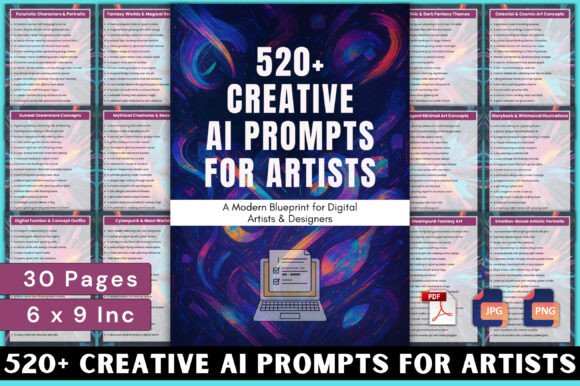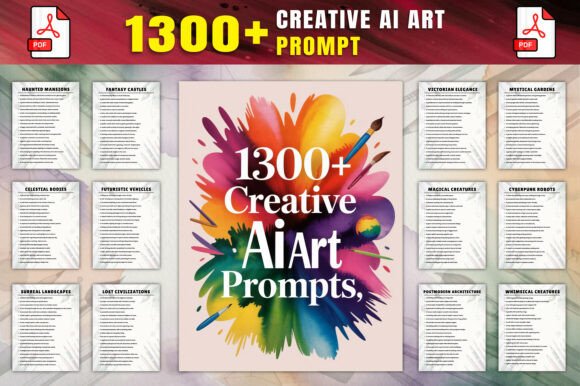
🎨 Creative 1300 AI Art Prompts: A Strategic Resource for Intentional Visual Creation
For professionals who rely on visual communication—whether launching a brand identity, developing marketing assets, prototyping product concepts, or teaching design principles—the challenge isn’t scarcity of tools. It’s the consistent, high-signal generation of ideas that align with purpose, audience, and outcome. That’s where 🎨 Creative 1300 AI Art Prompts functions not as a novelty, but as a calibrated input layer in your creative workflow.
Why Volume Alone Isn’t Enough—And Why This Collection Is Different
Most prompt libraries offer repetition disguised as variety: slight variations on “cyberpunk city at night” or “minimalist logo with leaf.” 🎨 Creative 1300 AI Art Prompts avoids that trap by structuring diversity across three dimensions: genre (sci-fi, botanical realism, retro-futurism, textile abstraction), intent (concept exploration, mood calibration, stylistic constraint, narrative scaffolding), and technical specificity (lighting cues, compositional directives, texture language, aspect ratio guidance). This means a freelance illustrator building a client pitch deck can isolate prompts optimized for “brand-aligned visual metaphors,” while an educator designing a generative art module might filter for “accessible, classroom-tested abstraction prompts with clear learning outcomes.”
Strategic Use Cases Across Professional Roles
The value of 🎨 Creative 1300 AI Art Prompts scales with intention—not just usage. Consider how it integrates into real-world decision-making:
- For marketers and small business owners: Launching a new product line? Instead of vague briefs like “make it feel premium,” use prompts tagged “luxury material study + soft ambient lighting + macro detail” to generate reference images that inform packaging photography, website banners, and social thumbnails—all aligned before a single asset is commissioned.
- For educators and curriculum designers: Teaching visual storytelling? Assign students to reinterpret the same core prompt—e.g., “a library staircase dissolving into constellations”—across three distinct styles (ink wash, vector flat, photorealistic collage). The structured variety in 🎨 Creative 1300 AI Art Prompts provides built-in scaffolding for comparative analysis, not just output.
- For UX/UI designers and product teams: Need rapid concept validation for an app interface icon set? Filter prompts by “monoline symbol + cultural neutrality + scalable clarity”. Generate dozens of variants in minutes, then test which visual metaphors resonate fastest with target users—reducing reliance on subjective internal consensus.
- For content creators and publishers: Maintaining visual consistency across long-form articles? Bookmark prompts tied to recurring themes—e.g., “data flow as organic river system + muted earth palette”—to ensure illustrations reinforce conceptual continuity without requiring custom art direction each time.
How to Approach It With Discipline—Not Default
Randomly scrolling through 1300 prompts invites distraction, not discovery. Treat 🎨 Creative 1300 AI Art Prompts like a reference manual—not a slot machine. Start with your objective: What decision needs support? What ambiguity needs resolution? Then apply filters:
- Define the constraint first. Is this about tone (e.g., “authoritative yet approachable”), medium (e.g., “SVG-compatible line art”), or audience context (e.g., “for healthcare professionals reviewing technical documentation”)?
- Select 3–5 prompts that match that constraint—not just aesthetic preference. Avoid choosing based solely on “what looks cool.” Prioritize prompts that force you to confront assumptions (“How would ‘trust’ look in a non-Western visual idiom?”) or expose gaps (“Do I even know what ‘biomimetic architecture’ implies visually?”).
- Use the editable Canva link to annotate—not just copy. Add notes like “Client prefers warm analog textures → skip metallic/glossy modifiers” or “Avoid humanoid figures per brand guidelines.” This transforms passive consumption into active curation.
Risks of Undisciplined Use—and How to Mitigate Them
Without grounding in goals, large prompt sets risk reinforcing bias, diluting voice, or creating misaligned outputs. For example:
- A branding agency using 🎨 Creative 1300 AI Art Prompts without clarifying client values may generate stunning visuals that clash with the brand’s established equity—e.g., selecting “chaotic neon fractals” for a heritage financial institution emphasizing stability.
- An educator assigning prompts without contextual framing might get technically proficient outputs that miss pedagogical intent—e.g., students generating hyper-detailed sci-fi armor without understanding how material choices signal power dynamics or cultural hierarchy.
- A solopreneur treating every prompt as equally actionable may burn time on low-impact explorations—e.g., iterating on “steampunk owl clock” when their actual need is “clean, scalable favicon for a meditation app.”
Mitigation starts with pre-prompt discipline: ask “What must this image communicate—not just depict?” before generating. Use the 67-page PDF’s organization to your advantage: scan section headers (“Emotion-Driven Realism,” “Architectural Abstraction,” “Cross-Cultural Symbolism”) as strategic filters—not decorative categories.
Long-Term Value: Building Your Own Prompt Literacy
The most durable ROI from 🎨 Creative 1300 AI Art Prompts isn’t the images it helps generate—it’s the pattern recognition it cultivates. As you work through prompts across genres, you’ll start noticing how subtle phrasing shifts outcomes: “sunlight filtering through stained glass” versus “refracted light patterns on stone floor” yield different compositional priorities and emotional weights. You’ll learn which modifiers reliably produce usable results in your preferred tools (MidJourney v6 vs. DALL·E 3 vs. Stable Diffusion XL), and which require post-processing trade-offs. This isn’t about memorizing prompts—it’s about internalizing the grammar of visual instruction.
Practical Integration Tips for Real Workflows
Don’t wait for “creative block” to reach for 🎨 Creative 1300 AI Art Prompts. Embed it proactively:
- In planning sprints: Block 15 minutes before kickoff to select 2–3 prompts that map to upcoming deliverables. Use them to draft visual briefs, not final assets.
- In client discovery: Share relevant prompt examples (e.g., “vintage travel poster style + sustainable materials focus”) to calibrate expectations faster than abstract adjectives like “timeless” or “modern.”
- In team critiques: When feedback stalls, pull a prompt from the “Unexpected Juxtaposition” section and ask: “How would this constraint shift our current direction?” It reframes discussion around possibility, not preference.
- In skill development: Pick one prompt weekly. Replicate it manually in Photoshop or Procreate—not to compete with AI, but to reverse-engineer how lighting, perspective, and texture interact in the original description.
Final Thought: Tools Serve Strategy, Not the Reverse
🎨 Creative 1300 AI Art Prompts is powerful because it respects your expertise. It doesn’t replace judgment—it multiplies its reach. It won’t tell you whether your brand needs warmth or authority, but it will give you 47 distinct, executable ways to explore warmth if that’s your conclusion. It won’t decide your audience’s visual literacy, but it offers prompts calibrated for varying levels of abstraction and cultural specificity. Used with clarity of purpose, it becomes less a “prompt pack” and more a strategic lever—one that turns intention into iteration, ambiguity into alignment, and vision into tangible, testable outcomes.