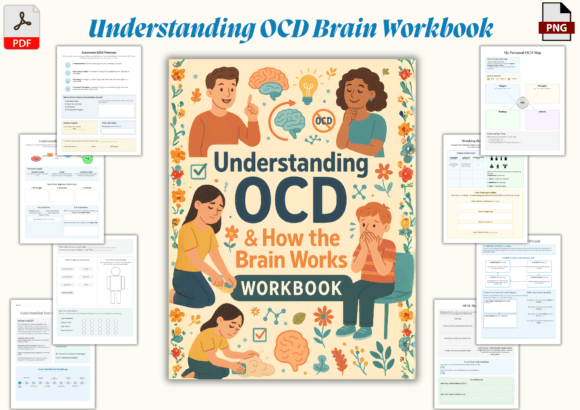
Understanding OCD How the Brain Works: A Strategic Resource for Educators, Clinicians, and Creators in the Emotional Literacy Economy
In an era where emotional intelligence is no longer a soft skill—but a measurable driver of engagement, retention, and well-being—the demand for tools that translate neuroscience into lived understanding has surged. Understanding OCD How the Brain Works stands at the intersection of this shift: not merely as a workbook, but as a purpose-built, evidence-informed communication platform designed to make neurobiological complexity legible, actionable, and human-centered.
This isn’t another checklist-style intervention guide. It’s a 8.5 x 11-inch, high-resolution printable workbook—available in both PDF and PNG formats—that reimagines how we scaffold self-knowledge for children, teens, and neurodiverse learners. Its visual language, grounded in developmental psychology and cognitive-behavioral science, transforms abstract concepts like “anxiety loops,” “intrusive thoughts,” and “compulsion reinforcement” into tangible, interactive experiences: thought-bubble activities, body-awareness trackers, trigger maps, and co-regulation prompts—all rendered in warm, accessible illustration style.
A Response to the Convergence of Three Powerful Trends
Understanding OCD How the Brain Works gains urgency and relevance because it aligns precisely with three converging macro-trends reshaping education, mental health support, and content creation:
- The Institutionalization of Social-Emotional Learning (SEL): Over 90% of U.S. states now have SEL standards or frameworks embedded in K–12 policy. Districts are moving beyond standalone “feelings charts” toward integrated, brain-aligned curricula. This workbook meets that need—not as supplemental material, but as infrastructure. Its pages map directly onto CASEL’s five core competencies: self-awareness, self-management, social awareness, relationship skills, and responsible decision-making—particularly through its emphasis on identifying physiological cues, naming cognitive patterns, and practicing regulation *before* escalation.
- The Rise of Neuro-Inclusive Design in Digital and Print Media: Consumers—and especially educators and clinicians—are increasingly rejecting one-size-fits-all resources. They seek materials that honor variation in attention, processing speed, sensory sensitivity, and executive function. The workbook’s intentional layout—generous white space, consistent visual grammar, dual-format delivery (PDF for digital annotation, PNG for LMS integration or custom adaptation), and print-ready resolution—reflects professional-grade design thinking. It doesn’t ask users to adapt to the tool; it adapts to how real brains learn.
- The Creator-Led Shift Toward “Explainable Mental Health”: Platforms like Instagram, TikTok, and Substack have democratized access to clinical concepts—but often at the cost of nuance or fidelity. Professionals and creators alike are responding with rigor: building libraries of vetted, visually rich, ethically grounded assets. Understanding OCD How the Brain Works serves this ecosystem not as static content, but as modular, reusable components—trigger maps for therapist handouts, body-scan diagrams for SEL slide decks, calming strategy cards for classroom morning meetings. Its design invites remixing, localization, and contextual extension—without compromising clinical integrity.
Why Practitioners Are Prioritizing This Resource Now
It’s not just what the workbook *contains*, but how it changes workflow efficiency and relational impact.
Consider a school counselor managing 300+ students across six grade levels. Traditional psychoeducation handouts often fail to land—not due to lack of effort, but because they assume literacy levels, attention stamina, or prior exposure to metacognitive vocabulary. With Understanding OCD How the Brain Works, that same counselor can assign targeted pages based on individual readiness: a 4th grader might begin with the “Thought Bubble Activity” to externalize intrusive ideas, while a 9th grader uses the “Anxiety Loop Diagram” to trace how avoidance reinforces fear. Each page includes built-in reflection prompts—no lesson planning required—yet leaves room for facilitation, discussion, and personalization.
Similarly, freelance therapists offering telehealth services report that digital fatigue makes traditional worksheets less effective. But this workbook’s PNG format allows seamless integration into platforms like Zoom whiteboards or Notability. A clinician can spotlight a specific neural pathway diagram, annotate it live with a client, then email the completed page as a takeaway—blending immediacy with continuity.
For creators building online courses or membership communities around anxiety literacy, the workbook functions as a premium, brand-aligned asset. Its clean, warm aesthetic fits seamlessly alongside video modules or guided journaling prompts—without requiring custom illustration budgets. And because all pages are print-ready at industry-standard size, it supports hybrid delivery models: digital-first learning paired with tactile reinforcement, proven to deepen encoding and recall.
Designing for Agency, Not Just Awareness
What distinguishes Understanding OCD How the Brain Works from earlier generations of mental health tools is its consistent centering of agency. It avoids pathologizing language (“disorder,” “deficit,” “dysfunction”) in favor of functional framing: “your brain is trying to protect you,” “this loop is learnable—and unlearnable,” “your body is giving you information, not warnings.”
This subtle but critical shift reflects evolving best practices in trauma-informed and neurodiversity-affirming care. Research shows that when learners understand *why* their nervous system responds the way it does—not as malfunction, but as adaptive survival architecture—they engage more readily in behavioral experiments and self-monitoring. The workbook’s “Body Sensation Tracker,” for example, doesn’t ask “What’s wrong?” It asks, “Where do you feel tightness, heat, or stillness—and what usually happens next?” That reframing builds interoceptive literacy, a foundational skill linked to improved emotion regulation and reduced symptom severity across anxiety-related conditions.
Moreover, its structure mirrors how the brain consolidates learning: repetition with variation. Learners revisit core concepts—like the role of the amygdala or the function of the prefrontal cortex—not through rote definitions, but through layered application: first in a visual diagram, then in a personal reflection, then in a co-created calming plan. This scaffolding supports long-term neural rewiring, not just short-term comprehension.
Strategic Value Beyond the Clinical Setting
Entrepreneurs and marketers in the wellness, edtech, and parenting spaces are recognizing that credibility now hinges on demonstrable alignment with evidence—not just anecdote or aesthetics. A product suite built around Understanding OCD How the Brain Works signals depth: it implies fluency in developmental neuroscience, commitment to accessibility standards (color contrast, font legibility, cognitive load management), and respect for user autonomy.
Imagine a homeschool curriculum provider bundling the workbook with video explainers and parent facilitation guides. Or a mental health app licensing select pages as in-app micro-learning modules—with optional therapist co-signing for clinical validation. Or a corporate DEIB initiative adapting its “Trigger Map” framework for workplace stress navigation, translating OCD-informed insights into broader resilience-building practices.
These aren’t hypothetical extensions. They’re logical evolutions made possible by the workbook’s intentional architecture: modular, scalable, research-grounded, and deeply human in tone.
Conclusion: Infrastructure for the Next Generation of Emotional Literacy
Understanding OCD How the Brain Works represents more than a teaching aid—it’s infrastructure. It meets professionals where they are: navigating tighter budgets, heavier caseloads, and higher expectations for outcomes. It meets creators where their audiences are: seeking clarity without oversimplification, science without coldness, support without stigma. And it meets learners where their brains are: wired for pattern, story, image, and embodied experience—not just text and terminology.
In a landscape crowded with quick fixes and superficial solutions, this workbook offers something rarer: fidelity. Fidelity to the science. Fidelity to developmental realities. Fidelity to the quiet courage it takes for a child—or adult—to name a thought, pause before acting, and choose response over reaction. That fidelity is no longer a differentiator. In the emotional literacy economy, it’s the baseline.