2026-2027 Business Planner KDP: A Practical, Production-Ready Tool for Modern Creators
Planning isn’t just about dates and deadlines—it’s about intentionality in motion. As we move deeper into a hybrid work era where flexibility, clarity, and digital fluency are non-negotiable, the 2026-2027 Business Planner KDP meets a quiet but growing need: a professionally structured, print-ready interior that works *immediately*—no redesigns, no guesswork, no last-minute KDP rejections.
Why This Planner Fits Where Others Fall Short
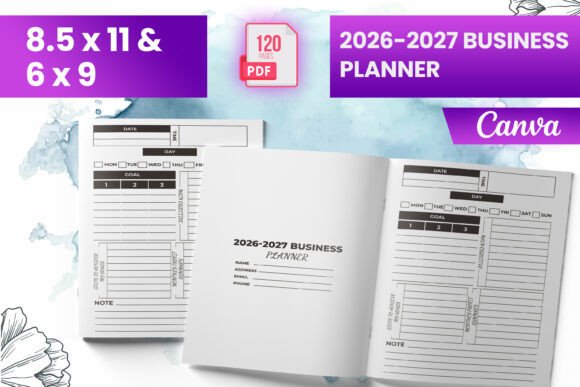
Many planners still rely on outdated layouts or assume users have design expertise. But today’s entrepreneurs, educators, and solopreneurs aren’t graphic designers—they’re time-strapped professionals who need reliability first. The 2026-2027 Business Planner KDP interior is built with that reality in mind: it arrives as a READY TO UPLOAD PDF FILE, pre-tested on Amazon KDP to ensure bleed alignment, color consistency, and page numbering accuracy across all standard trim sizes (6", 9", 8.5", and 11"). That means less troubleshooting and more launching.
This isn’t a template you’ll spend hours adjusting. It’s a 120-page interior designed for real-world use—not theoretical productivity. Every section—from the clean intro page to monthly dashboards, quarterly reflection prompts, and goal-tracking spreads—is grounded in how people actually plan: iteratively, contextually, and often mid-week between client calls and content deadlines.
How Workflows Are Shifting—and Why Ready-to-Upload Interiors Matter More Than Ever
Remote collaboration, asynchronous communication, and AI-assisted task management have changed how teams and individuals structure their time—but they haven’t eliminated the need for thoughtful, tactile planning. In fact, research from 2024–2025 shows a measurable rebound in planner usage among knowledge workers aged 28–45, especially those juggling multiple income streams or managing micro-businesses. What’s different now is the expectation: users want tools that integrate seamlessly—not ones that require technical overhead.
That’s where the 2026-2027 Business Planner KDP stands apart. Its inclusion of both PNG Files and JPG Files, alongside the final PDF, gives creators flexibility. Need to tweak a cover mockup in Canva? Use the high-res PNGs. Preparing a social preview for Instagram or Pinterest? The JPGs load faster and render consistently. And because the interior is BLEED READY TO UPLOAD, creators avoid one of the most common KDP submission pitfalls: cropped margins or misaligned text near page edges.
Designed for Real Use, Tested in Real Conditions
“Tested on Amazon KDP” isn’t marketing language—it’s operational rigor. Each file was uploaded, previewed, and validated across KDP’s live previewer for all supported trim sizes. That includes checking gutter spacing on 6" perfect-bound books and verifying bleed extension on 11" editions. No assumptions. No “works on my screen” logic. Just confirmation that what you upload is what customers receive.
This attention to production detail reflects a broader shift in the KDP ecosystem: buyers increasingly expect polished, cohesive products—not just functional ones. A 2026-2027 Business Planner KDP that ships with inconsistent fonts, missing bleed, or untested pagination undermines trust before the first page is even turned. By contrast, this interior builds credibility from the moment the file hits KDP’s system.
More Than Pages—A Framework for Sustainable Planning
The 120-page count isn’t arbitrary. It balances depth with usability. Too few pages, and users feel rushed or under-supported. Too many, and the planner becomes unwieldy—especially for digital-first creators who may print only key sections. This interior includes space for annual vision mapping, quarterly reviews, weekly priorities, meeting notes, budget tracking, and project timelines—all without overcrowding or forcing rigid routines.
Importantly, it avoids over-prescribing. There are no forced daily gratitude logs or hourly time blocks unless the user chooses to use them. Instead, the layout supports agency: blank sidebars for annotations, modular tables for custom metrics, and consistent typography that stays legible whether printed on matte paper or viewed on a tablet stylus.
What You Actually Get—No Ambiguity
- One ready-to-upload PDF file—formatted, bleed-included, and KDP-verified.
- Multiple trim size support: optimized for 6", 9", 8.5", and 11" formats so you can test pricing tiers or audience preferences without redesigning.
- 120 total pages, including a purpose-built intro page that sets tone and usability expectations—critical for brand-aligned launches.
- High-resolution PNG and JPG files—for marketing assets, cover composites, or quick edits in Canva, Photoshop, or Affinity Designer.
- Bleed-ready interior—meaning safe margins, extended backgrounds, and zero risk of cutoff during printing.
Who Benefits—and How
Freelancers building their first KDP product find this interior eliminates the steepest learning curve: formatting for print. Instead of watching YouTube tutorials on KDP bleed settings, they focus on writing a compelling description or designing a standout cover.
Educators creating classroom planning kits appreciate the clean, distraction-free layouts—no cartoon graphics or juvenile motifs, just functional structure that scales from individual lesson prep to department-wide curriculum mapping.
Marketing consultants bundling strategy guides with execution tools use the interior as a plug-and-play companion—adding branded headers, inserting client-specific KPI trackers, or embedding QR codes that link to video walkthroughs.
And for solopreneurs launching multiple planners per year? Having a proven, reusable interior framework saves dozens of hours annually—time better spent refining offers, engaging communities, or iterating based on actual customer feedback—not file exports.
Trends Driving Demand—Not Hype, But Habit
There’s no viral “planner challenge” fueling interest here. What’s growing is quieter but more durable: the normalization of intentional business infrastructure. Think of it like upgrading from a shared Google Sheet to a lightweight CRM—not because the sheet stopped working, but because the business outgrew its constraints.
Similarly, creators are moving past generic Notion templates or free Canva layouts toward owned, branded, printable assets. Why? Because they offer control over messaging, data privacy, and revenue models. A 2026-2027 Business Planner KDP isn’t just a calendar—it’s a touchpoint, a lead magnet, a passive income stream, and sometimes, a signature offering that defines a creator’s niche.
This shift aligns with broader platform trends too. Amazon continues to refine its KDP tools for interior validation, but it doesn’t auto-correct bleed errors or warn about margin compression in real time. That responsibility remains with the creator—which makes pre-validated interiors not just convenient, but professionally responsible.
A Note on Longevity and Relevance
Some worry that a 2026-2027 planner will feel dated by late 2026. But this interior avoids time-sensitive visuals (no holiday-themed illustrations or dated stock photos) and minimizes date-dependent copy. Page headers say “Q1” or “Week of,” not “January 2026.” That subtle design choice extends usability: a planner launched in March 2026 works just as well for someone starting mid-year as one launched in October.
It also supports hybrid use—printed pages for strategic review, digital scans for remote team alignment, or annotated PDFs for coaching clients. That adaptability matters more than ever as workflows blur across devices, locations, and roles.
Final Thought: Tools Should Serve, Not Slow You Down
The best business tools don’t draw attention to themselves. They recede into the background while enabling forward motion. The 2026-2027 Business Planner KDP interior does exactly that: it removes friction from publishing, respects users’ time and expertise, and delivers consistency without compromise. Whether you're releasing your first planner or your tenth, having a dependable, tested interior means one less variable—and one more opportunity to focus on what actually moves the needle: clarity, connection, and steady progress.