2026 Baby Bump Journal Pregnancy Book: A Practical, Editable Resource for Intentional Pregnancy Tracking
The 2026 Baby Bump Journal Pregnancy Book is a thoughtfully structured digital pregnancy memory book designed for expectant parents who value both organization and personal expression. Unlike static printed journals or generic apps, this resource bridges functionality with flexibility—offering a complete framework for documenting physical, emotional, and logistical aspects of pregnancy while remaining fully customizable in Canva. It’s not marketed as a medical tool, nor does it replace clinical guidance—but as a consistent, adaptable companion across 37 weeks of active tracking (weeks 4–40), it delivers measurable utility for users seeking coherence amid the unpredictability of pregnancy.
Structure Meets Real-World Pregnancy Rhythms
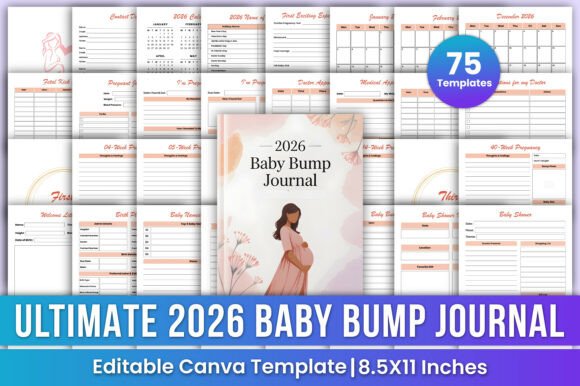
What distinguishes the 2026 Baby Bump Journal Pregnancy Book is its alignment with how pregnancy actually unfolds—not in rigid monthly blocks, but in evolving phases. The journal organizes content by trimester, then drills down into weekly pages that include space for symptom notes, mood reflections, and baby size comparisons (e.g., “pea → avocado → cantaloupe”). This granularity supports pattern recognition: a freelance designer noticing fatigue spikes every Tuesday might adjust her workload; an educator tracking fetal movement can correlate kick counts with hydration or activity levels. The inclusion of blood pressure logs and appointment summaries also provides continuity between visits—especially useful for those managing gestational hypertension or scheduling telehealth consults across time zones.
Beyond clinical logging, the journal embeds practical planning tools: baby shower timelines with guest list and gift tracking, registry coordination pages, and birth plan templates that prompt reflection on pain management preferences, support roles, and postpartum needs. These aren’t afterthoughts—they’re integrated into the same visual language and editable format, reducing cognitive load when switching between emotional journaling and logistical prep.
Editable Design Without Compromising Quality
The Canva-editable format is central to the 2026 Baby Bump Journal Pregnancy Journey Memory Book’s practical appeal. Each page—whether a bump photo collage layout or a fetal kick counter—is built as a layered Canva template. Users can modify fonts, colors, and text without breaking alignment or resolution. That means a brand-focused entrepreneur can match journal aesthetics to her Instagram feed; a bilingual parent can translate prompts into Spanish or Tagalog; a graphic designer can swap icons or reposition sections to suit left-handed writing habits.
Still, flexibility doesn’t mean inconsistency. The high-resolution PDF output maintains typography hierarchy and spacing integrity—even after edits. Tested across multiple Canva plans (free and Pro), all core elements—including calendar grids and checkbox-based trackers—render cleanly when exported. No pixelation, no misaligned tables. For professionals accustomed to delivering polished client-facing assets, that reliability matters: it means the journal functions equally well as a personal record or a shareable keepsake for grandparents or doulas.
Who Benefits—and When It Fits Best
The 2026 Baby Bump Journal Pregnancy Book serves three overlapping user groups particularly well:
- Self-directed planners—those who prefer tactile documentation over app notifications. A small business owner juggling vendor contracts and prenatal classes may find weekly journaling a grounding ritual, not another task.
- Visually oriented creators—designers, photographers, educators—who want to integrate pregnancy documentation into existing workflows. Editing directly in Canva avoids export-import friction common with PDF forms.
- Parents building legacy materials—including adoptive or surrogacy journeys where timelines differ from typical conception-to-birth arcs. The journal’s modular structure allows skipping or reordering sections (e.g., moving “First Ultrasound” before week 4) without disrupting flow.
It’s less suited for users seeking AI-powered insights, real-time health analytics, or integration with wearables. There’s no sync with Apple Health or glucose monitors—and that’s intentional. Its strength lies in human-centered reflection, not algorithmic interpretation.
Practical Considerations for Long-Term Use
Print quality holds up: the provided PDFs are CMYK-optimized and tested on standard home printers and local print shops (including Staples and FedEx Office). Bleed and margin settings prevent critical content from being cropped during binding. For those opting for hardcover printing, the 8.5" × 11" trim size balances portability and writing space—unlike compact 6" × 8" journals that crowd handwriting.
One realistic limitation: the medical log section assumes baseline health literacy. Terms like “fundal height” or “GTD” appear without definitions. That’s appropriate for users already familiar with prenatal terminology—but first-time parents may need to cross-reference with provider handouts or trusted sites like March of Dimes. Similarly, while the birth plan template covers key decision points, it doesn’t include state-specific legal notes for birth center transfers or VBAC eligibility—details best confirmed with a care team.
Still, the journal’s design anticipates iteration. The “Letters to Your Baby” section, for example, includes dated prompts spaced across trimesters—not just one generic note at the end. That scaffolding encourages sustained engagement, which data shows increases retention of meaningful details (e.g., scent memories from early pregnancy or voice memo timestamps of first kicks).
Integration Into Broader Systems
For marketers or content creators, the 2026 Baby Bump Journal Pregnancy Journey Memory Book doubles as a research asset. Tracking personal responses to product recommendations (e.g., “tried Brand X nausea band—wore 4 hrs, mild relief”) builds authentic case studies. Educators developing prenatal curricula have used its symptom tracker layout as a template for student-facing handouts—customizing severity scales or adding discussion prompts.
Its 2026 calendar integration—complete with U.S. federal holidays and observances like Maternal Mental Health Awareness Week—also supports strategic timing. A blogger launching a “30 Days of Pregnancy Reflections” series can align posts with journal prompts and cultural moments, increasing relevance without forced tie-ins.
In practice, the 2026 Baby Bump Journal Pregnancy Book earns its place not through novelty, but consistency. It avoids overpromising cure-alls or miracle solutions. Instead, it delivers what experienced parents, clinicians, and designers repeatedly cite as essential: clarity of purpose, fidelity of execution, and room to grow into the document—not the other way around. For anyone preparing for parenthood while maintaining professional commitments, creative projects, or caregiving responsibilities, it offers structure without rigidity—and memory-making that evolves alongside the journey itself.