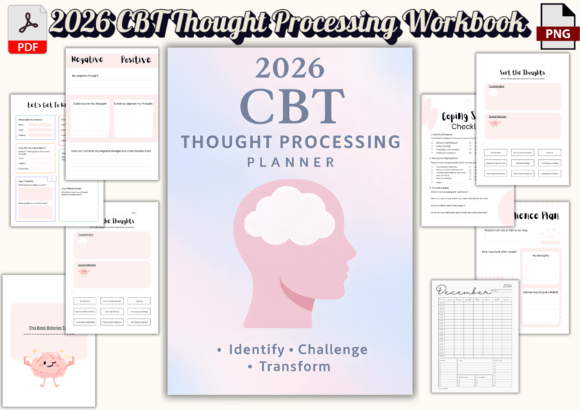
2026 CBT Thought Processing Planner
What if your planner didn’t just track deadlines—but helped you track the quiet shifts in your thinking? The 2026 CBT Thought Processing Planner is built for that exact purpose: not time management, but thought management. It’s a 50-page, pastel-toned companion grounded in Cognitive Behavioural Therapy—designed not as clinical homework, but as gentle, daily mental hygiene. You’ll find space to name what’s stirring beneath the surface: that familiar knot of worry before a meeting, the automatic self-criticism after sending an email, or the fog of emotional overwhelm that makes even small decisions feel heavy.
This isn’t about fixing yourself. It’s about noticing—with kindness—how thoughts, feelings, and situations connect. Each page invites reflection without pressure: a mood map to spot patterns across weeks, a trigger tracker to see what consistently pulls you off-center, and reframing prompts that guide you toward more balanced interpretations—not positivity for its own sake, but accuracy and flexibility in how you read reality.
Why this matters—differently—for different people
A student juggling exams and part-time work might open the planner each morning to pause before scrolling through anxious “what ifs” about grades—and instead use the Daily Thought Reframe page to gently question, “Is this thought based on evidence—or habit?” For them, the value lies in immediacy and simplicity: no therapy session required, just five minutes before class to ground themselves.
A freelance graphic designer facing creative burnout may turn to the Trigger Pattern Identification spread midweek—not to diagnose, but to recognize how back-to-back client revisions often spark a cascade of thoughts like “I’m never good enough” or “They’ll stop hiring me.” With that awareness, they adjust their boundaries or schedule buffer time—not as a reaction, but as informed self-care. Here, the planner serves as both mirror and compass.
For educators or wellness coaches, the 2026 CBT Thought Processing Planner works double duty: as a personal tool *and* a low-barrier resource to share with students or clients. Its clean layout and Canva-editable PDF mean it can be adapted for classroom handouts, coaching worksheets, or group journaling prompts—no licensing hurdles, no complex setup. The soft lavender and sky blue aesthetic isn’t just pretty; it signals psychological safety, especially for those new to CBT concepts.
What people actually prioritize—and why
Beginners care most about clarity over complexity. They need terms like “cognitive distortion” explained in context—not defined in a glossary, but modeled in action. The planner delivers that through intuitive prompts: instead of asking “Identify your cognitive distortions,” it asks, “What’s the story you’re telling yourself right now? Is there another way to see this situation?” That subtle shift lowers the entry barrier.
Experienced users—those already familiar with thought records or behavioral experiments—value depth and flexibility. They appreciate that the Healthy Belief Rewiring section doesn’t stop at one-time reframes, but guides iterative revision: “What would I tell a friend who believed this? How has this belief served me—and where has it held me back?” That layered approach supports long-term neural rewiring, not just symptom relief.
Creators and small business owners often weigh practicality against purpose. They notice the 6x9-inch size fits neatly in a tote or laptop bag—and that the PDF + PNG formats let them insert pages directly into digital workflows (Notion, Obsidian, or printed inserts). The included Canva link isn’t just a bonus; it’s permission to adapt tone, language, or branding—say, adding a therapist’s logo or translating prompts for neurodivergent learners.
Consumers focused on sustainability appreciate that this is intentionally lean: 50 thoughtfully curated pages, not 200 filler spreads. There’s no pressure to “keep up” or “catch up.” Miss a day? The weekly template still holds space for reflection—not judgment. That design choice honors real life, where consistency isn’t linear, and healing isn’t performative.
Real moments, not hypotheticals
- A marketing manager uses the Mood Mapping Worksheet every Sunday evening—not to “fix” stress, but to see if her afternoon energy dips correlate with back-to-back Zoom calls. Over three weeks, she notices a pattern—and negotiates shorter blocks or camera-off time. The planner helped her gather data, not just vent.
- A hobbyist potter recovering from grief keeps the planner beside her wheel. She doesn’t fill every prompt. Some days, she just circles one emotion on the mood tracker and writes one sentence: “Felt tender today. Made a lopsided mug. It’s okay.” That’s enough. The format holds space for slowness.
- An educator prints the Growth Resilience Reflection page for her high school advisory group. Students respond anonymously to, “When did you try something hard—and what helped you keep going?” The responses become a living archive of collective courage, not graded assignments.
The 2026 CBT Thought Processing Planner doesn’t assume you’re in crisis—or that you need to be. It meets you where your attention already lives: in the quiet moments between tasks, in the margins of your calendar, in the breath before you reply to a message. It’s useful whether you’re navigating anxiety, adjusting to life changes, building emotional literacy for the first time, or simply choosing presence over autopilot in 2026.
If you’ve ever paused mid-thought and wondered, “Is this really true—or just familiar?”—this planner gives you a place to sit with that question. Not to rush to an answer, but to honor the act of asking.