2026 Journal for the Law of Attraction
If you’ve ever tried to manifest with intention—but ended up overwhelmed by vague affirmations or scattered notes—you’ll appreciate how the 2026 Journal for the Law of Attraction bridges insight and action. It’s not a mystical artifact or passive diary. It’s a working tool: structured, psychologically grounded, and built for real-world consistency. Designed for creators, entrepreneurs, educators, and anyone building something meaningful, this journal meets you where you are—whether you’re launching a side project, resetting after burnout, or refining your personal brand.
A Framework, Not Just Feel-Good Pages
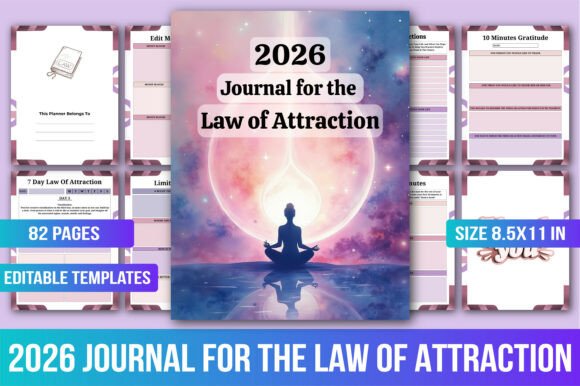
What sets the 2026 Journal for the Law of Attraction apart is its intentional scaffolding. The 7-day Law of Attraction program isn’t a one-off ritual—it’s a repeatable system. Day 1 guides you to choose an intention rooted in identity (“I am the kind of person who launches ideas confidently”) rather than outcome (“I want 10K followers”). Day 3 includes visualization prompts that ask you to engage *sensory detail*—not just “see success,” but notice the weight of your laptop, the tone of a client’s voice, the quiet pride in your chest after sending a pitch. That specificity trains neural pathways. It’s not magic; it’s neuroplasticity in practice.
The Abundance Mindset Worksheets go beyond listing goals. They ask: What version of yourself shows up when abundance is already present? A freelance designer might write, “I say no without guilt. I charge based on value, not urgency.” A teacher might note, “I trust my intuition during parent conferences—and follow up with calm clarity.” These aren’t affirmations to recite. They’re behavioral anchors. When you return to them mid-year, they become calibration points—not for perfection, but for alignment.
Creative Applications Across Roles
Different users don’t need to “use the journal differently”—they simply lean into the sections that serve their current work. Here’s how:
- Bloggers & Content Creators: Use the List of Attractions page to track not just desires (“more subscribers”), but *creative signals*—a comment that sparked energy, a topic that kept you writing past your timer, a draft that felt unusually fluid. Review these monthly to spot organic themes and refine your editorial focus.
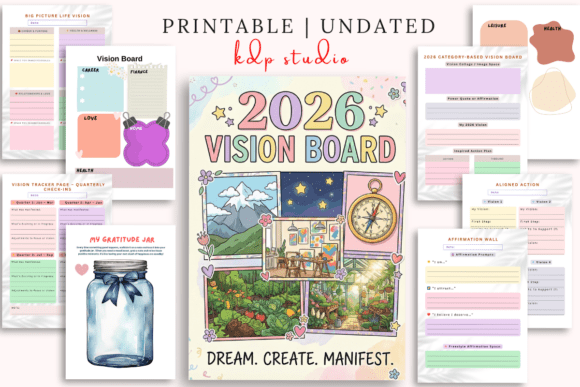
- Small Business Owners: Adapt the Vision Board Pages for tangible strategy. One board could map ideal client traits (not “rich people,” but “founders who prioritize team wellness and respond within 48 hours”). Another tracks operational wins—onboarding time reduced, recurring revenue growth, feedback that validates your pricing model.
- Educators & Coaches: Repurpose the Limiting Beliefs Breakthrough Sheets as facilitation tools. In a workshop, guide participants through identifying beliefs like “My expertise isn’t unique enough” — then co-create evidence-based counter-statements using real student outcomes or client testimonials.
- Freelancers & Hobbyists: Treat the Manifestation Reflection Pages like a design critique. Instead of “How did it feel?”, ask: “What part flowed? What friction revealed a skill gap? Where did I compromise—and was it strategic or fear-driven?” This turns reflection into iterative improvement.
Keeping It Real: Consistency Without Rigidity
Consistency doesn’t mean daily pages filled at 5 a.m. It means showing up *in ways that sustain you*. The 2026 Journal for the Law of Attraction supports flexibility: the monthly calendar has clean white space—not rigid hourly slots—so you can block “deep work,” “client calls,” or “vibration reset” (a 15-minute walk with no screen). Gratitude prompts include options like “One thing my body helped me do today” or “A small decision I made with integrity”—making them accessible even on high-stress days.
For teams or collaborators, the journal works as a shared reference—not by sharing entries, but by aligning on language. If your small studio uses “acting as if” from Day 4 of the 7-day program, you might adopt that phrase in stand-ups: “How would we act *as if* this launch were already resonating?” It creates subtle, values-based cohesion without forced positivity.
Design Choices That Support Clarity
The physical and digital design matters. The full-year calendar avoids clutter—no holidays pre-filled, no distracting graphics—so you own your time. Vision board pages use light gray guidelines, not rigid templates, giving room for collage, sketching, or typed lists. Even the paper stock (if printed) is chosen for pen compatibility—no bleed-through when you’re jotting fast ideas mid-thought.
This attention to usability reflects a deeper principle: manifestation isn’t about escaping reality. It’s about engaging with it more precisely. When the money-mindset worksheets ask you to list *specific* financial fears (“I’ll run out before the next invoice clears”), then trace their origin (“That panic started after my first late payment in 2022”), you’re not just “releasing blocks.” You’re mapping your relationship with resources—a prerequisite for sustainable growth.
Who Benefits Most—and Why
This journal resonates strongest with people who value structure *and* autonomy—who want guidance without dogma. It’s useful for those stepping away from hustle culture but still committed to growth. A marketer shifting from agency work to consulting might use the “Who Do I Want to Be?” worksheet to define boundaries before setting rates. A hobbyist turning pottery into a micro-business could use the gratitude prompts to reinforce confidence after their first local market sale—even if it was just $42.
It’s less effective for those seeking instant results or absolute certainty. There’s no “manifest wealth in 3 days” promise here. Instead, there’s repetition with variation: the same core practices—gratitude, visualization, belief inquiry—applied across changing contexts. That builds resilience, not dependency.
Getting Started Without Overwhelm
Start with one section—not the whole journal. Pick the 7-day program and commit to Days 1–3. Skip ahead to the Limiting Beliefs sheet only if a specific thought keeps looping (“I’m not ready to share this idea”). Use the vision boards for *one* priority area—not five—then revisit in 90 days. Let the journal support your rhythm, not override it.
The 2026 Journal for the Law of Attraction works because it treats manifestation as a practice—not a performance. It assumes you’re already capable. Your job isn’t to become someone new. It’s to remove the static between who you are and what you’re building. And sometimes, the clearest path forward begins with a single, well-placed line on a clean page.