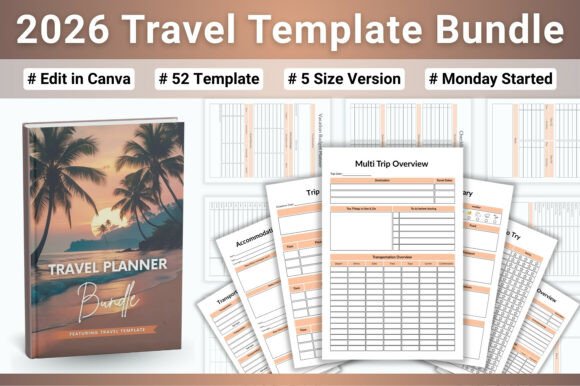
✈️ 2026 Travel Template Bundle: Your Quiet Co-Pilot for Every Journey Ahead
Let’s be real — planning travel isn’t just about picking a destination. It’s juggling flight times while your toddler naps, comparing hotel cancellation policies at midnight, realizing you forgot to budget for airport transfers, and trying to remember whether your passport expires before your Bali trip in October. The ✈️ 2026 Travel Template Bundle was built for *that* version of you — the one who wants adventure without administrative whiplash.
What It Actually Is (Beyond the Buzzwords)
This isn’t a glossy digital app that asks for your credit card before showing you a single calendar grid. The ✈️ 2026 Travel Template Bundle is a thoughtfully structured, 52-page printable PDF system — designed once, used endlessly. It’s like handing your chaotic travel brain a well-organized notebook with tabs already labeled: “Where am I going?”, “How much will it cost?”, “What do I pack?”, and “What did I love (or never do again)?”
You get full flexibility: print it on US Letter, A4, A5, or compact 6x9 half-US-letter paper — so whether you’re tucking it into a leather journal, sliding it into a clipboard for a family road trip, or using it digitally in GoodNotes on your iPad, it adapts to *your* rhythm — not the other way around.
When This Bundle Steps In (and Why It Feels Like Relief)
Families planning summer + holiday trips: Imagine two parents coordinating three separate vacations — a beach week in June, a mountain cabin in August, and a cross-country visit to grandparents in December. Instead of sticky notes scattered across the fridge and conflicting Google Sheets, the bundle gives each trip its own dedicated section: departure/return dates, kid-specific packing lists (yes, there’s space for “favorite stuffed animal” and “sippy cup count”), daily activity blocks, and even a “mood tracker” page to jot down what made the kids light up — or melt down — on Day 3 of the road trip.
Digital nomads managing overlapping stays: You’re renting an apartment in Lisbon for three months, then hopping to Medellín, then meeting friends in Chiang Mai. Keeping track of visa requirements, local SIM card purchases, co-working space bookings, and monthly rent payments gets messy fast. The ✈️ 2026 Travel Template Bundle includes multi-trip itinerary spreads, accommodation logs with check-in/out notes, and budget pages that let you split expenses by category (housing, food, transport, “unexpected espresso therapy”) — all in one place, no syncing required.
Retirees booking their first solo European tour: Maybe you’ve traveled for decades — but always with a spouse or group. Now you’re flying solo through Portugal and Spain, and want structure *without* rigidity. The daily itinerary pages offer gentle scaffolding: time blocks for meals, sightseeing, rest, and reflection — plus blank journaling space to record street names, café owners’ names, or how the light looked over the Douro River at dusk. It’s organization that breathes.
Small business owners combining work + wander: That conference in Berlin? The client visit in Tokyo? The “working remotely from a beach town” experiment in Tulum? The bundle helps separate professional logistics (meeting notes, contact follow-ups, Wi-Fi reliability ratings) from personal moments (local bakery recommendations, sunset photos, language phrases learned), so neither gets lost in the shuffle.
Real Considerations — Because Not Every Tool Fits Every Trip
This bundle shines brightest when you value intentionality over automation. If you rely heavily on live flight alerts, real-time weather overlays, or AI-powered restaurant suggestions, this won’t replace those tools — and it’s not meant to. It complements them. Think of it as the quiet anchor: while your phone buzzes with updates, your printed itinerary holds your priorities steady.
It’s also most powerful when you’re willing to spend 10–15 minutes *before* departure filling in key details — not as busywork, but as mental rehearsal. Writing down your train platform number, sketching your hostel’s location relative to the metro stop, or estimating your daily coffee budget builds familiarity *before* you arrive. That small investment pays off in reduced decision fatigue mid-journey.
And yes — it’s printable, but it’s also deeply digital-friendly. Many users print only the pages they need (e.g., just the packing list and budget sheet for a weekend trip), while keeping the full 2026 calendar and journal sections on tablet. The clean, minimal design means it works beautifully in GoodNotes, Notability, or even as a PDF annotation layer over your existing apps.
Who Might Pause Before Grabbing It (and What to Do Instead)
If you book *one* vacation every 18–24 months — and it’s always the same all-inclusive resort — this level of structure may feel like over-engineering. A simple Notes app checklist might serve you better.
If you thrive on total spontaneity — no plans, no reservations, just showing up and seeing what unfolds — then rigid daily time blocks won’t resonate. (Though even free spirits often appreciate the packing list and budget tracker — because running out of clean socks or cash is rarely part of the magic.)
And if accessibility is a priority — for example, needing screen-reader compatibility or high-contrast dynamic text — know that this is a static PDF. It’s optimized for clarity and print, not assistive tech navigation.
Why “2026” Isn’t Just a Date — It’s a Mindset
Choosing a planner labeled “2026” does more than mark time — it signals commitment. It says, *I’m claiming space for adventure next year.* Not “someday.” Not “when things settle.” But *2026*. That specificity invites intention: What kind of traveler do I want to be then? More present? Better prepared? Lighter in luggage and spirit?
The ✈️ 2026 Travel Template Bundle doesn’t promise perfect trips. It promises fewer forgotten chargers, less last-minute panic over currency exchange rates, and more room — on the page and in your mind — for joy, discovery, and the quiet satisfaction of knowing exactly where your boarding pass is.
Small Details That Add Up
- Budget pages break down costs by trip *and* category — so you can see at a glance whether dining or transportation ate up more of your Lisbon budget.
- Packing lists are grouped by type (toiletries, electronics, documents) *and* by person — helpful when packing for teens who roll their eyes at “sunscreen reminders” but still need them.
- Accommodation logs include space for Wi-Fi speed ratings, noise levels, and whether the shower actually worked — practical intel future-you will thank past-you for.
- Travel journal prompts avoid clichés (“What was your favorite moment?”) in favor of grounded reflections: “What surprised me about how people greeted each other here?” or “When did I feel completely un-rushed?”