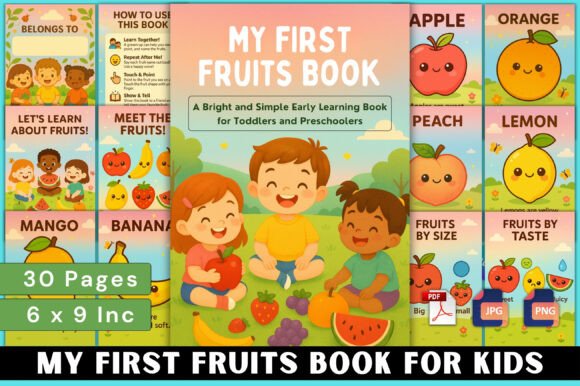
My First Fruits Book for Kids: A Thoughtful Tool for Early Cognitive and Linguistic Development
Early childhood is a period of extraordinary neural plasticity—when the brain forms foundational connections at an unparalleled pace. During ages 2 to 6, children rapidly absorb vocabulary, categorize sensory input, and begin constructing mental models of the natural world. In this context, My First Fruits Book for Kids functions not merely as a picture book, but as a developmentally calibrated learning scaffold—one that aligns with evidence-based principles in early literacy, multisensory cognition, and embodied learning.
Fruit Recognition as a Gateway to Conceptual Organization
Recognizing fruits may seem like a simple milestone, yet it serves as a critical entry point into broader cognitive frameworks. Each fruit in My First Fruits Book for Kids—from the familiar apple to the visually striking dragon fruit—is presented with intentionality: a clear illustration, a grammatically complete sentence (“The mango is sweet and juicy”), and a concrete, observable fact (“Monkeys love to eat mangoes!”). This triad supports three distinct processing modes: visual discrimination, syntactic modeling, and real-world association.
Children don’t learn categories in isolation; they build hierarchies. The book’s implicit taxonomy—grouping fruits by taste (sweet, sour, juicy) or size (big, small)—mirrors how young minds naturally cluster information. A toddler who notices that both lemon and orange are round, yellow-oranges, and make faces pucker begins forming proto-scientific reasoning. That observation isn’t just about citrus—it’s the seed of comparative analysis, a precursor to classification skills later applied in biology, math, or even data literacy.
Multisensory Engagement Without Screens
In an era where digital interaction dominates early attention economies, My First Fruits Book for Kids offers a deliberate, screen-free alternative grounded in tactile and kinesthetic learning. Its design invites physical interaction: pointing to seeds in a pomegranate, tracing the ridges of a pineapple, or pressing a finger on the fuzzy skin of a peach—all supported by the book’s “Touch Point” guidance in the parent/teacher section.
Research from the University of Iowa (2022) found that toddlers who engaged with high-contrast, textured physical books demonstrated stronger retention of object names and attributes than peers using identical content on tablets—even when tablet interactions included sound and animation. Why? Because manual exploration activates somatosensory cortex regions that reinforce memory encoding. The book’s thick pages, uncluttered layouts, and generous white space reduce visual load, allowing working memory to focus on meaning—not decoding distractions.
How Fruit Categories Build Transferable Thinking Skills
- Sweet vs. Sour: Introduces affective language and subjective experience—laying groundwork for emotional vocabulary and perspective-taking (“This tastes sour to me, but my friend says it’s tangy”).
- Juicy vs. Dry: Encourages descriptive precision and sensory comparison—skills essential for scientific observation and technical writing later on.
- Big vs. Small: Supports early measurement concepts, spatial reasoning, and ordinal thinking—foundations for numeracy and engineering intuition.
These categories aren’t arbitrary labels. They’re conceptual anchors. When a preschooler sorts real fruit at snack time—placing blueberries beside grapes because “they’re both tiny and purple”—they’re practicing pattern recognition, a core competency in fields ranging from machine learning to music theory.
Beyond Naming: Vocabulary Expansion Through Contextual Framing
Many early-learning resources stop at labeling: “Apple. Banana. Orange.” But My First Fruits Book for Kids embeds each term within syntactically rich, varied sentences. Consider these examples drawn from the book’s structure:
- “The coconut grows high up in palm trees.” (introduces prepositions, habitat, and passive voice)
- “We cut the watermelon into big red slices.” (models action verbs, adjectives, and part-whole relationships)
- “Papaya has black seeds inside.” (builds anatomical awareness and interior/exterior schema)
This approach mirrors findings from Hart & Risley’s landmark study: children exposed to rich, decontextualized language—language that goes beyond the immediate environment—develop significantly larger expressive vocabularies by age five. The book’s sentences avoid oversimplification without sacrificing clarity—a balance rarely achieved in toddler materials.
Designed for Diverse Learning Environments—and Educators
What makes My First Fruits Book for Kids adaptable across settings—from Montessori classrooms to homeschool co-ops to speech therapy sessions—is its built-in flexibility. The “How to Use This Book” guide doesn’t prescribe rigid lesson plans. Instead, it offers five evidence-informed strategies:
- Learn Together: Encourages joint attention and shared focus—key for language acquisition and social-emotional development.
- Repeat After Me: Supports phonological awareness and articulation practice, especially valuable for bilingual learners or children with speech delays.
- Touch Point: Turns passive viewing into active exploration—ideal for kinesthetic learners and those developing fine motor control.
- Show & Tell: Invites children to connect illustrations to lived experience (“Have you ever tasted a kiwi?”), strengthening episodic memory.
- Keep Learning: Suggests extensions—like comparing real fruit textures or drawing missing parts—which deepen inquiry and sustain engagement beyond the page.
Educators report using the “Notes” and “Drawing” pages not just for creativity, but as informal assessment tools. A child sketching a strawberry with exaggerated seeds may reveal emerging understanding of internal structure; scribbles beside “lemon” paired with a frown gesture offer insight into affective associations with sourness.
Real-World Integration: From Page to Pantry
The book’s 20 featured fruits—including guava, plum, and pomegranate—were selected not for novelty alone, but for cultural and nutritional relevance across diverse communities. Unlike many early-learning titles that default to Western-centric produce, this collection reflects global foodways: mango in South Asia, dragon fruit in Southeast Asia, papaya in Latin America, guava across tropical regions.
This breadth matters. When a child sees a fruit their family cooks with—whether coconut milk in Thai curry or pomegranate seeds in Persian rice—they experience validation of home knowledge. That connection strengthens motivation to engage, supports identity development, and signals to families that their linguistic and culinary practices are pedagogically valuable.
Practitioners in early intervention programs have observed that pairing the book with real fruit tasting sessions increases willingness to try new foods—a well-documented challenge in early nutrition. One preschool in Miami reported a 40% rise in voluntary fruit sampling after introducing weekly “Fruit Explorer Days” anchored by the book’s pages on mango, guava, and passionfruit.
Structural Features That Support Long-Term Use
The “This Book Belongs To” page does more than personalize ownership—it fosters early literacy identity. Children who see their name on a book are more likely to treat it as a meaningful artifact, not disposable media. Similarly, the “Thank You” page subtly introduces gratitude as a social script, while the blank “Drawing” page reinforces that ideas can be externalized and preserved—a foundational concept for future writing, coding, and design thinking.
Even the physical construction serves pedagogical aims. Thick, wipe-clean pages withstand repeated handling by small hands. The square format (common in Montessori-aligned materials) provides stability during floor-based exploration, and the absence of glossy finishes reduces glare—critical for children with visual processing sensitivities or those learning in varied lighting conditions.
Why Simplicity Isn’t Simplification
It’s easy to mistake minimalism for minimal effort. But every element in My First Fruits Book for Kids reflects layered decision-making: the choice to use bold, unembellished outlines instead of photorealistic images reduces cognitive load while preserving salient features; the consistent sentence structure builds predictability without monotony; the inclusion of less common fruits like rambutan (in expanded editions) or sapodilla (in regional adaptations) signals respect for developmental readiness—not just familiarity.
This is not a book that “dumbs down” content. It distills it—honoring the complexity of early learning by meeting children where they are, then extending just far enough to spark curiosity, not confusion.
Conclusion: A Resource That Grows With the Child
A child aged two may point and name “banana.” At three, they might compare its shape to a crescent moon. By five, they could sequence the growth stages of an orange tree or hypothesize why lemons float while limes sink. My First Fruits Book for Kids accommodates—and invites—that progression. Its enduring value lies not in static content, but in its capacity to serve as a flexible reference point across developmental stages: a vocabulary primer, a science prompt, a cultural bridge, a fine-motor tool, and a quiet invitation to wonder at the diversity of life—all held within one bright, sturdy, thoughtfully designed cover.