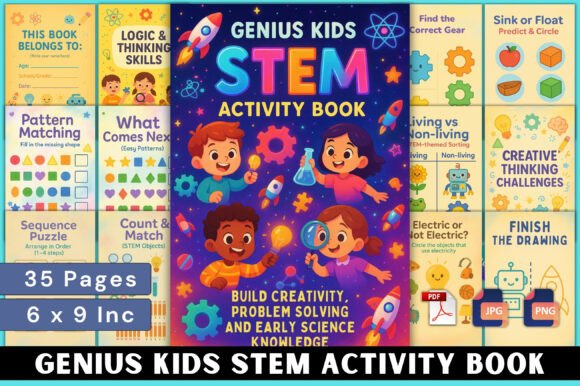
Genius Kids STEM Activity Book for Kids
If you’ve ever watched a child pause mid-scribble to ask, “Why does the balloon stick to the wall?” or spend 20 minutes rearranging toy gears just to see what happens when one turns — you know real learning isn’t always loud, scheduled, or screen-based. The Genius Kids STEM Activity Book for Kids meets kids where they already are: curious, hands-on, and full of quiet “what if” moments. It’s not another flashcard deck or timed worksheet. It’s a thoughtfully paced, illustration-rich workbook built for how young minds actually explore — through drawing, matching, predicting, building (on paper), and questioning.
Where This Book Fits Into Real Life — Not Just Lesson Plans
Think about your Tuesday afternoon. Maybe you’re a kindergarten teacher wrapping up circle time and need five minutes of calm, focused transition work that still reinforces sequencing and observation. Or you’re a parent juggling Zoom calls while your 6-year-old needs something self-directed but not screen-based. Or you run a small after-school program and want low-prep, high-engagement activities that spark conversation instead of silence. That’s where the Genius Kids STEM Activity Book for Kids works hardest — not as a standalone curriculum, but as a flexible, portable tool.
In a Montessori-inspired homeschool setup, it complements nature walks with “living vs. non-living” sorting pages — kids glue leaves or draw animals right alongside the prompts. In a public school resource room, therapists use the pattern-matching and odd-one-out puzzles to gently strengthen working memory without labeling it “therapy.” At a community library’s summer STEM fair, facilitators tear out the “invent-a-machine” pages and turn them into collaborative whiteboard challenges — no prep, no printing, just instant engagement.
What Actually Happens When Kids Use It (and Why Adults Notice)
It starts small: a 4-year-old tracing gear teeth in the dot-to-dot engineering section, then pointing to the bicycle outside and saying, “That wheel goes *click-click* like this!” A 7-year-old finishes the “sinking or floating” page, then drags a bowl of water and random kitchen items to the table — testing predictions she made on paper. That’s the quiet transfer the book supports: concepts become questions, then experiments, then confidence.
The logic puzzles aren’t abstract — they’re embedded in familiar contexts. Sequencing isn’t numbers; it’s “what happens next when a seed becomes a flower?” Shape recognition isn’t isolated polygons; it’s spotting triangles in rooflines, circles in clocks, rectangles in tablets. Even the “finish-the-drawing” prompts double as early systems-thinking exercises — “Draw what helps this robot move” invites discussion about energy, wheels, or even wind power.
Who Benefits — And How Their Needs Line Up With What’s Inside
- Educators: Use the 30-page structure to scaffold weekly themes — e.g., pair “simple machines” pages with a cardboard ramp experiment, or “weather types” with daily sky journaling. No lesson planning required; the visuals and prompts do the heavy lifting.
- Homeschoolers: Appreciate how cleanly it bridges play and pedagogy. One page might support fine motor development (tracing gears), math reasoning (counting gear teeth), and vocabulary (“axle,” “rotate”) — all without feeling like “school.”
- Therapists & Early Intervention Specialists: Leverage the consistent layout and visual cues to support attention regulation and executive function. The predictable format reduces cognitive load, letting kids focus on the thinking — not decoding instructions.
- Small Business Owners (e.g., toy shops, learning centers): Stock it as a trusted “add-on” — parents grabbing a puzzle set often reach for this too. Its bright cover stands out on shelves, and its age range (4–8) means it sells across multiple developmental stages.
- Creatives & Content Makers: Pull inspiration from its prompt style — “Invent a machine that helps birds build nests” is the kind of open-ended, empathetic challenge that sparks authentic kid-led storytelling, art projects, or even simple coding analogies.
Things to Keep in Mind Before You Choose or Use It
This isn’t a replacement for hands-on tinkering — it’s a companion to it. If your goal is deep robotics immersion, you’ll still want physical kits. But if you want to build foundational mental models *before* the hardware, this book delivers. Also, while illustrations are vibrant, it’s intentionally low-tech: no QR codes, no app tie-ins. That’s by design — it keeps the focus on the child’s own thinking, not external validation.
Consider your child’s or students’ stamina. Some 4-year-olds breeze through shape-recognition pages but need adult support on sequencing. Some 8-year-olds fly through logic puzzles but linger on the creative drawing prompts — and that’s okay. The book doesn’t force linear progression. You can start anywhere: the weather section before a storm hits, the plant growth page alongside planting seeds, the robot-building activity the day after watching a Mars rover video.
Why “Joyful” Isn’t Just Marketing Fluff Here
Look at the “basic electricity” spread: no equations, no jargon. Just two hands holding wires, a lightbulb lighting up, and a prompt: “Draw a path for the energy to travel.” That’s science made tactile — not intimidating. Or the “tool matching” page: a wrench, a hammer, a magnifying glass — each paired with a real-world action (“tighten,” “build,” “look closer”). It connects vocabulary to purpose, not memorization.
That’s the subtle strength of the Genius Kids STEM Activity Book for Kids. It doesn’t try to make kids “future engineers” overnight. It makes them feel capable *today* — capable of noticing patterns, asking better questions, sketching solutions, and trusting their own reasoning. And for adults? That means fewer “I’m bored” declarations, more “Can I show you what I figured out?”, and hours where learning feels less like a task — and more like play with purpose.