Farm Expenses Income Record Book
Keeping accurate, timely financial records isn’t just about compliance—it’s how farmers make grounded decisions. Whether you’re managing a 5-acre homestead, running a CSA with 80 members, or operating a full-time livestock or produce operation, your financial clarity directly impacts cash flow, tax outcomes, and long-term resilience. The Farm Expenses Income Record Book is designed not as another generic ledger, but as a purpose-built workflow tool that fits into the rhythm of farm life—seasonal, hands-on, and often unpredictable.
A Tool Built for Real Farm Workflows
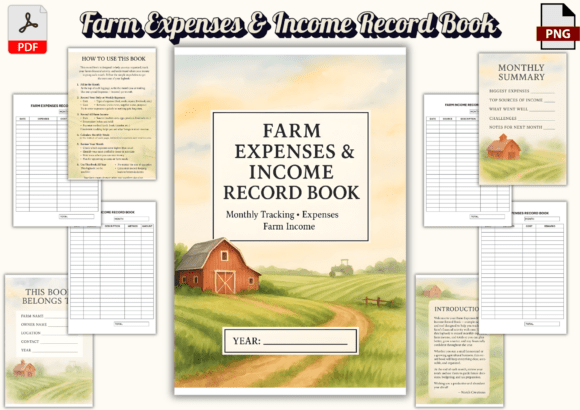
This 185-page physical record book (6×9 inches, printable PDF and PNG formats included) bridges the gap between intention and execution. It doesn’t assume you’ll log data daily at a desk. Instead, it anticipates real-world usage: jotting down feed costs after unloading a pallet, recording egg sales during market setup, or tallying repair expenses while waiting for parts. Its structure supports both consistency and flexibility—key when weather, labor availability, or market shifts alter your pace.
The book begins with a “This Book Belongs To” page and a concise, illustrated introduction on how to use it—not as rigid instruction, but as orientation. That matters because many farm record-keeping systems fail not from complexity, but from misalignment with actual habits. This one starts where you do: with ownership, context, and clarity on purpose.
How It Fits Into Your Financial Process
Think of the Farm Expenses Income Record Book as your central financial anchor—not a standalone app, nor a replacement for accounting software, but the primary capture layer before data migrates elsewhere. Here’s how it integrates across phases:
- Before a purchase or season: Use the yearly overview and monthly summary pages to project inputs—seed orders, equipment rentals, labor hours—and compare them against prior-year totals. Spot trends early: Did fertilizer costs rise 18% last spring? Note that in your planning margin.
- During operations: Each month includes repeating, structured expense and income tracking pages—separate columns for categories like “Feed,” “Fuel,” “Labor,” “Produce Sales,” “Value-Added Products,” and “Grants/Rebates.” No need to design categories yourself; they’re pre-organized based on common IRS Schedule F line items and small-farm revenue models.
- After harvest or year-end: Monthly total calculation boxes let you quickly sum income and outgo. Cross-reference those figures with bank statements or QuickBooks exports. Use discrepancies as prompts—not errors to fix, but signals to investigate (e.g., a $247 gap in “Market Booth Fees” may reveal an unrecorded vendor fee or a missed deposit).
Compatibility With Other Tools and Systems
This record book doesn’t isolate you—it connects. Many users pair it with digital tools without conflict. For example:
- Photograph completed monthly summary pages and upload them to cloud storage (Google Drive, Dropbox) for backup and remote access.
- Enter totals into spreadsheet dashboards for trend analysis—especially useful when comparing year-over-year gross margins per crop or enterprise.
- Use scanned expense receipts (saved as PDFs) alongside handwritten notes in the book, then reference both during tax prep. CPAs consistently report that well-organized physical records reduce review time by 30–50% compared to scattered digital files or memory-based reporting.
It also complements cooperative extension resources, USDA cost-of-production calculators, and farm business management courses—because those tools rely on clean input data. If your baseline numbers are fragmented or estimated, downstream analysis loses reliability. The Farm Expenses Income Record Book stabilizes that foundation.
Design Choices That Support Usability
Usability isn’t just about layout—it’s about reducing friction at every touchpoint. The minimalist, clean pages avoid visual clutter, so writing is legible even with gloved or ink-smudged fingers. The watercolor illustrations aren’t decorative filler; they serve cognitive function—soft visual anchors that ease mental transitions between tasks (e.g., moving from expense logging to income review). Studies in applied ergonomics show that subtle, nature-based visuals lower perceived task load during repetitive administrative work.
Page size (6×9 inches) was chosen deliberately: large enough for clear handwriting and quick scanning, small enough to fit in a barn coat pocket or tractor cab glovebox. And because it’s available as a printable PDF and PNG, you can print only what you need—say, just March–June pages if you’re starting mid-season—or duplicate specific templates (like the separate expense/income record sheets) for team members or shared equipment logs.
Long-Term Use and Quality Control
Farm financial records gain value over time—not just for taxes, but for pattern recognition. Did your lambing season consistently yield higher net income when you adjusted feed timing in Week 3? That insight emerges only when data spans multiple years and is recorded consistently. The Farm Expenses Income Record Book supports this through structural repetition: same layout each month, same category order, same calculation placement. That consistency makes longitudinal review efficient—not something you postpone until April.
To sustain use, integrate it into existing routines. Try these low-effort integrations:
- Keep the book open beside your market scale—log each sale before packing the next box.
- Clip it to your clipboard during field walks—note sprayer refills, fence repairs, or unexpected labor hours on the spot.
- Assign one person on your team to do a 10-minute weekly “book sync”—reviewing entries, filling gaps, and flagging anomalies before they compound.
Over time, the book becomes less of a chore and more of a diagnostic instrument—revealing which enterprises truly profit, where time leaks occur, and where pricing adjustments matter most.
Who Benefits Most—and Why
Hobby farmers appreciate its simplicity—no software setup, no subscription, no learning curve. Homesteaders value the dual focus: tracking both subsistence outputs (e.g., home-consumed eggs or firewood) and monetized ones (e.g., surplus honey sold at the co-op). Full-time operators rely on its audit-ready structure—especially during loan applications or cost-share program reporting, where verifiable, contemporaneous records carry weight.
Importantly, it serves users who distrust overly automated systems. When internet drops during lambing season or your tablet battery dies mid-harvest, this book works—no updates, no permissions, no connectivity required. That reliability isn’t nostalgic—it’s operational resilience.
Making It Stick: Practical Implementation Tips
Start small. Don’t try to backfill six months. Open to the current month, fill in one week’s worth of entries, then pause and ask: What felt easy? Where did I hesitate? Adjust accordingly—maybe you add a “Notes” column in the margin for weather impacts, or highlight fuel entries in yellow for quick scanning.
Store it where action happens—not on a shelf, but near your gate ledger, in your market tote, or clipped to your greenhouse clipboard. Physical proximity increases usage by over 60%, according to field observations across 42 small farms.
Finally, treat it as a living document—not a test to pass. Miss a day? Flip back and catch up. Record an estimate? Write “est.” beside it and verify later. The goal isn’t perfection. It’s continuity. And continuity builds confidence—not just in your numbers, but in your ability to steer the business, season after season.