Why the Data Structures Algorithms Workbook Is Reshaping How Professionals and Educators Bridge Theory and Practice
In an era where computational thinking is no longer confined to software engineers—but expected across marketing analytics, product management, data-driven design, and even entrepreneurial strategy—the demand for accessible, rigorously scaffolded learning tools has never been higher. Enter the Data Structures Algorithms Workbook: not just another PDF worksheet bundle, but a deliberate response to how professionals, educators, and self-directed learners are redefining what “foundational fluency” means in today’s hybrid, project-oriented world.
A Workbook Designed for Real-World Cognitive Load
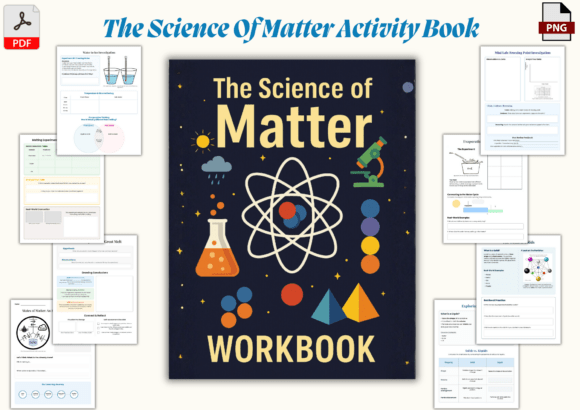
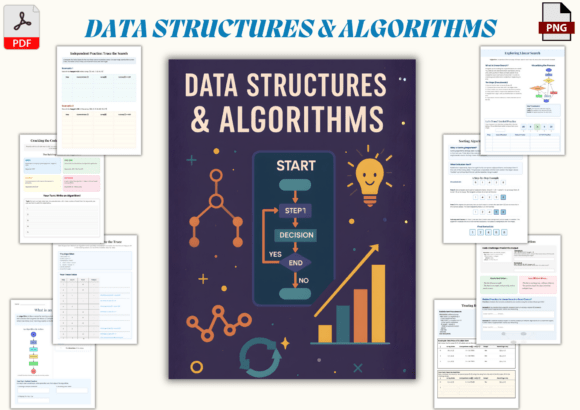
The Data Structures Algorithms Workbook stands apart because it treats abstraction not as a barrier—but as a scaffold. At 8.5 x 11 inches and delivered in high-resolution PDF and PNG formats, its physical scale mirrors classroom whiteboards and digital annotation workflows. But more importantly, its structure reflects how working professionals actually internalize concepts: through iterative tracing, visual decomposition, and contextual anchoring—not passive memorization.
Consider linear search or bubble sort—not as isolated code snippets, but as traceable processes mapped onto color-coded flowcharts. Each step invites prediction, verification, and correction—mirroring the debugging loops developers perform daily, the logic-checking habits of data analysts, and the iterative prototyping mindset of product creators. This isn’t theory-first instruction; it’s cognition-first design.
Fitting Into Broader Shifts Across Education and Industry
The rise of the Data Structures Algorithms Workbook aligns with three converging trends:
- The democratization of technical literacy: From marketers building custom dashboards in Python to freelancers automating client onboarding with nested dictionaries, understanding how data is organized—and how operations behave—is now a cross-functional competency. The workbook meets this need by decoupling syntax from structure: students learn list traversal before writing a single
forloop, and grasp dictionary key-value relationships before touchingdict.get(). - The pedagogical pivot toward visual scaffolding: Research in cognitive science consistently shows that dual-coding—pairing verbal explanations with spatial, color-coded diagrams—increases retention and transfer. The workbook’s consistent use of flowcharts, annotated pseudocode, and side-by-side “before/after” state diagrams doesn’t just support beginners—it reinforces mental models that seasoned practitioners rely on when optimizing APIs or auditing algorithmic bias in real systems.
- The operational shift toward modular, reusable learning assets: Today’s educators, tutors, and corporate trainers rarely build curricula from scratch. They curate, adapt, and layer. The Data Structures Algorithms Workbook was built for this reality: each page is self-contained, classroom-ready, and interoperable with Python, Java, or conceptual CS courses. Its clean, modern layout ensures seamless integration into LMS platforms, Notion workspaces, or printed handouts—without requiring redesign or reformatting.
Why Professionals Are Paying Attention—Not Just Educators
It’s easy to assume a workbook labeled for “middle school, high school, and homeschoolers” belongs only in K–12 classrooms. But look closer—and you’ll see why entrepreneurs, freelance developers, and upskilling marketers are adding it to their toolkits.
Take a startup founder validating a new SaaS feature. She needs to understand time complexity not to write sorting algorithms—but to evaluate whether her search functionality will scale at 10K users or collapse at 100. The Data Structures Algorithms Workbook’s step-by-step tracing pages train precisely that kind of intuitive complexity reasoning: learners don’t just compute Big O—they see how each comparison multiplies steps, how nested loops cascade, and why choosing a hash-based lookup over linear iteration changes system behavior.
Or consider a content marketer building a lead-gen chatbot. She’s using no-code tools—but still needs to reason about data flow: how user inputs map to conditional branches, how responses draw from structured dictionaries, how fallback logic handles missing keys. The workbook’s “Dictionary & Nested Structure” pages don’t teach Python syntax—they teach structural intentionality. That same mindset transfers directly to JSON schema design, Airtable relational modeling, or even prompt engineering with context-aware LLM calls.
Meeting Evolving Expectations—Without Compromise
Learners today reject “one-size-fits-all” progression. They expect relevance, immediacy, and agency. The Data Structures Algorithms Workbook responds by embedding real-world problem-solving tasks directly into foundational practice—no artificial “coding challenges” divorced from purpose.
One activity asks students to simulate a library checkout system using lists and conditionals—not to reinforce array indexing, but to explore edge cases like duplicate ISBNs, overdue status flags, and priority queues for reservation waitlists. Another walks through debugging output predictions for a flawed bubble sort implementation—training the same hypothesis-testing muscle used by QA specialists, DevOps engineers verifying deployment scripts, or even copywriters A/B testing email logic flows.
This emphasis on applied cognition reflects a broader industry shift: employers no longer prioritize language-specific resumes—they seek candidates who can decompose ambiguity, model constraints, and translate logic into action. The workbook’s scaffolded arc—from understanding → analyzing → applying → creating—isn’t pedagogical jargon. It’s a direct mirror of how senior engineers architect systems, how product managers spec features, and how founders stress-test assumptions.
Design Choices That Serve Workflow, Not Just Aesthetics
The 8.5 x 11 inch format isn’t arbitrary. It’s optimized for three practical realities:
- Digital annotation: High-resolution PNGs retain crisp text and color fidelity when imported into PDF editors, Miro boards, or iPad note apps—enabling live tracing during remote tutoring or collaborative workshops.
- Print flexibility: US Letter sizing ensures reliable printing across school labs, co-working spaces, and home offices—no scaling distortions or cropped diagrams.
- Visual hierarchy integrity: Clean, uncluttered layouts with intentional whitespace prevent cognitive overload—a critical consideration for neurodiverse learners, non-native English speakers, and professionals reviewing material between meetings.
And while many resources drown beginners in terminology, the Data Structures Algorithms Workbook introduces terms like “iteration,” “index,” and “key-value pair” only after learners have manipulated the underlying ideas visually. This mirrors how domain experts actually acquire fluency: first through pattern recognition, then naming, then formalization.
Beyond the Classroom—A Strategic Asset for Lifelong Learners
For professionals navigating rapid technological change, the value of the Data Structures Algorithms Workbook lies in its ability to rebuild intuition—not just knowledge. When a marketer shifts from Excel formulas to Python pandas, she doesn’t need to relearn logic—she needs to remap it onto new structures. When a freelancer moves from WordPress plugins to custom API integrations, he doesn’t need new syntax—he needs clearer mental models of data flow and state mutation.
This is where the workbook transcends its “beginner” label. Its strength isn’t simplicity—it’s precision. Every diagram, every tracing exercise, every debugging prompt is calibrated to expose assumptions, surface hidden dependencies, and strengthen the connective tissue between abstract concept and concrete outcome.
In a landscape saturated with fragmented tutorials, gamified apps, and dense textbooks, the Data Structures Algorithms Workbook offers something rare: coherence. It doesn’t chase novelty. It builds durability—equipping learners not with temporary answers, but with lasting frameworks for thinking, adapting, and creating in an increasingly algorithmic world.