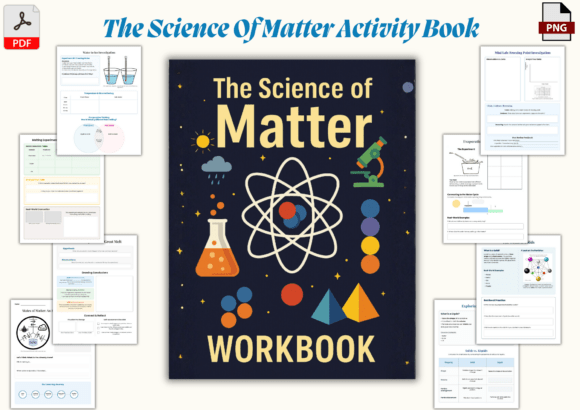
The Science of Matter Workbook: A Practical Evaluation for Educators and Learners
For educators, homeschool parents, and STEM facilitators seeking a grounded, classroom-ready resource on states of matter, The Science of Matter Workbook stands out not for novelty alone—but for its consistent alignment between conceptual clarity, visual scaffolding, and actionable practice. It doesn’t attempt to replace core curricula or digital simulations; instead, it fills a specific, recurring gap: the need for printable, low-prep, inquiry-driven materials that support hands-on learning without requiring specialized lab equipment or extensive setup time.
What Sets This Workbook Apart—Beyond the Cover
At first glance, The Science of Matter Workbook resembles many science activity books—colorful, well-organized, and topic-focused. What distinguishes it is how deliberately it bridges abstract theory and observable phenomena. Each concept—melting point, condensation, particle motion in gases—is introduced with a concise explanation paired with a labeled diagram or particle model. These aren’t decorative illustrations; they’re functional tools. For example, students don’t just read about evaporation—they shade in water molecules escaping from a liquid surface on a grid, then compare that to a sealed container where particles rebound. That kind of guided visual modeling reinforces spatial reasoning while anchoring vocabulary in concrete representation.
The workbook also embeds scientific practice into its structure. Observation tables appear before experiments—not as afterthoughts, but as prompts to focus attention. A “Predict–Observe–Explain” framework recurs across activities, encouraging metacognition without demanding advanced writing skills. Lab sheets include space for sketches alongside written responses, supporting diverse learners and reducing barriers to participation.
How It Compares to Other Approaches
Educational resources on states of matter fall broadly into three categories: digital interactives, textbook-aligned worksheets, and open-ended inquiry kits. The Science of Matter Workbook occupies a middle ground—more structured than discovery-based kits (which often require teacher interpretation), yet more flexible and tactile than static PDF worksheets that prioritize recall over reasoning.
Digital tools—like browser-based particle simulators—offer real-time manipulation and instant feedback, but they often lack reflection prompts or space for recording qualitative observations. In contrast, The Science of Matter Workbook’s print-first design encourages slower, more deliberate engagement. Students pause to draw, label, and annotate. There’s no “reset” button—just revision, comparison, and refinement across pages.
Compared to standard textbook supplements, this workbook avoids dense paragraphs and isolated multiple-choice questions. Instead, it sequences concepts incrementally: solids → liquids → gases → phase changes → energy transfer. Each section builds on the last, using consistent visual language (e.g., same color coding for particle types across diagrams) so students recognize patterns rather than memorize disconnected facts.
Strengths in Practice
- Classroom efficiency: Pages are designed for immediate use—no cutting, laminating, or prep. A teacher can assign “Pages 12–15” for a 30-minute station rotation and know students will engage with defined tasks, data collection, and reflection—all on one sheet.
- Digital adaptability: The high-resolution PDF and individual PNG files allow seamless integration into LMS platforms, interactive whiteboards, or digital notebooks. Annotations, highlighting, and layering work reliably—unlike some scanned or low-DPI resources.
- Assessment alignment: Charts and comparison tables mirror formats used in state science assessments (e.g., “Compare freezing and condensation using particle diagrams”). This isn’t test prep by rote—it’s fluency-building through repeated, low-stakes application.
Tradeoffs and Realistic Limitations
No single resource serves every context equally—and The Science of Matter Workbook is no exception. Its strength in structure becomes a limitation where open-ended exploration is the goal. It doesn’t include material lists for building cloud chambers or constructing barometers, nor does it scaffold long-term investigations like tracking humidity’s effect on evaporation rates over days. Those require supplemental planning.
It also assumes access to basic household or classroom materials—ice, warm water, clear jars, balloons, thermometers—for the hands-on components. While these are inexpensive, they do require coordination. In under-resourced settings—or fully remote environments without kit distribution—the workbook’s experiments may need adaptation or substitution.
Additionally, while the content aligns with NGSS performance expectations for grades 3–7 (particularly MS-PS1-4 on particle models and thermal energy), it doesn’t include differentiated versions for emerging readers or multilingual learners beyond simplified sentence structure. Teachers working with diverse language backgrounds may need to add glossary supports or sentence frames.
When This Workbook Fits—and When It Might Not
The Science of Matter Workbook is especially well-suited for educators who value consistency, clarity, and minimal prep. Homeschool families appreciate its self-contained flow—each lesson includes background, activity, and reflection, eliminating the need to stitch together videos, readings, and worksheets from disparate sources. Tutors find it effective for targeted intervention: if a student struggles with phase change diagrams, assigning just those five pages provides focused repetition with built-in feedback loops.
It’s less ideal when the priority is student-led design—such as engineering a device to separate mixtures based on state properties—or when deep cross-curricular connections (e.g., linking evaporation to climate science or water cycles) are central. In those cases, the workbook works best as a foundational component—not the sole resource.
Similarly, educators already using a comprehensive digital platform (e.g., one with embedded formative assessments, auto-graded quizzes, and adaptive pathways) may find the workbook redundant unless they intentionally carve out time for analog, reflective work. Its value lies in complementing—not replacing—other modalities.
Making an Informed Choice
Choosing a resource like The Science of Matter Workbook isn’t about finding the “best” option overall—it’s about matching features to your actual teaching conditions. Ask yourself:
- Do you need ready-to-print, standards-aligned materials that minimize prep time without sacrificing depth?
- Are your students benefiting from visual models that reinforce particle theory before moving to equations or abstract reasoning?
- Is there space in your schedule—or your students’ learning routines—for structured reflection, sketching, and comparative analysis?
- Can you source or substitute basic materials for the included experiments?
If most answers are yes, The Science of Matter Workbook offers reliable utility. If your context demands high customization, extended project timelines, or integrated literacy supports, you’ll likely pair it with other tools—or select a different starting point altogether.
In short, this workbook succeeds by staying focused: it doesn’t try to be everything. It’s a well-designed, pedagogically sound tool for making states of matter tangible—one diagram, one observation table, one experiment at a time. And for many educators, that focused utility is exactly what makes it worth keeping within reach.