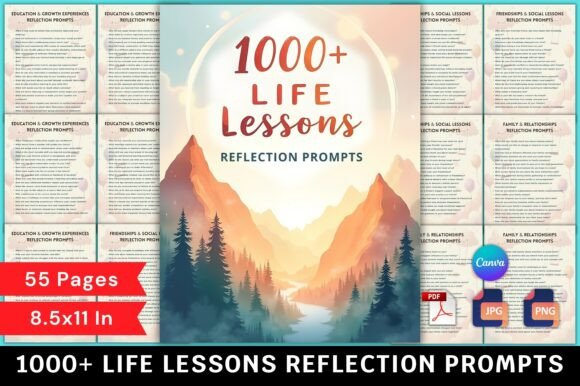
🌿1000 Life Lessons Reflection Prompts: A Practical Framework for Intentional Growth
Self-reflection isn’t just journaling—it’s a workflow. Like project retrospectives, quarterly reviews, or design sprints, it’s a structured pause that surfaces patterns, corrects course, and deepens alignment between action and values. The 🌿1000 Life Lessons Reflection Prompts is built for this: not as a passive diary, but as a precision tool for integrating lived experience into ongoing personal and professional development.
Where It Fits in Your Real-World Process
This workbook doesn’t replace your to-do list—but it strengthens the thinking behind every item on it. Think of it as the “pre-mortem” and “post-mortem” layer for life decisions: before launching a new business venture, you might use prompts from the Career and Failures sections to surface unexamined assumptions or past missteps. After closing a major client project, prompts under Relationships and Emotional Growth help process collaboration dynamics—not just outcomes. During a career transition, the Life Purpose and Legacy Wisdom sections ground ambition in continuity, not just novelty.
It integrates cleanly because it’s modular. You don’t need to start at page one or finish in order. If you’re preparing for a difficult conversation, pull three prompts from Emotional Awareness. If you’re drafting a mission statement, use five from Values and Legacy. The 1000 prompts are indexed by theme—not chronology—so they serve your current context, not an arbitrary timeline.
How It Works With Tools You Already Use
The 🌿1000 Life Lessons Reflection Prompts is designed for interoperability—not isolation. It complements digital tools without competing with them:
- Notion or Obsidian users can transcribe key insights into existing systems—e.g., linking a reflection on mentorship (Family & Friendships) to a “People I Learn From” database.
- Therapists and coaches assign targeted prompts as between-session work—say, two questions from Childhood to explore early attachment patterns before diving into current relationship challenges.
- Content creators and educators mine reflections for authentic storytelling material: a prompt like *“What did a small act of kindness teach you about trust?”* often yields richer narrative than brainstorming alone.
- Small business owners use the Success and Failures sections during annual planning—not to tally wins and losses, but to identify which behaviors actually drove results (e.g., “When did saying ‘no’ create more capacity than saying ‘yes’?”).
No syncing or setup is required. Because it’s a printable PDF with clean, pastel-toned layouts and dedicated note pages, it works offline, on paper, or printed and clipped into a binder alongside strategy documents or client feedback logs.
Preparation That Pays Off
Effective use starts with intention—not volume. You’ll get more from five focused minutes with one prompt than 30 distracted minutes skimming 20. Before opening the workbook:
- Define your scope: Are you reflecting on a specific event (a job loss), a recurring pattern (procrastination before deadlines), or a long-term arc (15 years in marketing)? Match the prompt section to that scope.
- Choose your medium deliberately: Handwriting activates different neural pathways than typing—especially for emotional processing. If you’re working through grief or regret, pen-on-paper is clinically supported. If you’re capturing fast-moving ideas for a product launch, use the blank note pages to sketch connections first, then refine digitally.
- Block realistic time: Most prompts take 5–12 minutes. Schedule them like micro-meetings—e.g., “Tuesday 7:15 a.m.: 1 prompt from Gratitude before checking email.” Consistency matters more than duration.
Workflow Examples You Can Adapt Today
Example 1: Preparing for a Leadership Role
A marketing manager promoted to director uses the 🌿1000 Life Lessons Reflection Prompts over four weeks: Week 1 focuses on Education and Mentorship (what teaching styles shaped her learning?); Week 2 draws from Failures (what misstep taught her most about team accountability?); Week 3 pulls from Relationships (how has she navigated conflict with peers vs. reports?); Week 4 synthesizes Legacy Wisdom (“What do I want my first 90 days to say about my leadership values?”). She shares distilled insights—not raw journal entries—with her new manager during onboarding.
Example 2: Post-Project Integration for Freelancers
After delivering a website redesign, a freelance designer opens the Career and Emotional Growth sections. Instead of only reviewing scope and timeline, she answers: *“When did I feel most resourceful—and what conditions made that possible?”* and *“What part of this project triggered old fears about being ‘not technical enough’?”* These answers feed directly into her next proposal template (e.g., adding clearer scoping language) and her skill-development plan (e.g., enrolling in one targeted frontend workshop).
Example 3: Legacy Planning for Educators
A high school teacher nearing retirement uses the Legacy Wisdom and Values prompts to draft a “teaching philosophy letter” for her department. Rather than abstract ideals, she grounds each value in a concrete memory: *“I believe curiosity is safer than certainty—because in 2013, when Maya questioned the textbook’s framing of colonialism, I didn’t have the answer, but we researched it together.”* That specificity makes her wisdom actionable for others.
Long-Term Use: Quality Over Quantity
The power of the 🌿1000 Life Lessons Reflection Prompts compounds with reuse—not repetition. Revisit the same prompt six months later, and your answer will likely shift. That’s not inconsistency; it’s evidence of integration. To sustain quality:
- Index your insights: Keep a simple log: date, prompt ID (e.g., “Failure-07”), and one-sentence takeaway. This reveals evolution—e.g., how your definition of “success” changes across career stages.
- Rotate themes intentionally: Don’t default to “comfort zones” (e.g., always choosing Gratitude). If you avoid Failures, that avoidance is data. Start there.
- Use output—not just input: Turn reflections into assets. A prompt about pivotal books (Education) becomes a reading list for your team. A reflection on boundary-setting (Relationships) informs your client onboarding email.
Compatibility isn’t about software—it’s about cognitive fit. The prompts avoid vague abstractions (“What makes you happy?”) in favor of grounded, behavior-linked questions (“What’s one decision you made last month that aligned with your stated values—and how did you know?”). That specificity makes them usable mid-day, mid-decision, mid-doubt.
Why This Isn’t Just Another Journal
Most journals ask *what happened*. The 🌿1000 Life Lessons Reflection Prompts asks *what it means—and what it releases you to do next*. It treats memory as data, emotion as signal, and legacy as practice—not distant aspiration. For professionals who manage complexity daily, that distinction is operational: it transforms reflection from self-soothing into strategic leverage.
Whether you’re refining a sales pitch, healing after burnout, documenting family stories, or designing a course syllabus, the prompts meet you where your work lives—not where idealized “self-care” says it should. They don’t demand more time. They make the time you already invest in thinking—about decisions, relationships, growth—more precise, more humane, and more useful.