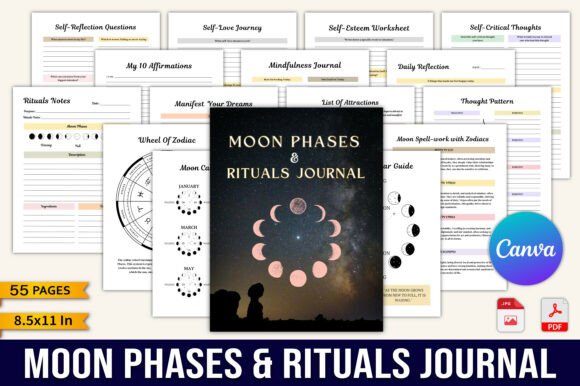
Moon Phases Rituals Journal: A Practical Framework for Lunar-Aligned Intentionality
For centuries, humans have observed the moon not just as a celestial body—but as a rhythmic anchor for inner timing. The Moon Phases Rituals Journal transforms that ancient awareness into a modern, structured practice. It is neither a mystical artifact nor a generic planner; rather, it functions as a grounded, evidence-informed tool that bridges lunar cycles with behavioral psychology, mindfulness science, and intentional habit formation. Its design reflects deep understanding of how external rhythms—like the 29.5-day lunar cycle—can support internal regulation, especially for professionals managing high cognitive loads, educators fostering emotional literacy, creators navigating inspiration ebbs and flows, and caregivers sustaining long-term resilience.
How Lunar Rhythms Inform Daily Decision-Making
The journal’s foundation rests on the observable physiological and psychological correlations tied to lunar phases—not as deterministic forces, but as environmental cues that mirror natural human oscillations. Research in chronobiology shows that melatonin secretion, sleep architecture, and even cortisol reactivity subtly shift across the lunar month. While mainstream science continues to investigate causal mechanisms, many users report heightened intuition during the Waxing Moon, increased clarity at First Quarter, expanded receptivity near Full Moon, and deeper restorative capacity during the Waning and Dark Moon phases. The Moon Phases Rituals Journal leverages this patterned sensitivity by assigning distinct cognitive and emotional tasks to each phase:
- New Moon: A window for low-stakes ideation—ideal for drafting project outlines, refining learning goals, or initiating boundary-setting conversations. The “Desire Worksheet” and “Manifest Your Dreams” prompts guide users to articulate aims without pressure for immediate outcome.
- First Quarter: A time of constructive friction—perfect for reviewing progress, adjusting workflows, or launching small experiments. The “Limiting Beliefs Worksheet” and “Self-Critical Thoughts” tracker help surface hidden assumptions before they derail momentum.
- Full Moon: Not merely for celebration, but for calibration. The “Receiving In Worksheet” and “Evening Routine” pages encourage conscious pause—reviewing what has emerged, acknowledging effort over completion, and releasing unhelpful commitments using the “Rituals Notes” section.
- Last Quarter & Dark Moon: Designed for integration—not passive rest, but active consolidation. The “Weekly Reflection,” “Gratitude List,” and “30 Minutes Self Care” prompts support neural rewiring through deliberate attention to safety, stillness, and somatic awareness.
Structural Intelligence: Beyond Aesthetic Design
What distinguishes the Moon Phases Rituals Journal from standard planners is its layered scaffolding. Each page serves a functional purpose rooted in behavioral design principles:
The “Wheel Of Zodiac” isn’t astrology-as-entertainment—it’s a contextualizer. Rather than prescribing personality traits, it maps planetary energy (e.g., Mercury retrograde periods, Venus transits) onto practical domains: communication clarity, relational boundaries, creative output, or financial decision-making. Educators use this to schedule feedback sessions during communicative lunar-zodiac alignments; business owners reference it when planning contract negotiations or product launches.
“Mindfulness Journal” and “Daily Reflection” pages integrate micro-practices backed by clinical research: brief sensory grounding, non-judgmental observation of thought patterns, and values-congruent check-ins. Unlike generic gratitude journals, the “Daily Gratitude” spread includes space for *why* a moment mattered—not just listing items, but reinforcing neural pathways tied to meaning-making.
The “Habit Tracker” avoids binary yes/no logging. Instead, it invites rating consistency, energy level, and alignment with intention—turning habit formation into a data-informed dialogue with self. Similarly, “My 10 Affirmations” encourages curation over repetition: users select statements tied to current developmental needs (e.g., “I trust my capacity to pivot” during organizational change), not static declarations.
Real-World Integration Across Roles
Professionals in fast-paced sectors—tech, healthcare, law—use the journal’s “Moon Calendar 2026” and “Moon Calendar Guide” to batch cognitively demanding tasks (e.g., deep work during Waxing Gibbous) and reserve collaborative or administrative work for high-energy phases (e.g., Full Moon). One UX researcher noted using the “Thought Pattern” worksheet to identify recurring mental loops before stakeholder presentations—leading to more adaptive communication strategies.
Creatives—writers, designers, musicians—leverage “Moon Spell-work with Zodiacs” not as literal magic, but as ritualized framing. For example, aligning a pitch deck revision with Sagittarius’ expansive energy supports bold vision-casting, while editing fine details under Virgo’s influence enhances precision. The “List Of Attractions” page helps surface subconscious preferences—what colors, textures, or metaphors keep appearing? These become intuitive inputs for branding or storytelling decisions.
Educators incorporate “Self-Awareness Worksheet” and “Self-Reflection Questions” into professional development. A middle-school principal used the “Self-Esteem Worksheet” to map how her confidence shifted across academic terms—and correlated those shifts with staff meeting frequency, parent complaint volume, and lunar phase. This revealed patterns she could proactively manage rather than react to.
Small business owners rely on “Planetary Energy” notes alongside cash flow tracking. During Mars retrograde (a period often linked to delays or technical hiccups), they prioritize relationship maintenance over new feature launches—using the “Receiving In Worksheet” to clarify what support they need from partners or clients.
Science-Informed Rituals, Not Superstition
Ritual, when stripped of dogma, is simply repeated action with attention and intention. The Moon Phases Rituals Journal codifies this principle. Its “Moon Phase Activities” are drawn from occupational therapy, narrative psychology, and trauma-informed care:
- Waxing Moon rituals include “Essential Oil uses” paired with breathwork—leveraging olfactory input to anchor focus during goal activation.
- Full Moon release practices utilize the “Self-Love Journey” prompts to reframe self-judgment as data, not identity—a technique validated in ACT (Acceptance and Commitment Therapy).
- Dark Moon integration engages “Positive Self-Reflection” to reinforce agency: “What did I protect this week?” or “Where did I choose rest over performance?”—countering achievement culture with embodied wisdom.
Even the “All Time Favorites” page serves functional purpose: it’s a curated archive of personal resonance—songs that calm the nervous system, quotes that recalibrate perspective, scents that signal safety. Over time, this becomes a personalized neuro-regulatory toolkit.
Considerations for Sustainable Use
Like any tool, effectiveness depends on fit—not faith. The Moon Phases Rituals Journal works best when treated as a responsive companion, not a rigid mandate. Users who thrive with it tend to:
- Approach it with curiosity, not compliance—skipping pages that don’t resonate in a given week;
- Use it in tandem with digital systems (e.g., syncing moon phase reminders to calendar apps);
- Revisit earlier entries quarterly to spot evolving patterns in “Self-Confidence Builder” or “Limiting Beliefs Worksheet”;
- Pair written reflection with movement—walking during New Moon intention-setting, stretching while completing the “Evening Routine.”
It is not designed for those seeking quick fixes or prescriptive answers. Its power lies in gradual attunement: noticing how energy shifts, honoring fluctuation as natural, and building response flexibility. One university librarian described using the “My Desires” and “Receiving...” spreads to distinguish between urgent requests and aligned opportunities—reducing burnout while increasing impact.
Conclusion: A Compass, Not a Map
The Moon Phases Rituals Journal doesn’t promise transformation—it offers orientation. In a world saturated with fragmented inputs and relentless optimization, it provides rhythm without rigidity, structure without suppression, and reverence without abstraction. Whether you’re designing curriculum, scaling a startup, healing from chronic stress, or simply reclaiming presence amid daily noise, its pages hold space for discernment. You don’t need to believe in lunar magic to benefit from its framework—you only need to believe in your capacity to notice, reflect, and respond with greater fidelity to your own nature.