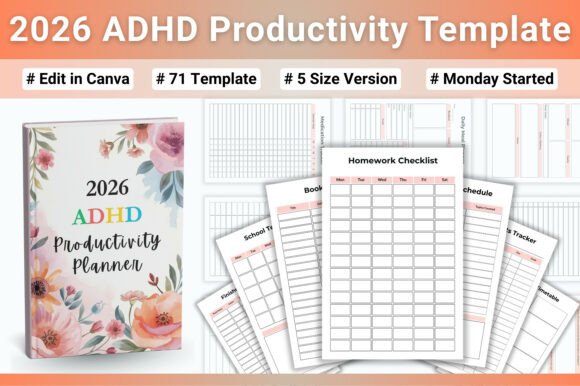
🧠 2026 ADHD Productivity Template
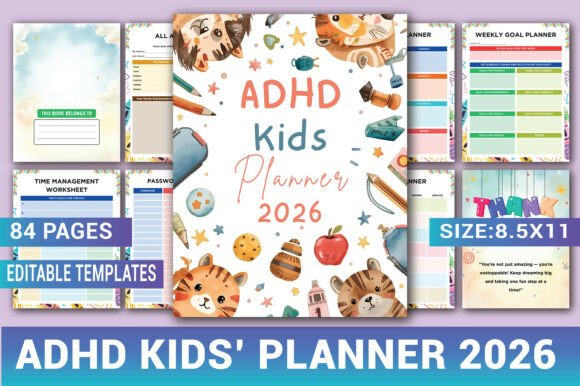
If your to-do list feels like a moving target—if starting tasks is easy but finishing them isn’t—if calendars fill up but nothing sticks—then structure that bends *with* your brain, not against it, isn’t a luxury. It’s essential. The 🧠 2026 ADHD Productivity Template is a 71-page printable workbook built from lived experience and cognitive science, not generic productivity dogma. It doesn’t assume you’ll “just get organized.” Instead, it meets you where attention, working memory, and executive function actually live: in real time, with room to pivot, pause, and personalize.
Why this isn’t just another planner
Most planners reward linear thinking. ADHD brains often thrive in loops, bursts, and lateral connections. This template works *with* that rhythm. Its undated, reusable design means you don’t have to wait for January—or beat yourself up for skipping three weeks. You open it when you’re ready, pick a page that fits *today’s* energy level, and go. No guilt. No reset required.
The 71 pages include daily, weekly, and monthly planning tools—but they’re not rigid schedules. They’re scaffolds: space to note sensory needs (“Need quiet before 11 a.m.”), track dopamine-friendly wins (“Sent one email without rereading it five times”), or flag emotional friction points (“Felt overwhelmed during team sync—what changed?”). That kind of self-awareness isn’t fluff. It’s data—and data helps you adjust, not abandon.
Freelancers & solopreneurs
When your calendar is your income, unpredictability is costly. A freelance graphic designer might use the Project Group Planner to break client work into micro-steps tied to energy windows—not hours. She’ll skip the “ideal” 9–5 block and instead map “deep focus blocks” around her natural alertness peaks, using the Priority Tracker to visually weight tasks by deadline *and* mental load. For her, flexibility isn’t optional—it’s how she avoids burnout while hitting deadlines.
Educators & tutors
A middle school teacher juggling IEPs, lesson prep, grading, and parent communication doesn’t need more to-do lists. She needs clarity on *what must be done today* versus *what can wait until after lunch*. She uses the Daily Planner’s “Top 3 + One Pause” layout—three non-negotiables, plus intentional breathing or hydration time. The Homework Assignment Tracker helps her spot patterns: “When do students consistently miss deadlines? Is it timing, instructions, or support gaps?” That insight feeds better lesson design—not just personal management.
Students & lifelong learners
For a college student with ADHD, reading logs and revision trackers aren’t about discipline—they’re about reducing cognitive drag. Instead of re-reading chapters because retention feels slippery, she uses the Reading Log to jot one sentence summarizing each section *as she goes*, anchoring understanding in real time. The Revision Planner breaks exam prep into 20-minute “focus sprints” with built-in reflection prompts: “What stuck? What confused me? What helped me remember it?” That turns passive review into active learning.
Creatives & hobbyists
A writer drafting a novel or a quilter planning a complex pattern needs structure that doesn’t suffocate inspiration. The Yearly Overview Goal Planner lets her define outcomes without locking in dates (“Finish first draft” vs. “Write 500 words every Tuesday”). She uses the Project Planner to capture ideas *in context*: “Scene idea—add when protagonist visits grandmother’s attic,” or “Fabric swatch photo—attach to quilt pattern page.” This keeps momentum alive between bursts of creativity.
What matters most—depends on who you are
Not every priority carries equal weight across users:
- Ease of use matters deeply to beginners—especially those newly diagnosed or recovering from years of self-blame. The clean, uncluttered layouts (no tiny fonts or dense grids) reduce visual overwhelm. The consistent color-coding and intuitive icons mean you can start without a tutorial.
- Flexibility is critical for parents managing household logistics alongside work. They might print only the Weekly Meal + Task Sync page and tape it to the fridge—or use the Budget Tracker to log grocery runs alongside therapy co-pays and school supply costs, all in one glance.
- Long-term usefulness matters to educators building classroom routines or therapists recommending tools to clients. Because it’s undated and printable in five sizes—including A5 for pocket notebooks and 6x9 for journaling—it adapts as needs shift over semesters, treatment phases, or life transitions.
- Digital-friendly format supports hybrid workflows. A marketing manager might scan the Daily Planner into Notability, handwrite notes, then export as PDF to share with her accountability partner. No app login, no subscription—just control over how and where she engages with her own time.
Does it fit *your* reality?
Ask yourself:
- Do you often lose track of time *after* starting a task—not just before?
- Do checklists feel helpful only until they grow longer than your attention span?
- Do you need reminders that care for your nervous system—not just your schedule?
- Do you prefer writing by hand to typing—but still want clean, functional layouts?
If yes, the 🧠 2026 ADHD Productivity Template is designed for that exact intersection. It won’t fix everything—but it gives you a consistent, compassionate place to begin again. Every day. Every week. Every project.
No two ADHD experiences are identical. Neither are the ways people build sustainable systems. This template doesn’t prescribe one path. It offers 71 thoughtful, tested entry points—and leaves the rest up to you.