🎨 2026 Craft Business Template
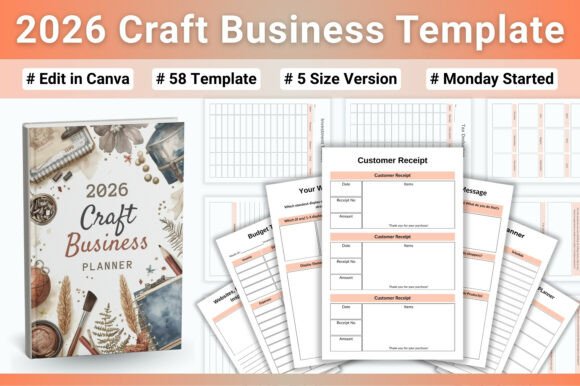
The 🎨 2026 Craft Business Template is a 58-page printable planner designed specifically for makers, artists, and handmade business owners. It is not software or a subscription service—it is a downloadable PDF organizer with structured sections for planning, tracking, and reflecting on key areas of a craft-based business. Available in five physical print sizes (US Letter, A4, A5, 6x9, and Half US Letter), it supports flexible use across devices and paper formats. Its undated layout means users can begin at any point in 2026—or even later—without needing to wait for a calendar year to start.
This template serves as a centralized tool for organizing foundational business elements: from defining a brand identity and analyzing competitors to managing product inventory, recording sales, and planning marketing activities. It includes monthly calendar pages for 2026, worksheets for clarifying business purpose and target audience, branding resources like color palette and logo concept prompts, and financial tracking tables. Because it’s digital-first and print-ready, it avoids the learning curve of complex apps while offering more structure than blank notebooks or generic planners.
Who Might Find This Template Useful?
Crafters evaluating tools for early-stage business development may consider the 🎨 2026 Craft Business Template if they value clarity over complexity. It suits individuals who:
- Are launching or refining a handmade business on platforms like Etsy, local markets, or independent websites;
- Prefer tactile planning—writing by hand or annotating printed pages—to typing into spreadsheets or apps;
- Want consistent prompts to reflect on pricing, customer feedback, or seasonal trends without building systems from scratch;
- Need flexibility in format—whether printing full-size for desk use or shrinking to A5 for portability between studio and craft fair;
- Are budget-conscious and prefer a one-time purchase over recurring fees for digital tools.
It also appeals to those who find free templates too sparse or overly broad. Unlike generic business planners, this one includes craft-specific prompts—such as material cost breakdowns, craft fair prep checklists, or photo shoot planning grids—that align with common operational needs in handmade businesses.
Practical Benefits and Realistic Tradeoffs
The primary benefit lies in its focused scope. With 58 pages distributed across defined sections—Business Setup, Product Inventory, Sales Tracking, Marketing Planning, and Finance Organizer—it encourages intentional, step-by-step progress rather than overwhelming breadth. The inclusion of problem-solution worksheets and competitor analysis templates helps surface assumptions before launch. Monthly calendar notes support habit-building, such as scheduling social media posts or restocking deadlines.
However, users should recognize its limitations. As a static PDF, it does not auto-calculate totals, sync across devices, or generate reports. Financial tracking relies on manual entry and basic arithmetic. There is no built-in data backup, cloud access, or integration with Etsy or PayPal. Users comfortable with Excel or Google Sheets may find some tracking functions duplicative, especially if they already maintain separate financial records.
Another consideration is adaptability. While the undated format offers flexibility, the 2026-labeled monthly calendars limit reuse beyond that year unless repurposed for non-calendar tasks. Those planning multi-year growth strategies may need supplemental tools for long-term forecasting or goal mapping beyond the planner’s scope.
When This Template Is a Strong Fit
The 🎨 2026 Craft Business Template is especially well-suited for solopreneurs in the first 1–3 years of operation who prioritize consistency and reflection over automation. It works well for artists preparing for their first holiday season, makers transitioning from hobby to side income, or craft fair vendors seeking better preparation systems. Its strength is in scaffolding—not replacing—existing workflows. For example, someone already using QuickBooks for accounting might still use this planner for visual branding exercises or quarterly marketing reviews.
It also fits users who learn best through guided writing. Worksheets like “Target Audience + Product Message” prompt concrete answers (“What frustrates my ideal buyer about current options?”) rather than abstract questions. That structure reduces decision fatigue when starting out, helping users clarify positioning before investing in logos or ads.
When Alternatives May Be More Appropriate
This template may be less suitable for users who require real-time collaboration, automated calculations, or integrations. Teams of two or more working on a shared craft business would likely benefit more from cloud-based tools like Notion, ClickUp, or Airtable—where permissions, version history, and linked databases add value a static PDF cannot provide.
Those already using robust accounting software (e.g., Wave, Xero, or FreshBooks) may find the finance section redundant unless used for high-level summaries or cash flow visualization. Similarly, established sellers with complex inventory (dozens of SKUs, variants, or wholesale channels) may need dedicated inventory management systems instead of manual log sheets.
Finally, users who primarily plan digitally—and rarely print—may prefer editable Notion templates or Canva-based planners that allow drag-and-drop customization. While the 🎨 2026 Craft Business Template is print-optimized, its PDF format doesn’t support easy reordering of pages or dynamic content insertion.
Making an Informed Choice
Before selecting the 🎨 2026 Craft Business Template, ask: What gaps am I trying to fill? If the answer is “I struggle to define my ideal customer,” “I forget to review pricing after material cost changes,” or “I want a simple way to track which products sell best at fairs vs. online,” then this tool directly addresses those needs.
If, instead, your challenge is scaling fulfillment logistics, automating tax calculations, or collaborating with a photographer or assistant, other solutions will better match those functional requirements. Consider testing the template with a single section—like the Competitor Market Analysis worksheet—before committing to the full set. Many creators find value in mixing tools: using this planner for strategic reflection while relying on spreadsheets for numbers or apps for scheduling.
Ultimately, the effectiveness of the arty 2026 Craft Business Template depends less on its completeness and more on how consistently it’s used. Its design assumes that clarity emerges through repetition—not perfection. For crafters seeking grounded, low-friction structure in a crowded landscape of digital tools, it offers a practical, accessible starting point.