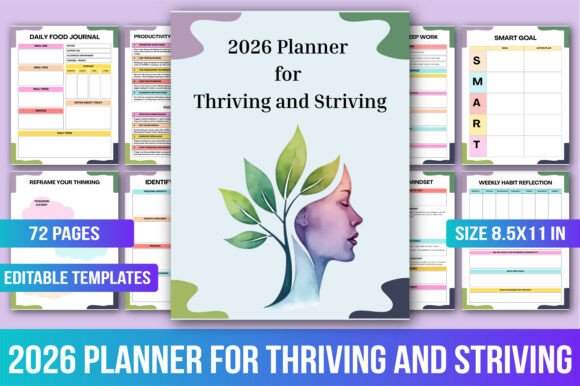
2026 Planner for Thriving and Striving
If you’ve ever opened a new planner only to abandon it by February—drowning in blank pages, mismatched priorities, or rigid structures that ignore your humanity—you’re not alone. The 2026 Planner for Thriving and Striving was built for people who refuse to choose between ambition and well-being. It’s not another productivity gimmick. It’s a thoughtfully layered system that meets you where you are: juggling deadlines and self-doubt, launching side projects while managing burnout, studying for exams while protecting your nervous system.
A Planner That Grows With You—Not Against You
Most planners treat time as a finite resource to be conquered. The 2026 Planner for Thriving and Striving treats it as terrain to navigate with intention. Its architecture supports dual movement: striving toward goals *and* thriving in the process. That means space for SMART goal breakdowns (Pages 17–25) sits just pages away from growth mindset reflections (Pages 16–18) and daily affirmations (Page 19)—so planning doesn’t become an act of self-reduction.
Take the yearly calendar on Page 3. It’s clean, color-coded, and intentionally uncluttered—not a place to cram every commitment, but a visual anchor for rhythm. You’ll spot seasonal shifts, align deadlines with energy cycles, and protect buffer time before major milestones. For a freelance designer launching a course in Q2, this isn’t decoration—it’s strategic foresight.
Where Productivity Meets Presence
The daily, weekly, and monthly spreads (Pages 33–35) go beyond scheduling. Each day includes a priority list *and* a gratitude prompt. Weekly layouts integrate meal planning with emotional check-ins (Page 46). Monthly spreads link habit tracking to reflection—not “Did I do it?” but “What did this reveal about my boundaries or energy patterns?”
This duality matters most when life fractures focus. A high school teacher using the 2026 Planner for Thriving and Striving might block prep time Monday–Wednesday, then use Friday’s self-care planner (Page 39) to schedule a 20-minute walk *before* grading begins—not as an afterthought, but as non-negotiable infrastructure. Similarly, a solopreneur launching a podcast can pair episode deadlines (in the weekly spread) with stress-relief prompts (Pages 37–38), turning anxiety into actionable resilience tools—not just coping mechanisms.
Mindset Tools That Stick—Not Just Sit
“Growth mindset” is often reduced to a buzzword. Here, it’s operationalized. Pages 16–18 guide users through identifying limiting beliefs (“I’m not technical enough to automate my workflow”), reframing them with evidence (“I built three Zapier automations last quarter”), and linking shifts to concrete next steps. It’s psychology grounded in practice—not theory detached from Tuesday afternoon.
And those 20 daily affirmations (Page 19)? They’re not generic mantras. Phrased in active, present-tense language (“I trust my capacity to learn what I need”), they’re designed to interrupt habitual self-talk *in real time*. A content creator reviewing analytics mid-morning might pause, flip to that page, and re-anchor before spiraling into comparison. That’s usability with emotional intelligence baked in.
Wellness That Fits—Not Forces
The self-care toolkit (Page 44) avoids prescriptive lists like “drink water, sleep 8 hours.” Instead, it invites customization: What restores *you* when your calendar hits critical mass? Is it voice memos instead of meetings? A 5-minute breathwork sequence before email? A boundary script for clients? This isn’t wellness as performance—it’s wellness as calibration.
Burnout prevention (Pages 37–38) is equally pragmatic. It maps early warning signs (e.g., “I’m canceling plans but saying ‘I’m fine’”) to micro-adjustments (“Swap one Zoom call for a voice note + shared doc”). For remote workers, educators, or caregivers, that specificity transforms abstract risk into manageable action.
Real-World Fit Across Roles
- Freelancers & entrepreneurs: Use the long-term goal planner to map client acquisition alongside personal capacity audits—so scaling doesn’t mean sacrificing sleep.
- Educators & students: Layer exam timelines (monthly spread) with emotional check-ins (Page 46) to recognize when study fatigue masks deeper overwhelm.
- Creators & marketers: Pair content calendars with the affirmation page to counteract imposter loops before posting—building confidence *into* the workflow, not after.
- Hobbyists & lifelong learners: The brainstorming worksheets (Page 22) help structure curiosity without pressure—turning “I’d love to learn pottery” into “Try one workshop by March; reflect on joy vs. frustration.”
What to Consider Before You Commit
The 2026 Planner for Thriving and Striving shines when used consistently—but consistency isn’t about perfection. If you’re new to planning, start with just two elements: the weekly spread and one self-care slot per week. Let the rest unfold organically. If you prefer digital tools, treat this as your “source of truth”—sync key deadlines and reflections into apps, but keep mindset and wellness work analog. The tactile act of writing builds neural pathways that typing rarely replicates.
Also notice how it handles flexibility. Unlike rigid hourly grids, its daily layout leaves breathing room between tasks. That’s intentional. When your 10 a.m. call runs late, you’re not left scrambling—you’re invited to adjust, not abandon. That’s not leniency; it’s design empathy.
More Than Paper—A Partnership With Your Potential
At its core, the 2026 Planner for Thriving and Striving operates on a quiet premise: sustainable success requires honoring both your drive *and* your design. It doesn’t ask you to hustle harder—it asks you to understand yourself more deeply, then build systems that reflect that understanding. Whether you’re negotiating a promotion, recovering from illness, launching a business, or simply reclaiming mornings from scroll fatigue, this planner meets ambition with compassion, structure with spontaneity, and effort with ease.
Your 2026 won’t be perfect. But with this tool, it can be purposeful—grounded in growth, guarded by self-awareness, and genuinely yours.