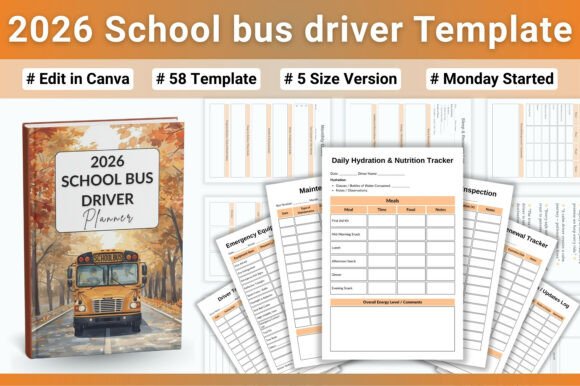
2026 School Bus Driver Template
Driving a school bus is more than navigating routes—it’s managing time, safety, student well-being, compliance, and personal stamina—all before lunchtime. The 🚌 2026 School Bus Driver Template meets that complexity with intention: a 58-page printable planner designed not as a generic notebook, but as a field-tested companion for the real rhythms of school transportation.
What This Planner Actually Does (No Jargon, Just Clarity)
This isn’t a calendar with bus icons slapped on it. It’s built around recurring operational needs: logging daily pre-trip inspections, tracking student attendance across multiple stops, noting route deviations, recording incidents without scrambling for paper, and even checking in on driver wellness—hydration, fatigue cues, stress levels. Every section serves a documented pain point: missed sign-offs, inconsistent documentation during high-volume drop-offs, or difficulty recalling when a brake inspection was last completed.
The template includes undated pages—so you can start mid-year, after summer break, or even mid-month. And because drivers work across different regions and districts, it’s formatted for five standard sizes: US Letter, A4, A5, 6×9 (half US Letter), and a compact version ideal for clipboard use. All pages are print-ready, optimized for both home printers and district repro centers.
For New Drivers
If you just earned your CDL and passed your school bus endorsement, your first few weeks involve steep learning curves—not just driving, but paperwork, communication protocols, and routine-building. The 🚌 2026 School Bus Driver Template gives structure without rigidity. Daily route logs include prompts like “Did all students board with seat belts secured?” and “Any behavioral notes?”—helping new drivers build consistent observation habits. Monthly route planners let them preview upcoming changes (e.g., early dismissals, field trip days) so nothing catches them off guard.
For Seasoned Drivers
Veterans often rely on mental checklists or scattered sticky notes. Over time, that can lead to gaps—especially during audits or incident reviews. This planner offers reliability through repetition: same layout every day, same location for tire pressure readings, same place to log weather conditions affecting traction. Its reusable, undated format means no throwing away half-used planners when the school year shifts. One driver in Ohio uses the wellness tracker to correlate fatigue patterns with back-to-back afternoon runs—then shares anonymized insights with her union steward to advocate for adjusted schedules.
For District Coordinators & Transportation Managers
You’re accountable for compliance, training records, and fleet safety metrics. When drivers use a standardized, district-adopted version of the 🚌 2026 School Bus Driver Template, documentation becomes legible, comparable, and audit-ready. No more deciphering handwritten notes across 42 different notebooks. The incident report section includes fields aligned with NHTSA reporting categories—making data aggregation faster. Some districts print only the inspection and incident pages for mandatory binder use, while letting drivers keep full planners for personal organization.
For Educators & Special Needs Support Staff
Many drivers collaborate closely with paraprofessionals, IEP teams, or behavior intervention specialists. The student attendance sheets allow space for quick, respectful notes—“Used visual schedule today,” “Assisted with sensory break en route”—that support continuity between bus and classroom. These aren’t medical records, but shared observational touchpoints that help everyone stay aligned on student needs.
How Different Priorities Shape Use
- Ease of use: Teachers-turned-drivers appreciate the clear typography and generous line spacing—no squinting or cramped writing. The A5 and 6×9 versions fit neatly into a jacket pocket or console tray.
- Flexibility: Homeschool co-op organizers adapt the route logs for shared van rotations; some use the monthly calendar pages to coordinate volunteer drivers across three towns.
- Reliability: Drivers who’ve experienced software crashes or app logouts during morning runs trust paper-based consistency. Nothing reboots. Nothing loses data mid-route.
- Long-term usefulness: Because it’s undated and modular, a driver can reuse the wellness tracker across multiple years—or repurpose blank note pages for parent meeting summaries or route optimization sketches.
A Few Real Moments Where It Makes a Difference
• A driver in rural Oregon logs foggy conditions and reduced visibility each morning in the weather tracker—then notices a pattern linking those entries to delayed arrivals at two specific stops. She adjusts departure time by seven minutes and shares the data with dispatch.
• During a routine DOT inspection, an auditor asks for the last three months of pre-trip inspection records. Instead of digging through binders or photo folders, the driver hands over three clean, labeled sections from the planner—each page signed, dated, and complete.
• A new driver forgets to record a minor fender-bender detail until later that afternoon. Because the incident report page includes a “Time of Entry” field—and a reminder to add witness names if applicable—she fills it out accurately while memory is fresh, avoiding vague recollections later.
Does This Fit Your Reality?
Ask yourself:
- Do you spend more than 10 minutes per week reconstructing route notes or attendance counts?
- Do you wish your wellness wasn’t the last thing you check—even though it’s the first thing that affects every other task?
- Are you tired of adapting generic planners that don’t reflect how school transportation actually works—like grouping “AM run” and “PM run” separately, or separating special education transport notes from general logs?
If yes, the 🚌 2026 School Bus Driver Template isn’t about adding more to your plate. It’s about reducing cognitive load, honoring your expertise with thoughtful design, and building small, repeatable habits that compound into safer, smoother, more sustainable days behind the wheel.
No subscriptions. No login. No updates to install. Just clarity—printed, held, filled, and trusted.