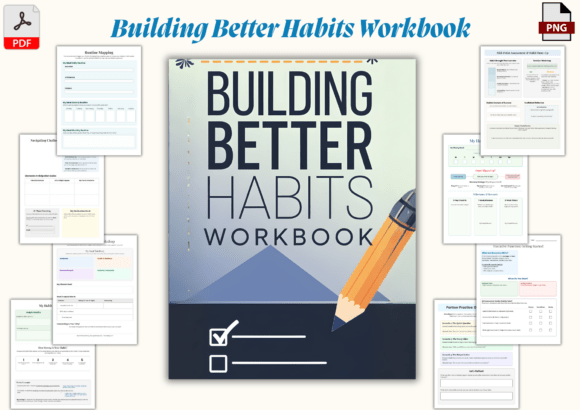
Building Better Habits Workbook
What if building a new habit didn’t mean white-knuckling willpower—or giving up after three days? What if it meant understanding *how* habits actually form, seeing your progress in real time, and adjusting with kindness instead of criticism? That’s the quiet revolution behind the Building Better Habits Workbook: a science-inspired, visually grounded tool that makes habit formation tangible, teachable, and truly inclusive—for kids, teens, adults, educators, therapists, and coaches alike.
Why “Better” Habits Start With Understanding—Not Just Doing
Habits aren’t just behaviors repeated until they stick. They’re neural pathways shaped by cues, routines, rewards, and context—and they’re deeply tied to executive function, emotional regulation, and self-efficacy. The Building Better Habits Workbook begins there: not with “just start meditating” or “wake up earlier,” but with clear, illustrated explanations of how habits work in the brain and body. Its colorful diagrams break down complex ideas—like the habit loop or dopamine’s role in reinforcement—into digestible visuals that resonate across ages and learning styles.
This isn’t abstract theory. It’s scaffolding. Each section invites reflection before action: “What’s already working in your routine?” “What small cue could anchor your new habit?” “How might you celebrate effort—not just outcome?” That intentional pause is where lasting change begins.
What’s Inside? Tools Designed for Real Life—Not Just Ideal Scenarios
The Building Better Habits Workbook delivers 8.5 x 11-inch printable pages in high-resolution PDF and PNG formats—designed for flexibility, not friction. You’ll find:
- SMART Goal Planners that guide users to define goals with specificity, measurability, and built-in review points—no vague resolutions allowed;
- Executive Function Worksheets targeting planning, task initiation, working memory, and flexible thinking—especially helpful for neurodivergent learners or anyone overwhelmed by daily demands;
- Habit Trackers with multiple formats (weekly grids, streak calendars, emoji-based mood + habit logs) so users can choose what feels motivating—not burdensome;
- Troubleshooting Guides that normalize setbacks (“What if I miss two days?” “What if my environment keeps derailing me?”) and offer evidence-based pivots—not shame;
- Motivational Prompts grounded in self-determination theory—focusing on autonomy, competence, and connection rather than external pressure.
Every page balances structure with space for personalization. A teen sketching their ideal morning routine beside a guided template. A teacher printing copies for a life-skills unit on responsibility. A therapist adapting a habit tracker for a client managing anxiety-related avoidance. The Building Better Habits Workbook doesn’t assume one-size-fits-all—it assumes one-size-can-adapt.
Where It Fits—and Why It Fits Well
This workbook thrives where intention meets implementation. Here’s how it shows up in real settings:
✨ Classrooms & Homeschooling
Teachers use it to embed social-emotional learning (SEL) into daily practice—not as a separate lesson, but as part of science, health, or advisory time. Students map study habits alongside growth mindset reflections. Homeschooling families co-create weekly rhythm charts, turning abstract concepts like “responsibility” into visible, shared commitments.
✨ Therapy & Behavior Support
Clinicians appreciate its non-pathologizing language and trauma-informed design. Instead of framing habit failure as resistance, the workbook invites curiosity: “What need was this behavior meeting?” “What support would make consistency feel safer?” Its visual nature also supports clients with ADHD, autism, or language-based processing differences.
✨ Teen Life-Skills Programs
Youth development programs use the Building Better Habits Workbook to build agency—not compliance. Teens set goals around sleep hygiene, digital balance, or community involvement using tools that honor their developmental need for voice and choice. The motivational prompts help reframe self-criticism into compassionate inquiry.
✨ Coaching & Personal Development
Coaches integrate pages into sessions as collaborative worksheets—not homework. A client exploring time management might use the “Routine Audit” worksheet to identify energy peaks and friction points, then co-design a micro-habit using the “Habit Stacking” template. It turns abstract coaching goals into concrete, trackable experiments.
Strengths That Stand Out—Without Overpromising
The Building Better Habits Workbook excels where many habit tools fall short:
- Science made accessible—No jargon, no oversimplification. Concepts from behavioral psychology, neuroscience, and education research are translated into intuitive visuals and plain-language prompts.
- Design that serves function—Color isn’t decorative; it signals categories (blue for planning, green for reflection, gold for celebration). Icons replace dense text. White space reduces cognitive load.
- Inclusivity baked in—It avoids assumptions about family structure, neurotype, ability, or access to technology. Printable format means no login, no subscription, no device dependency.
- Flexibility over rigidity—There’s no “correct” way to fill it out. Users skip sections, revisit pages, combine templates, or use them digitally with annotation tools.
Realistic Expectations: What It Is—and Isn’t
The Building Better Habits Workbook is not a magic fix. It won’t erase systemic barriers—like unstable housing, chronic stress, or lack of sleep—that profoundly impact habit formation. It doesn’t replace clinical treatment for depression, OCD, or severe executive dysfunction. And it’s not meant to be completed cover-to-cover like a textbook.
Instead, it’s a responsive toolkit. Think of it like a well-organized drawer of habit-building supplies: sometimes you need the “Cue Identifier” worksheet, other times the “Motivation Matchmaker” prompt, or just the blank habit tracker grid. Its value grows with consistent, low-stakes engagement—not perfection.
For best results, pair it with gentle consistency: 5–10 minutes, 2–3 times per week. Revisit old pages. Celebrate noticing patterns—even when change feels slow. That’s where the science aligns with lived experience: habits strengthen through repetition *and* reflection.
Is It Right for You—or Your People?
Ask yourself:
- Do you or your learners benefit from visual structure? If checklists, color coding, or flowcharts help clarify next steps, this workbook meets that need directly.
- Are you supporting habit change across diverse needs? Whether guiding a 9-year-old through bedtime routines or helping an adult restructure work habits post-burnout, its layered design adapts without dilution.
- Do you value evidence-informed tools that respect human complexity? It bridges research and realism—acknowledging motivation fluctuates, environments shift, and progress isn’t linear.
If yes, the Building Better Habits Workbook isn’t just another planner. It’s a quietly powerful companion—one that treats habit-building not as a test of discipline, but as an act of self-knowledge, care, and creative problem-solving.
Because better habits aren’t about doing more. They’re about understanding more—about ourselves, our brains, and the small, steady choices that, over time, become the architecture of our lives.