Cybersecurity Basics for Kids: Building Digital Resilience at the Foundation
Today’s children aren’t just growing up with technology—they’re growing up inside it. From educational apps and interactive learning platforms to gaming ecosystems and social media lite-tools, digital environments are their first classrooms, playgrounds, and communities. That reality has shifted how educators, parents, and product creators approach digital literacy—not as an elective skill, but as essential infrastructure for childhood development. Enter Cybersecurity Basics for Kids: a thoughtfully engineered, visually driven workbook that transforms abstract, often intimidating cybersecurity concepts into tangible, age-appropriate learning experiences.
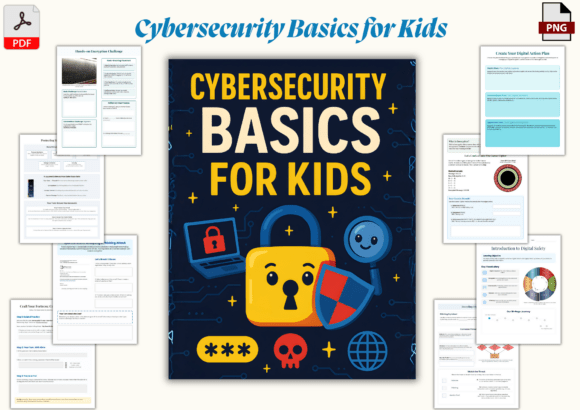
This isn’t a simplified glossary or a passive coloring sheet disguised as education. Cybersecurity Basics for Kids is a pedagogically grounded, activity-first resource—designed for real-world application in homes, classrooms, and after-school STEM programs. Its 8.5 x 11 inch US Letter format and high-resolution PDF + individual PNG page structure reflect a deliberate alignment with modern teaching workflows: printable, projector-ready, screen-share friendly, and adaptable across hybrid learning models. More importantly, its architecture mirrors how cognitive science tells us children learn best—through repetition, visual scaffolding, narrative context, and immediate, low-stakes practice.
A Response to Evolving Digital Realities—Not Just a Trend
The rise of resources like Cybersecurity Basics for Kids isn’t driven by novelty—it’s a direct response to measurable shifts in behavior, regulation, and risk exposure. Consider this: According to the FBI’s Internet Crime Complaint Center (IC3), reports involving minors as victims rose over 40% between 2021 and 2023—with phishing attempts, credential theft, and predatory scams increasingly targeting younger users via gaming platforms and school-issued devices. Simultaneously, legislation like the UK’s Age-Appropriate Design Code and the U.S. COPPA updates now require platforms serving children under 13 to embed privacy-by-design principles—raising the bar for what “digital safety” means in practice.
Yet policy alone doesn’t change behavior. What does? Consistent, contextual learning—delivered early and reinforced regularly. That’s where Cybersecurity Basics for Kids meets the moment. It bridges the gap between regulatory intent and lived experience. Instead of telling kids “don’t click suspicious links,” it guides them through a real-life example of a fake birthday party invite email—complete with highlighted red flags (urgent language, mismatched sender address, odd URL)—followed by a quick “Spot the Scam” challenge they can complete in under two minutes. This mirrors evidence-based instructional design: concrete before abstract, guided before independent, visual before verbal.
Why Professionals Are Taking Notice
Educators, curriculum designers, edtech founders, and even corporate L&D teams are integrating Cybersecurity Basics for Kids not only for its pedagogical strength—but for its strategic versatility. In classrooms, it serves as a ready-made module for digital citizenship units aligned with ISTE Standards and Common Core cross-curricular competencies. For homeschooling families, it replaces fragmented YouTube tutorials and inconsistent blog posts with a coherent, sequenced progression—from understanding what personal information is, to recognizing how data travels, to making intentional choices about sharing.
Entrepreneurs building child-facing tech products are using the workbook as a benchmark for usability testing: if a 7-year-old can successfully complete the “Password Power-Up” activity (where they combine favorite animals, numbers, and symbols into a memorable, strong passphrase), then the underlying UX principles—clarity, predictability, feedback—are working. Marketers, meanwhile, recognize its resonance in an era where authenticity and purpose-driven engagement dominate consumer trust metrics. Parents don’t buy “cybersecurity”—they invest in confidence, agency, and peace of mind. Cybersecurity Basics for Kids delivers those outcomes visibly and repeatedly.
More Than Activities—A Framework for Responsible Innovation
What makes this workbook distinctive isn’t just its illustrations or challenges—it’s its embedded philosophy: cybersecurity isn’t about fear or restriction; it’s about empowerment through awareness. Each section builds toward a broader mindset shift:
- 🛡️ Cyber safety rules aren’t presented as prohibitions—but as “digital superpowers” (e.g., “The Privacy Shield” teaches kids to ask, “Who needs to know this?” before sharing);
- 💻 Online privacy awareness is anchored in relatable metaphors: comparing data trails to footprints in snow, showing how some vanish quickly while others last—and why that matters;
- 🔑 Password creation protection moves beyond “use uppercase and numbers” to explore why randomness matters—using a simple dice-roll game to generate unpredictable combinations;
- 📧 Phishing detection leverages emotional intelligence: kids learn to pause when a message triggers urgency or excitement—and practice checking sender details *before* reacting;
- 🕵️ Identifying safe vs. unsafe sites focuses on observable cues (padlock icons, URL spelling, site layout consistency) rather than technical jargon;
- 💬 Digital footprints and data protection introduces consequence without abstraction: “If your drawing goes online, who might see it—and what could they do with it?”
This layered, scaffolded approach reflects a larger industry evolution: from reactive security (firewalls, antivirus) to proactive resilience (critical thinking, behavioral habits, ethical decision-making). It’s the same shift happening in enterprise cybersecurity training—now translated down to the developmental level where neural pathways for judgment and habit formation are most malleable.
Designing for Today’s Workflows—Not Just Tomorrow’s Needs
The technical execution of Cybersecurity Basics for Kids also signals deep fluency with contemporary professional demands. High-resolution PDF ensures crisp printing for handouts and posters; individual PNG pages enable easy integration into Google Slides, Canva presentations, or LMS dashboards like Canvas or Seesaw. There’s no proprietary software lock-in—just universally compatible assets that respect educators’ time and autonomy.
For freelancers developing custom digital literacy curricula—or startups launching kid-safe apps—the workbook functions as both inspiration and validation. Its structure demonstrates how complex domains can be deconstructed without dilution: each concept retains technical accuracy (e.g., malware is explained as “unwanted software that sneaks in like a stowaway”) while remaining actionable. That balance—rigor plus accessibility—is precisely what stakeholders across education, tech, and parenting ecosystems are demanding.
Looking Ahead: Foundations That Scale
As AI tools become more embedded in K–5 learning environments—from adaptive tutors to generative writing assistants—the need for foundational cybersecurity literacy intensifies. Children who understand how data fuels algorithms, who recognize when a system is making assumptions about them, and who know how to verify digital sources are better equipped to use emerging tools ethically and effectively. Cybersecurity Basics for Kids doesn’t teach AI literacy directly—but it cultivates the precise cognitive muscles required to engage with it wisely: skepticism, pattern recognition, systems thinking, and self-advocacy.
In essence, this workbook represents more than a product. It’s a quiet but significant inflection point—a signal that digital safety education is maturing from fragmented awareness campaigns into structured, scalable, developmentally informed practice. It acknowledges that protecting children online isn’t about shielding them from technology. It’s about equipping them with the clarity, confidence, and competence to shape their own digital futures—starting with one illustrated page, one thoughtful question, and one empowered choice at a time.
Whether you're designing a district-wide digital citizenship initiative, building a family media plan, or launching a new edtech platform, Cybersecurity Basics for Kids offers more than lessons—it offers a replicable model for how to make critical, complex ideas feel human, relevant, and within reach.