Retraining the Body’s Alarm System: How the OCD, Anxiety Panic Regulation Workbook Builds Sustainable Emotional Resilience
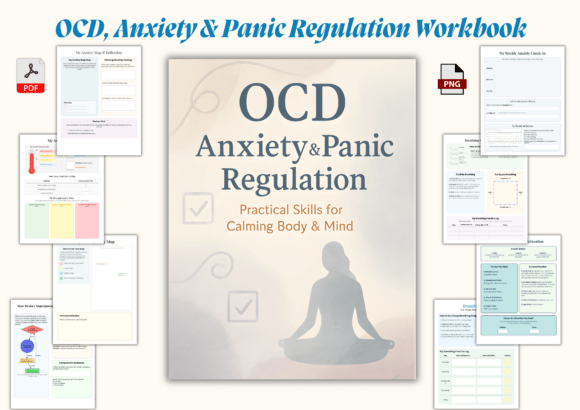
At the heart of chronic anxiety, OCD spikes, and recurrent panic lies a misfiring alarm system—not in the environment, but within the body itself. The OCD, Anxiety Panic Regulation Workbook approaches this reality not as pathology to be suppressed, but as physiology to be understood, mapped, and gently recalibrated. Unlike symptom-focused tools that prioritize short-term relief, this resource grounds its methodology in neurobiological literacy: teaching users how their autonomic nervous system interprets threat, stores somatic memory, and defaults to survival patterns—even when no real danger is present. Its 8.5 x 11 inches format isn’t arbitrary; it’s intentionally spacious enough to invite slow, embodied engagement—no rushed scrolling, no cognitive overload. Designed with therapeutic watercolor illustrations and uncluttered layouts, the workbook operates on the principle that visual calm supports neural calm.
Why Nervous-System Literacy Is the First Step Toward Regulation
Most people experiencing intrusive thoughts or sudden surges of dread describe feeling “hijacked”—as if their mind or body has taken control. What’s often missing is a clear map of *how* that hijacking occurs. The OCD, Anxiety Panic Regulation Workbook begins not with coping strategies, but with education: body alarm system maps demystify the interplay between amygdala activation, vagal tone, breath rate, and muscle tension. One early exercise invites users to chart their personal “anxiety panic thermometer,” identifying where sensations first appear (e.g., tightness behind the eyes, heat in the chest, tingling in the fingertips) and how those physical cues escalate before thoughts spiral. This isn’t abstract theory—it’s functional anatomy made accessible. A teacher noticing jaw clenching before staff meetings, a software developer recognizing shallow breathing before code reviews, or a parent sensing throat constriction during bedtime routines can all use this mapping to catch reactivity earlier—not to stop it, but to witness it with less judgment.
From Awareness to Action: Grounding Missions That Anchor in the Present
Once users recognize their unique physiological signatures, the workbook transitions into experiential practice—what it calls “nervous-system grounding missions.” These aren’t passive affirmations or vague suggestions to “just breathe.” Instead, they’re structured, repeatable sequences grounded in polyvagal-informed movement, interoceptive awareness, and sensorimotor integration. For example, the “5-4-3-2-1 grounding worksheets” go beyond listing senses: they prompt users to identify textures they *can* tolerate (not just what’s present), name one sound that feels safe *right now*, and locate a point of contact between body and surface that offers subtle pressure. This specificity matters—especially for individuals whose nervous systems have learned to distrust internal signals. A researcher using the workbook during grant-writing deadlines reported that shifting from “I need to calm down” to “Where do my palms make contact with the desk?” reduced pre-submission panic by interrupting the anticipatory loop before cortisol spiked.
Mindful Breathing Quests: Rhythm Over Rigidity
Breathwork is often oversimplified as “breathe in for four, hold for four…”—but rigid counting can backfire for those with OCD or trauma histories, triggering performance anxiety or compulsive repetition. The OCD, Anxiety Panic Regulation Workbook reframes breathing as exploration. “Mindful breathing quests” guide users to notice natural rhythm shifts without correction: how breath changes when sitting versus standing, how exhales lengthen after humming, how diaphragmatic movement softens when shoulders are supported. One page features a gentle watercolor illustration of lungs nested within ribcage contours, inviting tracing with a finger—not to control, but to reconnect. This somatic anchoring helps disrupt the hypervigilance cycle common in OCD, where attention fixates on bodily sensations as potential threats. Over time, users report less fear *of* the sensation itself—like heart palpitations—and more curiosity about its transient nature.
Emotional Weather Maps and the Language of Inner Shifts
Traditional mood tracking often reduces experience to single-word labels (“anxious,” “stressed”) or numeric scales that erase nuance. The workbook introduces “emotional weather maps”—a metaphor that validates complexity. Instead of asking “How anxious are you?” it invites users to sketch or describe conditions: *Is this a low fog clinging to the ground? A sudden thunderclap followed by silence? A persistent drizzle that blurs edges?* This approach aligns with Acceptance and Commitment Therapy (ACT) principles, encouraging psychological flexibility over emotional elimination. Educators using these maps in social-emotional learning units found students more willing to articulate uncertainty or ambivalence—states often pathologized in high-stakes academic settings. Similarly, business owners navigating team conflict noted that describing tension as “static electricity before a storm” opened space for collaborative problem-solving, rather than reactive blame.
Body Scan Adventures: Reclaiming Safety in Sensation
For many with long-standing anxiety or OCD, the body feels like unfamiliar territory—or worse, a site of threat. Standard body scans can inadvertently reinforce avoidance if users rush through or dissociate from discomfort. The OCD, Anxiety Panic Regulation Workbook transforms this practice into “body scan adventures,” framing attention as gentle exploration rather than inspection. Prompts ask users to notice temperature gradients, weight distribution, or micro-movements (e.g., “Where does your tongue rest against your teeth right now?”). Crucially, each page includes explicit permission to pause, redirect, or skip—validating nervous-system boundaries as part of the process. A physical therapist integrating these pages into chronic pain rehabilitation observed that clients who previously associated body awareness with fear began reporting moments of neutral or even pleasant sensation—shifting their relationship to embodiment itself.
Calming Rituals and the Architecture of Habit Formation
Sustained regulation isn’t built through isolated exercises—it emerges from consistent, context-aware rituals. The workbook dedicates space to co-creating “calming rituals” tailored to individual rhythms and environments. Rather than prescribing universal routines, it asks: *What 90 seconds can you protect before your morning coffee? What gesture anchors you after closing a difficult email? What sensory input reliably signals safety in your workspace?* One creator developed a ritual involving pressing thumbs into collarbones while naming three things she’d seen that day—simple, portable, and tied to her visual processing strengths. Another used the “weekly check-ins” not to measure progress, but to reflect on which rituals felt nourishing versus obligatory. This emphasis on self-determined scaffolding reflects evidence that habit formation thrives on autonomy, competence, and relatedness—not willpower.
Who Benefits Beyond Clinical Diagnosis?
While designed with clinical rigor—integrating CBT, Exposure and Response Prevention (ERP), ACT, and nervous-system regulation frameworks—the OCD, Anxiety Panic Regulation Workbook serves far beyond those with formal diagnoses. Professionals managing decision fatigue (e.g., clinicians, engineers, designers) use the “emotional weather maps” to distinguish burnout signals from acute stress. Researchers cite the “body alarm system maps” when preparing for peer review or conference presentations, recognizing how anticipatory arousal manifests physically before cognitive doubt arises. Educators adapt the “grounding missions” into classroom transitions, helping students regulate collective energy without singling out individuals. Even hobbyists—woodworkers, gardeners, knitters—report applying the “calming rituals” framework to deepen focus during repetitive, tactile tasks. The workbook’s strength lies in its refusal to medicalize ordinary human reactivity, instead treating regulation as a learnable, embodied skill—like literacy or numeracy.
Practical Considerations for Real-World Use
The PDF/PNG format offers flexibility: printable for tactile engagement, screen-friendly for on-the-go reflection, or adaptable for digital annotation. Its 8.5 x 11 inches size ensures readability without requiring magnification—a subtle but critical accessibility feature for users experiencing visual sensitivity during heightened states. Importantly, the workbook avoids prescriptive timelines or “mastery” language. Progress isn’t measured in completed pages, but in increased capacity to notice, pause, and choose—not always perfectly, but more frequently. One user shared that her “breakthrough” wasn’t eliminating panic, but realizing she could name the exact moment her shoulders lifted toward her ears—and that naming alone created half a second of choice. That half-second, multiplied across days and months, reshapes neural pathways more durably than any quick-fix technique.
Ultimately, the OCD, Anxiety Panic Regulation Workbook succeeds not by promising freedom from discomfort, but by expanding the space between stimulus and response. It treats the nervous system not as a broken machine to be fixed, but as an intelligent, adaptive system waiting to be listened to—with patience, precision, and profound kindness. In doing so, it offers something increasingly rare in our accelerated world: permission to move at the pace your physiology requires, while building the quiet, resilient capacity to meet whatever comes next.