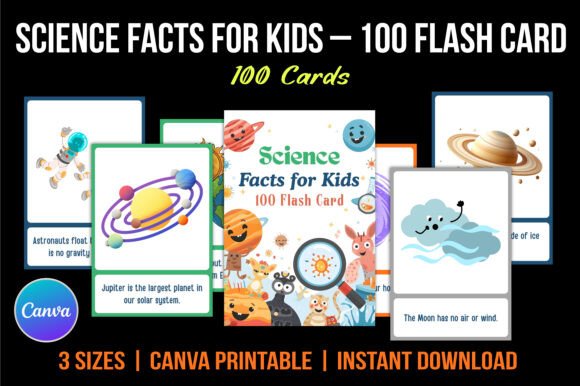
Science Facts for Kids 100 Flash Cards: Igniting Curiosity Through Playful Learning
Every child is born a natural scientist—asking “why?” at sunrise, peering under rocks at recess, and wondering how rockets fly or why frogs hop but birds soar. Science Facts for Kids 100 Flash Cards transforms that innate curiosity into structured, joyful learning. Designed for children ages 5 to 12, this vibrant card set delivers bite-sized, accurate science knowledge across five major domains: space, animals, the human body, Earth science, and technology. But it’s more than just facts—it’s a gateway to critical thinking, memory development, and lifelong wonder.
Why Flash Cards Still Matter in the Digital Age
In an era dominated by screens and algorithms, tactile, screen-free tools like flash cards offer unique cognitive benefits. Research in educational psychology shows that spaced repetition—the technique of reviewing information at increasing intervals—strengthens neural pathways and improves long-term retention. Each of the 100 cards in this set is intentionally crafted to support that process: one clear fact per card, illustrated with clean, colorful design, and written in language a first grader can grasp yet rich enough to spark deeper questions from a fifth grader.
Unlike passive scrolling or autoplay videos, flash cards invite interaction—flipping, sorting, quizzing, and even acting out concepts (“Can you show me how a volcano erupts with your hands?”). This active engagement aligns with multimodal learning theory, which emphasizes that children absorb and retain information best when they see, say, hear, and do.
What Makes These Cards Truly Educational—and Fun?
Not all science flash cards are created equal. What sets Science Facts for Kids 100 Flash Cards apart is its thoughtful balance of rigor and accessibility:
- 100 Kid-Friendly Science Facts: No jargon, no oversimplification—just truthful, age-appropriate explanations. Example: “Your brain weighs about as much as a small grapefruit—and it uses 20% of your body’s energy!”
- Educational Fun Learning Tool: Each card invites extension—“What would happen if Earth had no moon?” or “Draw your favorite animal cell part.” Teachers and parents report kids requesting ‘one more card’ long after scheduled learning time ends.
- Colorful, Clean Design: High-contrast visuals, uncluttered layouts, and consistent typography reduce cognitive load—especially helpful for neurodiverse learners, English language learners, and emerging readers.
- Boosts Memory & Understanding: The set includes built-in scaffolding—cards group related ideas (e.g., “How do clouds form?” followed by “What makes rain fall?”), helping kids build mental models instead of isolated trivia.
- Use Anywhere: Whether on a road trip, during breakfast, or as a calm-down tool before bedtime, these cards adapt seamlessly to real life—not just classrooms.
Real-World Applications: From Homeschooling to Classroom Innovation
For homeschool families, the flash cards serve as a flexible core curriculum supplement. A parent might start the day with a “Space Fact” while packing lunch, then use the matching “Earth Science Fact” during a nature walk, reinforcing connections between disciplines. In classrooms, teachers integrate them into science centers, morning meetings, or exit-ticket quizzes—no prep required.
One third-grade teacher in Oregon shared how she uses the cards for “Science Circle Time”: students draw a card, read it aloud, and then share a personal connection (“I saw lightning last summer!” or “My grandma has a pacemaker—that’s technology inside the body!”). This builds not only scientific literacy but also empathy, communication, and community.
And for caregivers seeking screen-free enrichment? These cards double as conversation starters, travel companions, and even collaborative art prompts—kids love illustrating their favorite facts or designing new ones using the editable Canva templates included.
Beyond Memorization: Building Scientific Habits of Mind
A common misconception is that flash cards only promote rote learning. In reality, well-designed cards like these nurture essential scientific habits:
- Observation: “A honeybee’s wings beat 200 times per second.” → Encourages listening for buzzing, watching flight patterns.
- Questioning: “Why do some animals hibernate?” naturally leads to “What happens to their hearts? Do humans ever do something similar?”
- Predicting & Testing: “Water expands when it freezes.” → Kids can test this by freezing water in a sealed container (with supervision) and observing cracks.
- Connecting Ideas: Pairing “The Sun is 93 million miles from Earth” with “It takes sunlight 8 minutes to reach us” builds spatial reasoning and time-scale awareness.
This isn’t about filling heads with data—it’s about equipping young minds with frameworks to explore, question, and understand their world more deeply.
Designed for Grown-Ups Too: Flexibility That Fits Real Life
The product includes more than just printed cards—it comes with practical resources that empower adults:
- Editable Canva Link: Customize fonts, colors, or add student names—ideal for special education accommodations or bilingual classrooms.
- High-Quality Ready-to-Upload PDF Files: Print at home, school, or local print shops in three versatile sizes: standard 8.5×11 inches (great for group display), A4-compatible 8.3×11.7 inches, and portable 3.5×5 inches (perfect for pockets or travel pouches).
- 101 Different Canva Templates: Not just for cards—use them for posters, worksheets, digital presentations, or classroom decor. One template features a “Fact of the Week” bulletin board layout; another supports student-led science fair prep.
This level of flexibility reflects deep understanding of modern educators’ and caregivers’ realities: tight schedules, diverse learner needs, and the desire for tools that grow with the child—not expire after one unit.
More Than a Gift—A Catalyst for Lifelong Discovery
Giving Science Facts for Kids 100 Flash Cards isn’t just handing over a toy or textbook replacement. It’s gifting permission to wonder, tools to investigate, and confidence to ask bold questions. It’s the kind of resource that sits on a bookshelf for years—not gathering dust, but being pulled out again and again: by a kindergartener pointing to planets, a fourth grader preparing for a science bowl, or a curious teen flipping through “old cards” and realizing, “Wait—this is how photosynthesis actually works.”
And because science literacy is foundational—not just for future scientists, but for informed citizens, ethical decision-makers, and creative problem-solvers—the impact ripples far beyond the classroom. Understanding climate basics helps kids advocate for recycling. Knowing how vaccines work fosters health literacy. Grasping simple circuits sparks tinkering with robots or coding games.
Final Thought: Science Starts With a Single Question
Every great discovery began with someone pausing, looking closely, and asking, “What if…?” or “How come…?” Science Facts for Kids 100 Flash Cards doesn’t aim to have all the answers. Instead, it gives children—and the adults who guide them—the vocabulary, confidence, and joy to keep asking. Because in the end, the most important science fact isn’t printed on any card. It’s this: Curiosity, nurtured with care, never expires.
Thank you for visiting this product. If you enjoyed learning about how playful, purposeful tools like these support meaningful science education, explore more evidence-informed resources in our store—designed by educators, for real families and classrooms.