The Amazing World of Science for Kids
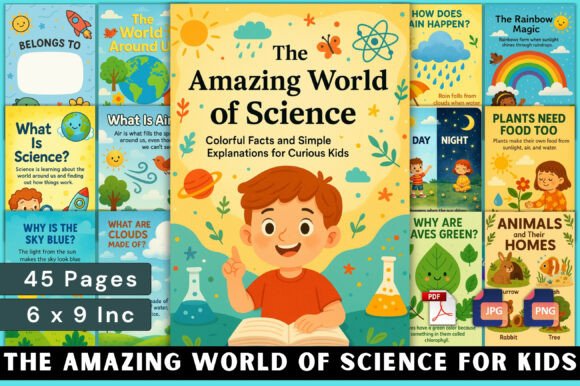
Imagine your child pausing mid-scoop of ice cream—not to eat, but to wonder why it’s melting. Or pointing at a rainbow after rain and asking, “How did that get *in* the sky?” That spark of curiosity isn’t just charming—it’s the first step toward scientific thinking. The Amazing World of Science for Kids meets children exactly where they are: in the middle of everyday moments full of questions, wonder, and playful discovery.
A Print-and-Play Bridge Between Wonder and Understanding
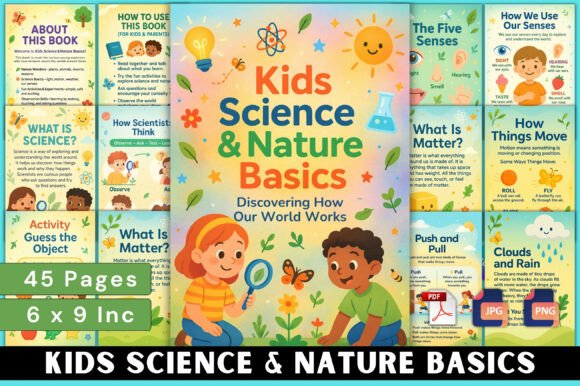
This isn’t a dense textbook or a screen-based app demanding attention. It’s a joyful, printable science book designed for real life—bright colors, friendly illustrations, and bite-sized lessons that fit naturally into morning routines, quiet afternoons, or classroom circle time. Each page invites interaction: trace a rainbow’s arc, draw your own moon phase, or predict whether a toy boat will float before testing it in the sink. The tone is warm and encouraging, never overwhelming—like a patient teacher kneeling beside a child at the kitchen table.
What Makes It Work So Well for Young Learners?
Three things stand out: simplicity without oversimplification, consistency with variety, and grounding in the familiar.
- Simplicity without oversimplification: On page 21, “What is Light?” doesn’t dive into wavelengths—but it does show how light travels in straight lines, bounces off mirrors, and bends through water. A child grasps cause and effect, not jargon.
- Consistency with variety: Every section follows a gentle rhythm—observe → explore → explain—but the topics shift meaningfully: from clouds (pages 5–8) to magnetism (page 25), from plant photosynthesis (pages 11–12) to simple machines like levers and pulleys (toward the end). This keeps attention engaged while building foundational connections across science domains.
- Grounding in the familiar: Rainbows aren’t abstract phenomena—they’re tied to puddles and sunlight. Sound isn’t just vibrations—it’s the hum of the fridge, the clatter of blocks, the whisper of wind through leaves (pages 23–24). That familiarity makes learning stick.
More Than Just “Fun Facts”—It Builds Real Skills
Parents and educators often ask: “Does this actually support development?” Yes—and in ways that go beyond science literacy. Children strengthen observation skills when comparing cloud types (pages 5–8), practice prediction and testing during floating vs. sinking experiments (page 26), and build vocabulary through clear, repeated phrasing (“Plants eat sunlight, air, and water”). Even fine motor skills get a boost with tracing stars (page 20) or coloring phases of the moon (pages 17–18).
For homeschoolers, it’s a ready-to-use unit study anchor. For classroom teachers, it’s a low-prep resource for science centers or morning exploration bins. For busy caregivers, it’s a 10-minute activity that feels meaningful—not filler. And for creators or small business owners developing educational content, it’s a thoughtful reference for how to distill complex ideas into accessible, visually supportive formats.
Real-Life Uses You’ll Recognize
• A librarian prints pages 13–15 on insects for a summer reading program craft station—kids label parts of a ladybug while learning about exoskeletons.
• A freelance educator uses the “How Sound Travels” spread (pages 23–24) as a discussion prompt before a live demo with tuning forks and rice on paper.
• A parent prints just the “Hot & Cold” page (27) and pairs it with a thermometer, letting their child record temperatures around the house—and notice patterns.
• A small business selling STEM-themed birthday kits includes the “Rainbow Magic” page (9) as a take-home experiment card with prism instructions.
Things to Keep in Mind Before You Begin
First, it’s intentionally print-based—so access to a printer and basic supplies (colored pencils, glue, maybe a magnet or bowl of water) enhances the experience. Second, it’s designed for ages 4–8, so older kids may enjoy it as a refresher or creative springboard (e.g., extending “Moon Phases” into a stop-motion animation project), but won’t find advanced detail. Third, while it covers broad science themes—from Earth and space to physics and life science—it doesn’t replace hands-on lab work or outdoor exploration. Think of it as the friendly guide who points toward the door, then says, “Let’s go look together.”
Why This Approach Fits Today’s Learning Needs
In an age of rapid information and short attention spans, The Amazing World of Science for Kids offers something increasingly rare: unhurried, tactile, and emotionally safe learning. There’s no timer, no score, no “right answer” pressure—just space to notice, ask, try, and giggle when the baking soda volcano overflows. That emotional safety builds confidence far more effectively than quizzes ever could.
It also respects the adult’s role—not as a subject-matter expert, but as a co-explorer. The language is clear enough that a non-scientist can read aloud and genuinely engage (“Hey—why *do* you think shadows get longer near sunset? Let’s check page 22!”). That shared inquiry strengthens relationships and models lifelong curiosity.
A Thoughtful Tool, Not a Magic Fix
No single resource transforms a child into a scientist overnight. But consistent, joyful exposure to ideas—like why things melt (page 28), how plants “eat” (pages 11–12), or what makes a lever helpful (toward the end)—builds mental frameworks. Over time, those frameworks help children make sense of new information, ask sharper questions, and approach problems with creativity and calm.
Whether you're a teacher planning next month’s science block, a parent looking for screen-free engagement, or a content creator seeking authentic examples of early science communication—The Amazing World of Science for Kids offers substance wrapped in delight. It doesn’t shout. It invites. And in doing so, it helps turn ordinary moments into gateways—to understanding, to wonder, and to the quiet, steady joy of knowing how the world works.