Supporting Autistic Individuals Through Change: Why the Routine Transitions Autism Workbook Makes a Real Difference
For many autistic children, teens, and adults, routine isn’t just helpful—it’s foundational. Predictable structure supports executive functioning, reduces sensory and cognitive load, and fosters emotional safety. Yet daily life rarely stays predictable. A canceled bus, a substitute teacher, a shift in mealtime, or even an unexpected question can trigger overwhelm, anxiety, or shutdown. That’s where intentional, neurodiversity-affirming support becomes essential—not as a tool to “fix” differences, but to honor them while building practical, sustainable coping strategies.
What Is the Routine Transitions Autism Workbook?
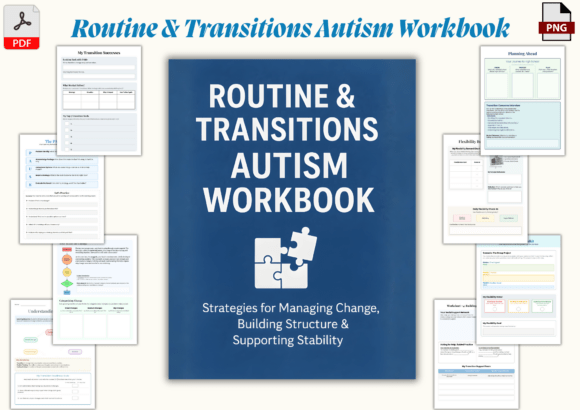
The Routine Transitions Autism Workbook is a thoughtfully designed, print-ready resource created specifically for autistic individuals across the lifespan—and the parents, educators, therapists, and support professionals who walk alongside them. Unlike generic planning tools, this workbook centers autistic experiences from the ground up: it assumes difference is valid, prioritizes autonomy and consent, and avoids behavioral compliance language. Its 8.5 x 11 inch format (available in both PDF and PNG) ensures clarity, accessibility, and ease of use—whether printed at home, projected in a classroom, or adapted digitally.
At its core, the workbook is not about enforcing rigid schedules. It’s about cultivating predictability with flexibility—a nuanced balance that respects neurocognitive needs while gently expanding capacity for change. Each page reflects evidence-informed practices rooted in occupational therapy, trauma-informed care, and autistic-led research—making it both clinically sound and deeply human-centered.
Why Neurodiversity-Affirming Design Matters
A common misconception is that “structure” means control—or that “routine” must look the same for everyone. In reality, neurodiversity-affirming structure honors individual sensory profiles, communication styles, energy rhythms, and learning preferences. The Routine Transitions Autism Workbook embodies this principle through:
- Pastel color palettes and uncluttered layouts—reducing visual overwhelm without sacrificing clarity;
- Visual-first supports, including customizable schedule templates and sequencing sheets that rely on icons, symbols, and minimal text;
- Choice-based prompts, like “What helps me feel safe when something changes?” instead of prescriptive instructions;
- No reward charts or token systems—because intrinsic motivation and self-trust are cultivated through consistency and respect, not external incentives.
This approach aligns with growing consensus among autistic self-advocates and developmental researchers: effective support doesn’t pathologize difference—it removes barriers and amplifies agency.
What’s Inside? Practical Tools That Work in Real Life
The workbook includes eight key sections—each purpose-built to meet real-world challenges with dignity and practicality:
- Visual schedule templates—modular, editable grids that support hour-by-hour or activity-based planning, adaptable for school, home, or community settings;
- Morning & evening routine planners—with optional sensory check-ins (e.g., “How loud is my brain right now?”) and transition buffers built in;
- Transition practice worksheets—guided exercises for rehearsing small changes (e.g., “What if my favorite chair is taken?”), reducing anticipatory anxiety;
- Emotional regulation prompts—non-judgmental, body-aware questions (“Where do I feel this in my body?”) paired with co-regulation ideas;
- Handling the unexpected pages—not as crisis-response scripts, but as reflective tools to identify patterns, preferences, and trusted supports;
- Support network mapping—a strengths-based way to identify who offers what kind of help (listening? quiet space? concrete steps?) and how to ask;
- Weekend planning sequencing sheets—designed to prevent “Saturday overload” by balancing preferred activities, rest, and low-demand transitions;
- Flexibility meter progress tools—a self-paced, non-competitive way to notice growth over time, emphasizing effort and insight—not just outcomes.
Importantly, these aren’t abstract concepts. A teacher might use the transition practice worksheet before a fire drill; a teen could map their weekend using sequencing sheets to avoid burnout after school; an adult might revisit the support network map before starting a new job. Each tool meets users where they are—no assumptions, no pressure, no one-size-fits-all.
How This Fits Into Modern Life—At Home, School, and Beyond
In education, shifting expectations—from hybrid learning to standardized testing—can destabilize even well-supported autistic students. The workbook’s schoolwork block planners help break assignments into sensory-friendly chunks, while emotional regulation prompts offer immediate grounding during high-stakes moments.
In workplaces increasingly embracing neuroinclusive hiring, managers and HR teams can use the support network mapping and handling the unexpected pages to co-create reasonable accommodations—not as exceptions, but as part of inclusive onboarding.
At home, caregivers often feel stuck between wanting to protect and needing to prepare. This workbook sidesteps that tension. Instead of “toughening up” or shielding completely, it invites collaboration: “Let’s plan *together* what makes sense for *you*.” That shift—from external control to shared problem-solving—is where lasting confidence begins.
Common Misunderstandings—Clarified
Myth: “Routine means rigidity.”
Truth: Healthy routine creates space for choice and variation. The workbook teaches how to build “anchor points” (e.g., same breakfast time, consistent wind-down ritual) so that other elements can flex safely.
Myth: “This is only for kids.”
Truth: Autistic adults face transition challenges too—especially in areas like healthcare appointments, housing changes, or relationship shifts. The language, visuals, and depth of reflection are intentionally age-neutral and identity-respectful.
Myth: “If someone struggles with change, they just need more exposure.”
Truth: Forced exposure without preparation, consent, or processing time increases threat response—not resilience. The workbook emphasizes predictable practice, not pressure.
Why Format and Accessibility Are Non-Negotiable
The 8.5 x 11 inch size isn’t arbitrary. It fits standard printers, three-ring binders, and classroom displays—maximizing usability without tech dependence. The dual PDF/PNG format allows for both crisp printing and digital annotation (ideal for telehealth sessions or remote learning). Fonts are dyslexia-friendly, contrast meets WCAG 2.1 AA standards, and all images are described in alt-text-ready language.
And because autism intersects with many other identities—ADHD, anxiety, chronic illness, disability, cultural background—the workbook avoids assumptions about family structure, language fluency, or access to resources. It’s designed to be used in schools with limited budgets, homes with multiple caregivers, or solo by an autistic adult seeking self-understanding.
Final Thought: Routines Aren’t About Control—They’re About Belonging
When a child knows exactly what comes next—and feels safe asking for a pause, a change, or silence—they’re not “well-behaved.” They’re held. When an adult uses a flexibility meter not to measure “progress” but to honor their own pacing, they’re not “getting better.” They’re being seen.
The Routine Transitions Autism Workbook doesn’t promise perfection. It offers partnership. It says: Your nervous system matters. Your pace matters. Your way of being in the world matters. And with gentle, consistent, affirming tools, transitions don’t have to mean turmoil—they can become moments of connection, clarity, and quiet courage.